Claude Code v2.1.294 Update: Fixing Hook Instruction Behavior Logic

Claude Code v2.1.294 fixes natural language hook instruction misclassification to improve automation reliability.
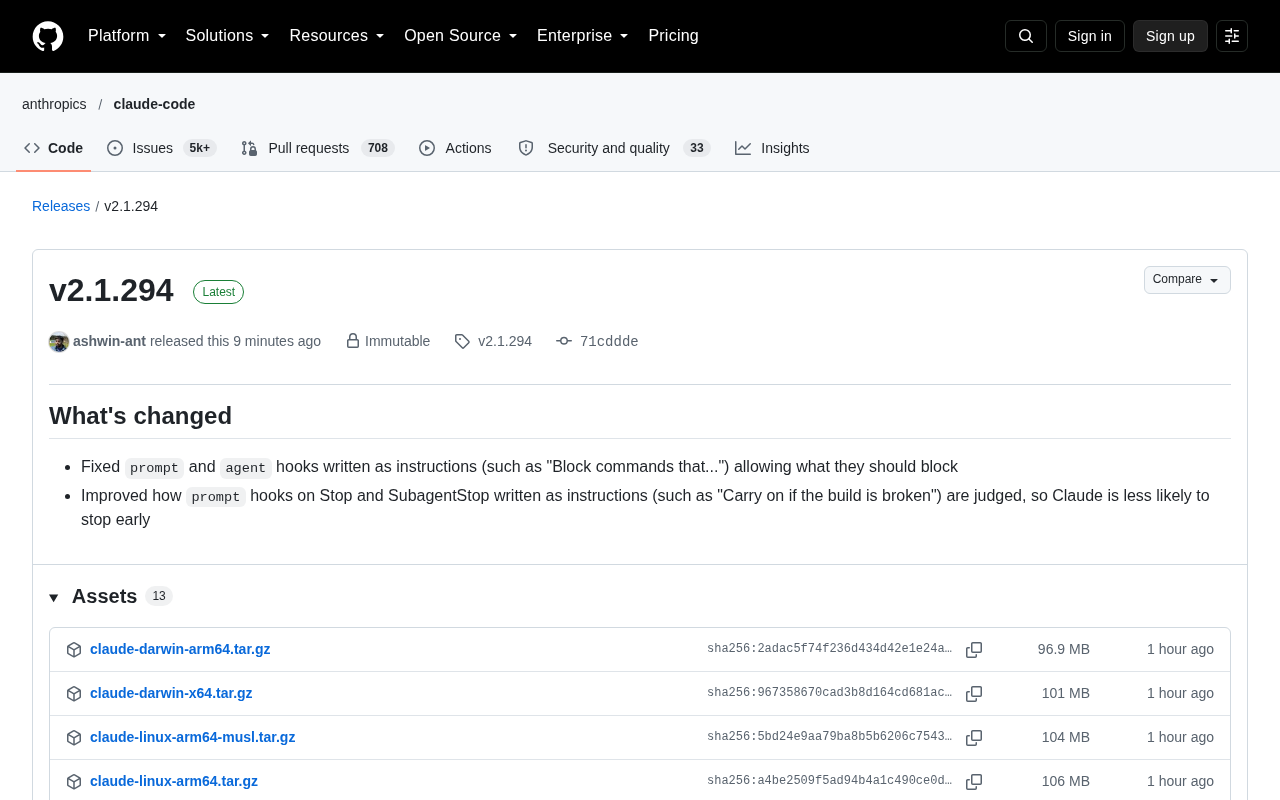
Claude Code v2.1.294 is a minor update focused on hook mechanism stability, addressing two issues that directly affect automation reliability. First, `prompt` and `agent` hooks written as natural language instructions had a logic flaw where "block" was misinterpreted as "allow" — particularly dangerous in security and permission contexts. Second, the judgment logic for prompt hooks on `Stop` and `SubagentStop` events was optimized, making Claude less likely to terminate prematurely in multi-step tasks. Both fixes target the same core challenge: ensuring natural language rules are accurately understood and executed by the model. This is an immutable release, reflecting strict version consistency controls.
Version Overview
Claude Code has released version v2.1.294 (published by ashwin-ant, commit hash 71cddde). This is a minor update focused on stability and behavioral corrections, centered around the instruction parsing logic for prompt hooks and agent hooks. While the changelog is brief, these fixes directly impact the reliability of automated workflows for developers who rely on the hook mechanism to control Claude's behavior.
This release is an immutable release — once published, only the title and description can be modified, while the release content itself is locked. This reflects a strict commitment to version consistency.
Fix Breakdown
Hook Instruction Misclassification
In previous versions, when prompt and agent type hooks were written as natural language instructions (e.g., "Block commands that..."), there was a logic flaw: instructions that were meant to block certain operations would instead allow the very actions they were supposed to prevent.
In other words, a developer could write a rule saying "prohibit this operation," and the system would incorrectly interpret it as "allow this operation." This kind of misclassification is especially sensitive in security and permission control contexts — if a hook designed to restrict dangerous commands fails, it could result in unintended commands being executed. v2.1.294 fixes this behavior so that instruction-based hooks correctly block actions according to their literal intent.
Background on the Hook Mechanism: In Claude Code, hooks are an event-driven interception mechanism that allows developers to inject custom validation logic at specific points in time (e.g., before a tool call, when a task ends). Prompt hooks operate at the natural language instruction processing level, while agent hooks operate at the scheduling nodes of agent subtasks. Unlike hard-coded if/else logic in traditional rule engines, these hooks support rule descriptions in natural language — for example, writing "Block any command that modifies production database" directly, with the model interpreting and enforcing that rule at runtime. This design lowers the configuration barrier but also introduces the risk of model misunderstanding: the model must determine whether a current operation "conforms to" or "violates" a given rule. If the judgment direction is wrong (interpreting "block" as "allow"), it produces the false-pass problem that this fix addresses.
Early-Stop Optimization for Stop and SubagentStop
Another improvement targets prompt hooks on Stop and SubagentStop events. When these hooks are written as instructions (e.g., "Carry on if the build is broken"), the system's judgment logic has been optimized so that Claude is less likely to stop a task prematurely.
This means that in multi-step or long-chain agent tasks, Claude can more accurately understand when to continue and when to stop, reducing interruptions caused by misjudgment. For users running long-running automated tasks, this improves the continuity of task completion.
About Stop and SubagentStop Events: The Stop event fires when Claude determines that the overall task is complete and is ready to terminate its response; SubagentStop corresponds to the stop signal when a subagent in a multi-agent architecture finishes its assigned subtask. In long-chain automated workflows (such as CI/CD pipelines or multi-step code generation), Claude may prematurely trigger these events by misjudging task completion conditions, causing subsequent steps to never execute. By attaching prompt hooks to these event nodes, developers can inject conditional "continue execution" logic — for example, checking whether a build succeeded or tests passed. The previous issue was that even when a hook instruction explicitly called for continuation, the system's recognition of the "continue" intent was unstable. This fix improves the accuracy of that determination.
What This Means for Developers
The hook mechanism is a key tool in Claude Code for implementing behavioral control, allowing developers to inject custom logic at specific event nodes (such as before a tool call or when a task stops). Both fixes in this update point to the same core problem: how hook instructions written in natural language are correctly understood and executed by the system.
The fundamental challenge is that when rules are not hard-coded conditional logic but instead natural language instructions handed to the model to "understand," misinterpretation can cause behavior to deviate from expectations. The fixes in v2.1.294 show the development team is continuously refining the accuracy of this "instruction understanding" logic, making hook behavior more closely match developer intent.
If your workflow uses instruction-based prompt or agent hooks — especially in scenarios involving command interception or task stop control — upgrading to this version is recommended for more reliable behavior.
Summary
While v2.1.294 is a small release, the fixes for hook instruction misclassification and early-stop misjudgment address real pain points that directly affect automation reliability. It reflects Claude Code's continued iteration toward turning natural language rules into deterministic behavior.
Related articles

macOS Is No Longer UNIX: Apple Didn't Renew Certification, But the Technology Is Unchanged
Apple did not renew macOS's UNIX certification, and the Open Group has removed Apple's entry. This article analyzes the technical reality behind the expiration, Apple's possible intentions, and the practical impact on developers.

Building Stateful Multi-Agent Systems with Azure Cosmos DB
Based on the official Azure Cosmos DB tutorial, this article explains how to use the Agent Memory Toolkit to add shared persistent memory to a multi-agent travel planner, covering short-term, long-term, episodic, and semantic memory plus cross-session state continuity.

Production AI Agent Operations: A Three-Step Framework for Observing, Evaluating, and Optimizing
Azure Cosmos DB team proposes a three-step framework for production AI Agent operations: observe trace tracking, evaluate with LLM as a judge and regression testing, optimize cost across RU, retrieval, memory, and LLM layers.