Claude Code v2.1.295 Update Deep Dive: Hook Interception, Background Tasks, and Gateway Enhancements

Claude Code v2.1.295 delivers Hook interception, background task fixes, and enterprise gateway enhancements.
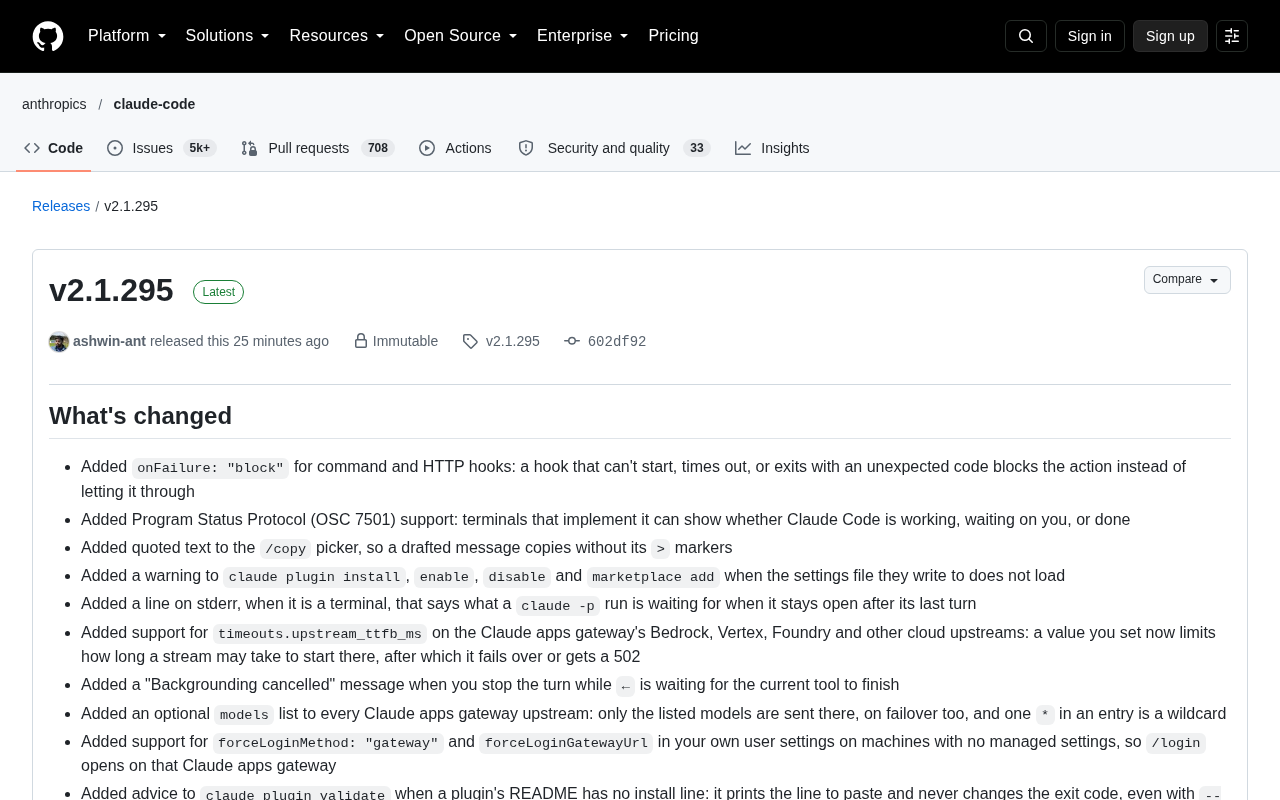
Claude Code v2.1.295 is a release centered on stability and production reliability. The most security-significant new feature is the `onFailure: "block"` option for Hooks, enabling failed guard hooks to actively block operations rather than pass through, upgrading the Hook security model from fail-open to configurable fail-closed. Background task fixes address interrupts, session recovery, and `/loop` lifecycle edge cases. The enterprise gateway gains TTFB timeout control, model allowlist routing, and `request_id` audit correlation, while reducing Bedrock costs via the CountTokens API and Haiku 4.5 background model. Terminal rendering freezes and memory bloat issues are also resolved.
Claude Code has released version v2.1.295, an update focused primarily on stability fixes while delivering several new features across three main threads: Hook control, background task management, and Claude apps gateway capabilities. For developers who have deeply integrated Claude Code into their workflows, each of these changes deserves careful attention.
Hook Control: From "Pass-Through" to "Interception"
The most practically valuable addition in this update is the introduction of the onFailure: "block" option for command-type and HTTP-type Hooks. Previously, when a Hook failed to start, timed out, or exited with an error code, the default behavior was to allow subsequent actions to proceed. Now, developers can explicitly configure a "block" response, causing a failed Hook to directly abort the corresponding operation.
This change may seem minor, but it fundamentally shifts the design logic for security guard plugins. Several accompanying fixes reinforce this direction: a bug was fixed where mod Hooks receiving truncated deeply-nested tool inputs showed no error — meaning guard hooks could previously "pass over" content they never actually saw. Additionally, a vulnerability was patched where guard Hooks with .catch could be bypassed during plugin worker restarts. Together, these significantly improve the reliability of Hooks as a security boundary.
Hooks are the event interception mechanism within Claude Code's plugin system, allowing developers to inject custom logic before and after Claude performs specific operations (such as calling tools or making HTTP requests). Command-type Hooks execute local scripts or binaries, while HTTP-type Hooks send requests to a specified URL. In security guard scenarios, Hooks are typically used for content filtering, permission verification, or operation auditing — for example, having a Hook verify that a file path is within an allowed range before Claude writes to it. The core significance of
onFailure: "block"is this: previously, Hook failures were "soft failures" that allowed operations to continue; now you can declare "hard failures," meaning a Hook's own unavailability (timeout, crash, abnormal exit) can also trigger a block rather than silently passing through. This shifts guard hooks to a conservative fail-closed default during infrastructure failures, rather than a fail-open posture.
Background Tasks and Interrupts: More Predictable Behavior
Fixes related to backgrounding account for a significant portion of this update, reflecting that this has been an ongoing pain point requiring sustained refinement.
Multiple fixes address backgrounding triggered by the ← key: when you press ← to background a task while a tool is running and then stop the round, a "Backgrounding cancelled" message now appears. If you cancel backgrounding by typing in the prompt box, Claude no longer stops at the end of the current tool but instead continues working in the foreground. Additionally, Esc now correctly stops a self-paced /loop that has been moved to the background — previously it would silently hang.
Scenarios where a session is terminated and then resumed have also been patched: if a background session's /loop reaches its next wake time during a process crash, it now stops and explicitly notifies you rather than silently failing. A bug where prompts sent after /rewind were lost when a session was backgrounded or killed and then restored has also been fixed. Collectively, these details point toward making async, long-running, interruptible tasks behave consistently and maintain traceable state across all abnormal execution paths.
Enterprise Gateway Capability Expansion
The Claude apps gateway is one of the most heavily invested modules in this update, targeting teams running Claude Code on cloud upstreams such as Bedrock, Vertex, and Foundry.
Several key capabilities are worth highlighting:
- TTFB timeout control: A new
timeouts.upstream_ttfb_mssetting limits the time-to-first-byte for streaming responses, automatically triggering failover or returning a 502 on timeout. - Model allowlist: Each upstream can now be configured with a
modelslist, routing only the listed models to that upstream (with the same behavior applying during failover). Entries support*as a wildcard. - Audit trail enhancements:
inferenceaudit events now includeupstream_request_id, and successful responses include arequest-idheader, enabling therequest_idin Claude Code telemetry to be correlated with gateway audit logs for easier support case investigation. - Cost optimization: Token counting on Bedrock now uses AWS's CountTokens API (requires granting
bedrock:CountTokenspermission), replacing the previous approach that consumed a full model request; gateway background requests now use Haiku 4.5 instead of the session model to reduce overhead.
Additionally, a bug affecting [1m] 1M context models where all requests would fail if the gateway or cloud upstream rejected the context-1m beta flag has been fixed — Claude Code now automatically retries the request without that flag to prevent the entire chain from blocking.
The Claude apps gateway is a middleware proxy layer Anthropic provides for enterprise customers, responsible for routing Claude Code requests to cloud upstreams including AWS Bedrock, Google Vertex AI, and Azure AI Foundry, while centrally handling authentication, rate limiting, failover, and auditing. For teams deploying AI capabilities in private cloud or regulated environments, the gateway layer is a critical node for achieving compliance controls. TTFB (Time To First Byte) timeout is a pain point unique to streaming scenarios: since LLM responses are streamed token by token, traditional connection or response timeouts struggle to cover situations where "the connection succeeds but the model takes a long time to produce output." The
timeouts.upstream_ttfb_mssetting is designed precisely for this gap. The introduction ofupstream_request_idaddresses a broken link in distributed tracing: previously, the telemetry ID on the Claude Code client and the request ID in gateway audit logs were independent, making it difficult to locate issues across systems. Now both can be correlated through the same ID, dramatically reducing troubleshooting costs.
Terminal Rendering and Editor Experience Fixes
Terminal-level fixes address several classes of "freezing" and display misalignment issues. Syntax highlighting lag when responses reach tens of thousands of lines, when code contains very long lines, or when unclosed strings/heredocs are present has been fixed, along with terminal freezing and multi-GB memory consumption caused by deeply nested quote indentation.
On the editing side, vim mode's ~ no longer moves the cursor past the end of a line; a bug where pasting text with accented characters copied from macOS into the middle of a prompt caused the cursor to advance one extra position has also been corrected. Windows users benefit from several fixes including CRLF short command output being squeezed onto a single line and project-level plugins failing to load in VS Code due to drive-letter casing issues.
New Notifications and Protocol Support
For observability, support has been added for the Program Status Protocol (OSC 7501), enabling terminals that implement this protocol to display whether Claude Code is currently working, waiting for the user, or finished. Mod developers also gain the $.ui.notify interface, which allows triggering native notifications through the user's own notification settings with a clearly identified source channel.
Summary
v2.1.295 brings no sweeping feature leaps — instead, it's a typical "deep-water polish" release: Hook interception completes the final piece of the security guard puzzle, extensive background task fixes make async workflows more reliable, and enterprise gateway enhancements for timeouts, allowlists, and audit trails directly address production operations needs. For power users and enterprise deployment scenarios, this is a version worth upgrading to promptly.
Related articles

Free Unlimited Claude Code Solution: Agnes AI + CC Switch Setup Guide
No paid subscription needed — pair the free AI platform Agnes AI with the open-source tool CC Switch to provide a backend for Claude Code, enabling unlimited free calls to text, image, and video models. This guide covers the full setup, test results, and usage boundaries.

A Complete Zero-Cost Guide to Getting Started with Claude Code for Beginners in China
A beginner's guide to Claude Code for users in China: two installation methods (command line and IDE plugin), full configuration steps for replacing the official API with the free domestic LongCat model, and a hands-on demo of building a small tool with natural language, plus tips.

When the NSA Gets Involved: The AI Supply Chain Crisis Behind Open-Source CVEs and API Key Hijacking
Multiple open-source projects disclosed severe CVEs in one day, PHP flaws alarmed the FBI, and Railway and OpenCode were breached with API keys stolen. This article breaks down the vulnerability window, AI-accelerated exploitation, and the AI supply chain crisis behind the API key black market, with a developer defense checklist.