Claude Code v2.1.301 Update Breakdown: Unattended Retry and Enhanced OpenTelemetry Tracing

Claude Code v2.1.301 focuses on engineering robustness with unattended retry ceilings, OpenTelemetry refinements, and multiple fixes.
Claude Code v2.1.301 is a mid-sized release focused on stability fixes and enterprise-grade observability. Key changes include a usage limit guard for unattended retry mode, new classifier verdict and permission mode fields in OpenTelemetry's tool_decision event, the % motion in Vim mode plus Esc key fixes, Worktree exit confirmation before deletion of possibly unpushed commits, and LaTeX math rendering with performance optimizations in the VS Code extension. It also fixes model switching, full-disk prompts, and binary file reading. Overall it leans toward engineering robustness, with practical value for both individuals and teams.
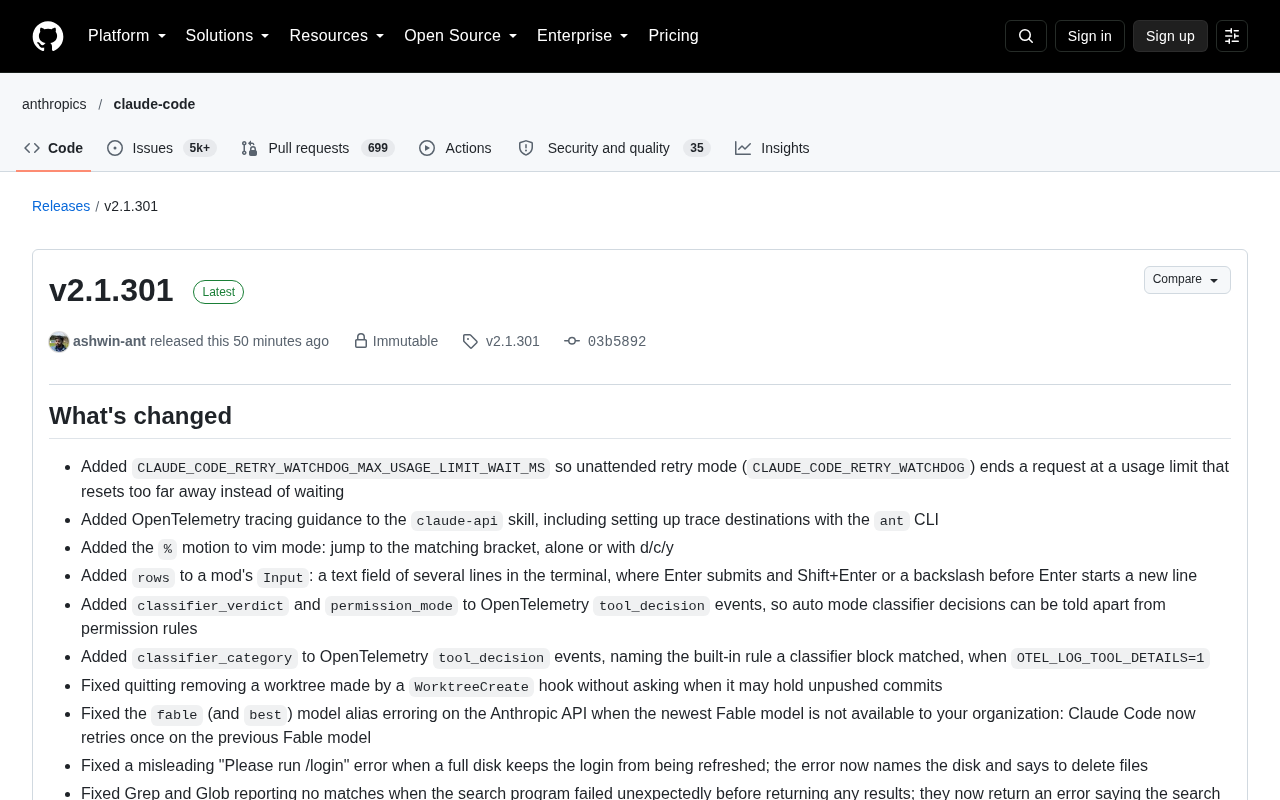
Claude Code v2.1.301 is a mid-sized release focused primarily on stability fixes and enterprise-grade observability. Based on the release notes, this update touches on unattended retries, OpenTelemetry tracing, Vim mode interactions, Worktree safety guards, and VS Code rendering performance. Compared to new features, this version is more about "making existing capabilities hold up in complex scenarios."
Unattended Retry Gets a New Usage Limit Guard
This release adds two environment variable configurations directly related to unattended mode: CLAUDE_CODE_RETRY_WATCHDOG_MAX_USAGE_LIMIT_WAIT_MS. Its purpose is: when unattended retry mode (CLAUDE_CODE_RETRY_WATCHDOG) hits a usage limit, if the limit's recovery time is too far in the future, it will end the request immediately instead of continuing to wait.
For teams integrating Claude Code into CI/CD or scheduled task pipelines, this change solves a real pain point: previously, unattended scenarios encountering quota exhaustion could get stuck in long waits, tying up resources and slowing down the pipeline. Now a millisecond-level threshold can control the wait ceiling, letting automated workflows fail fast and surface problems early.
The unattended retry mode (CLAUDE_CODE_RETRY_WATCHDOG) is a mechanism Claude Code designed to ensure task completion in non-interactive environments: when a request fails due to rate limiting, temporary service unavailability, or similar reasons, the client automatically retries instead of exiting with an error. This mechanism is critical in CI/CD, scheduled batch jobs, and other unattended scenarios, because no one is there to manually click "retry." However, when a usage limit is exhausted, recovery time can be hours or even span days — continuing to wait would occupy pipeline runners for long periods, waste resources, and mask the real problem of insufficient quota. The CLAUDE_CODE_RETRY_WATCHDOG_MAX_USAGE_LIMIT_WAIT_MS environment variable allows setting a wait ceiling (in milliseconds); if the quota recovery time exceeds this threshold, it stops retrying and returns an error directly. This lets teams fail fast and trigger alerts, promptly adjusting quota strategies or task scheduling instead of consuming resources in long silent waits.
OpenTelemetry Tracing Capabilities Further Refined
On the observability side, this update adds two new fields to the tool_decision event: classifier_verdict and permission_mode, used to distinguish classifier decisions from permission rule decisions in automatic mode. It also adds classifier_category, which when OTEL_LOG_TOOL_DETAILS=1 is enabled records the built-in rule name matched by a classifier interception.
Another notable change is that the claude-api skill now includes guidance documentation for OpenTelemetry tracing, including how to configure trace targets via the ant CLI. This means Claude Code's observability capabilities are advancing from "able to report" to "knowing where and how to report," which is friendlier for enterprises needing centralized distributed tracing.
OpenTelemetry is an open-source, vendor-neutral observability framework for uniformly collecting traces, metrics, and logs across distributed systems. After integrating OpenTelemetry, Claude Code can report each tool call and decision event as spans to a centralized backend (such as Jaeger, Tempo, Datadog, etc.), enabling end-to-end tracing and performance analysis. The newly added classifier_verdict in the tool_decision event represents the verdict of the automatic-mode classifier (used to judge whether a tool call is safe/permitted); permission_mode distinguishes the current permission mode (such as auto-approve, ask-per-item, etc.); classifier_category records the specific name of the built-in rule hit by the classifier (such as "filesystem write"), and is only reported when OTEL_LOG_TOOL_DETAILS=1 is enabled. These fields let enterprise operators clearly distinguish "auto-approved by classifier" from "explicitly allowed by permission rule," enabling better auditing and tuning of permission policies. The new tracing guidance in the claude-api skill helps teams configure trace reporting targets via the ant CLI, lowering the integration cost.
Vim Mode and Terminal Interaction Experience Completed
Vim mode adds the % motion, supporting jumps to matching brackets on a single character or in combination with d/c/y operators. This fills in the common ability for Vim users to quickly move between code blocks, JSON, and bracketed expressions.
There are also several Vim-related fixes: the Esc key occasionally still stayed in INSERT mode on slow or busy machines; Esc would discard already-entered AskUserQuestion answers — now the free-text box supports Vim NORMAL mode, and Esc only truly cancels in NORMAL mode.
On terminal compatibility, fixes address stray characters like >0q and >4m on VTE versions below 0.53 (such as MATE Terminal on RHEL 8) that overlaid the folder trust prompt, as well as GOK text appearing in the prompt on startup for some iTerm2 versions.
Safety and Correctness Fixes for Worktree and Workflow Agents
On exit, if a worktree created by the WorktreeCreate hook is detected to possibly contain unpushed commits, previously it would be deleted without asking; now it asks first before handling, preventing accidental deletion of unsynced code.
On the workflow agent side, a fix addresses an issue where the agent, after reading a harness note stating "its task text does not carry user authorization," might skip steps while the run still reported success. This is a classic "silent failure" scenario; after the fix, the process status stays consistent with actual execution, which is especially important for teams relying on workflows for automated orchestration.
Git Worktree allows multiple working trees to be checked out under the same repository simultaneously, each associated with a different branch, commonly used for parallel development, code review, or automated builds. Claude Code's WorktreeCreate hook can automatically create a worktree on specific events (such as starting a session), making it convenient to modify code in an isolated environment. But previously, on exit, if a worktree created by WorktreeCreate was detected to possibly contain unpushed commits, the worktree would be deleted directly, causing those local commits to be lost. Unpushed commits exist only locally with no remote backup, and once deleted they cannot be recovered. This update changes to ask the user for confirmation before deletion, preventing accidental loss of unsynced code. For workflow agents, there was previously a "silent failure" scenario: when the agent read a harness note indicating the task text did not carry user authorization, it might skip key steps while the run result still reported success. This inconsistency masks problems, causing automated workflows to continue executing based on an incorrect status. After the fix, the agent's status stays consistent with actual execution, improving the reliability of automated orchestration.
VS Code Extension: LaTeX Rendering and Performance Optimization
The VS Code side adds LaTeX math rendering, supporting $$ blocks, multi-line \[ … \] blocks, and inline $…$ and \(…\) formulas. For users who frequently discuss math and algorithm derivations, output readability is noticeably improved.
On the performance side, a fix addresses the chat panel slowing down during long thinking processes — it no longer re-parses the entire thinking text on every update; it also fixes an issue where some language server diagnostics displayed [object Object] instead of rule codes (such as MD013). Additionally, it fixes conversations that crashed or froze being reopened on every reload.
LaTeX is a typesetting system widely used in academic papers and technical documentation, and its math formula syntax (such as $$...$$, \(...\)) is common in technical discussions. Previously, Claude Code's VS Code extension could not render these formulas, so users only saw raw LaTeX code with poor readability. The newly added LaTeX math rendering supports $$ blocks, multi-line \[ … \] blocks, and inline $…$ and \(…\) formulas, displaying math- and algorithm-related conversation content directly in typeset form. On performance, previously during long thinking, the chat panel re-parsed the entire thinking text on every update, causing increasing lag as the text grew. After optimization, only new content is processed incrementally, no longer re-parsing the full text, significantly improving fluency in long conversations. Additionally, it fixes diagnostics from the language server showing [object Object] instead of specific rule codes (such as MD013), making it easier for users to locate issues; it also fixes crashed or frozen conversations being reopened on every reload, avoiding repeated interruptions.
Detail Improvements for Model Switching and Context Window
When switching to a model with a smaller context window, if the current conversation exceeds the new model's capacity, it now first uses the previous model to summarize before switching. This echoes another fix: previously, in some cases, switching to a smaller-window model could consume the previous model's quota to do summarization without asking.
It also fixes an issue where model aliases (such as fable, best) errored when the organization had not enabled the latest Fable model — now it falls back to the previous Fable model and retries once. It also fixes an issue where application-inference-profile-related models mistakenly triggered the awsAuthRefresh command under non-Bedrock providers.
Other Notable Fixes
- When a full disk prevents login refresh, the error message no longer misleads users into running /login, but directly points out the disk problem and suggests deleting files.
- Grep and Glob no longer report "no matches" when the search program unexpectedly fails, but instead return a search failure error.
- The Read tool no longer reads binary files like
.xlsm,.parquet,.epub,.heicas text. - Markdown tables with only a header row are now drawn correctly when too wide for the terminal, including tables in plan approval cards.
- Fixed sluggishness and excessive memory usage in skill, command, and hook calls when there are very many parameter placeholders or very long parameter names; now only the first 64 names are filled, each up to 64 characters.
Overall, v2.1.301 is an update leaning toward "engineering robustness." For individual users, the most noticeable changes are probably VS Code's LaTeX rendering and the Vim mode completion; for team users, the unattended retry ceiling and OpenTelemetry tracing refinements are more practically valuable.
One-line Summary
Claude Code v2.1.301 focuses on engineering robustness, bringing unattended retry ceilings, OpenTelemetry refinements, and multiple fixes.
Paragraph Summary
Claude Code v2.1.301 is a mid-sized release focused primarily on stability fixes and enterprise-grade observability. Main changes include: adding a usage limit guard for unattended retry mode to avoid long waits when quota recovery is far off; adding classifier verdict and permission mode fields to OpenTelemetry's tool_decision event to improve observability of automated decisions; adding the % motion in Vim mode and fixing Esc key abnormalities; changing worktree deletion on exit to ask first before deleting worktrees that may contain unpushed commits; adding LaTeX math rendering in the VS Code extension and optimizing performance during long thinking. It also fixes various details including model switching, full-disk prompts, and binary file reading. Overall it leans toward engineering robustness, with practical value for both individual users and teams.
Related articles

Free Unlimited Claude Code Solution: Agnes AI + CC Switch Setup Guide
No paid subscription needed — pair the free AI platform Agnes AI with the open-source tool CC Switch to provide a backend for Claude Code, enabling unlimited free calls to text, image, and video models. This guide covers the full setup, test results, and usage boundaries.

A Complete Zero-Cost Guide to Getting Started with Claude Code for Beginners in China
A beginner's guide to Claude Code for users in China: two installation methods (command line and IDE plugin), full configuration steps for replacing the official API with the free domestic LongCat model, and a hands-on demo of building a small tool with natural language, plus tips.

When the NSA Gets Involved: The AI Supply Chain Crisis Behind Open-Source CVEs and API Key Hijacking
Multiple open-source projects disclosed severe CVEs in one day, PHP flaws alarmed the FBI, and Railway and OpenCode were breached with API keys stolen. This article breaks down the vulnerability window, AI-accelerated exploitation, and the AI supply chain crisis behind the API key black market, with a developer defense checklist.