Claude Code v2.1.317 Update Breakdown: Tighter Permission Safety and Enterprise Cost Controls

Claude Code v2.1.317 tightens Agent security boundaries and fills in enterprise cost and observability capabilities.
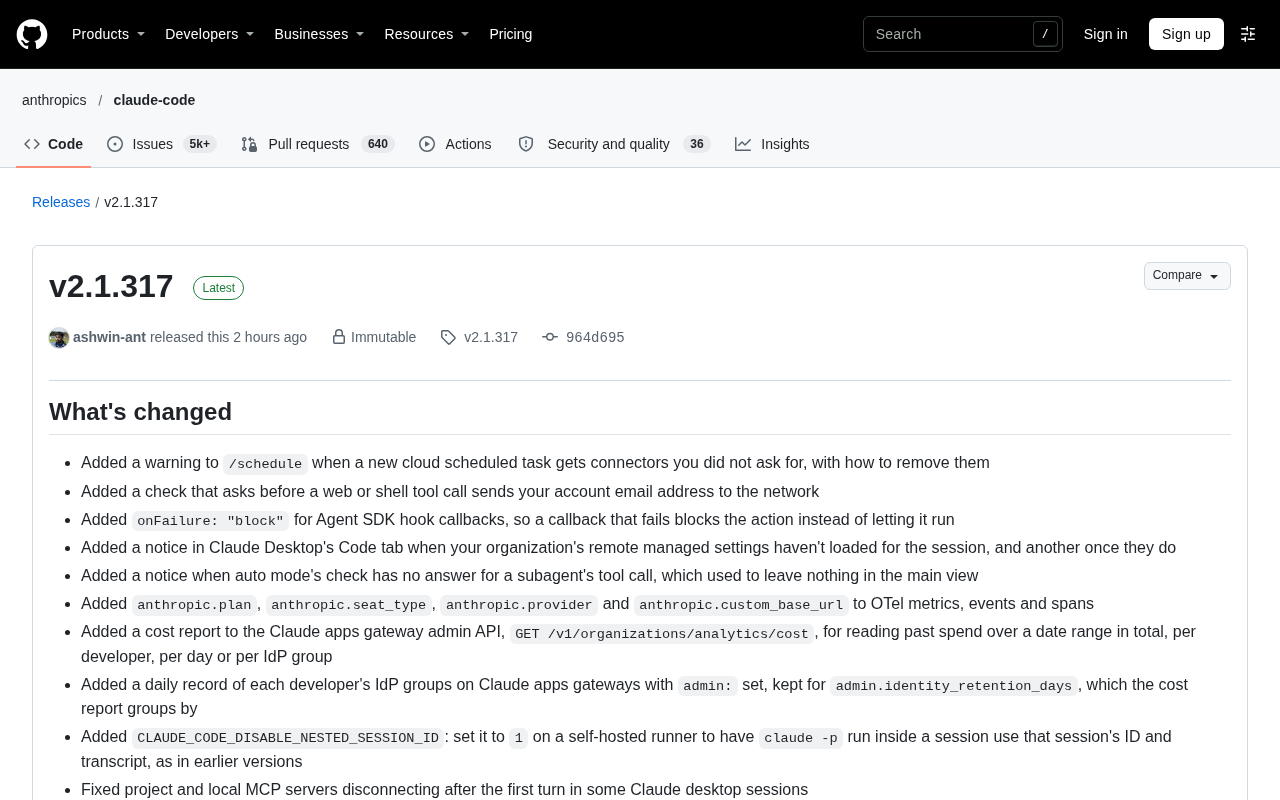
Claude Code v2.1.317 is a broad update with two main threads: tightening the Agent security boundary so "confirm before executing" becomes the default (email-send confirmation, /schedule connector-mount warnings, and a new Agent SDK `onFailure: "block"` hook that blocks on failure); and strengthening enterprise observability and cost governance (a new gateway cost report API plus daily IdP group records enabling spend views by developer, day, and IdP group, and four new OTel dimensions: plan, seat_type, provider, custom_base_url). It also fixes MCP server disconnects after the first turn, premature auth status exits, and `claude -p` exiting 0 on write failures.
Claude Code has released v2.1.317, and this update is packed with information—from permission confirmations and Agent SDK hook behavior to enterprise gateway cost reports and OpenTelemetry metric dimensions, it covers nearly everything individual developers and team administrators care about. On the surface it's a lengthy changelog, but it actually reveals Anthropic's continued investment in two main threads: "agent behavior controllability" and "enterprise observability."
Tightening the Security Boundary: Ask First, Then Act Becomes the Default
The most noteworthy category of changes in this update is a series of reinforcements around "when should user consent be obtained first." When /schedule creates a new cloud scheduled task, if the system automatically mounts connectors you didn't explicitly request, it now shows a warning and explains how to remove them; and web or shell tool calls now perform a confirmation check before attempting to send the account email address over the network.
What these changes have in common is: actions that might previously have been "executed by default and only discovered afterward" are now front-loaded into explicit confirmation. For teams integrating Claude Code into automated workflows, this "better to ask one more time" design can significantly reduce the cost of mistakes.
On the Agent SDK side, a new onFailure: "block" hook callback option has been added—when the callback fails, the action is blocked directly rather than being allowed to continue. This gives developers writing custom hooks stricter failure semantics, avoiding privilege escalation or dirty data caused by hooks silently failing.
Agent SDK and the hooks mechanism
The Agent SDK is the programming interface Anthropic provides to developers, letting them embed Claude Agent capabilities (tool calls, multi-turn planning, session management, etc.) into their own applications. A hook is a type of callback point in the SDK: before or after the Agent executes an action, the SDK calls a function registered by the developer, through which the developer can perform auditing, rewrite parameters, inject context, or block the action.
The onFailure parameter determines "what to do when the hook function itself errors (throws an exception, times out, returns an invalid value)." There are two common semantics: one is fail-open, meaning if the hook fails it's treated as if it wasn't written and the action proceeds as normal; the other is fail-closed (here, "block"), meaning if the hook fails the action is aborted and an error is reported. The former has high availability but carries security risks; the latter is stricter but may block normal business due to hook bugs. Which to choose depends on how large the side effects of the action are.
Enterprise Gateway: Cost Visibility and Identity Retention
On the part aimed at team administrators, v2.1.317 fills in several previously missing pieces. The Claude apps gateway admin API adds a GET /v1/organizations/analytics/cost cost report endpoint, supporting reading historical spending by date range and optionally viewing it grouped by total, by developer, by day, or by IdP.
Correspondingly, the gateway records each developer's IdP group information daily (enabled via admin: configuration, with retention controlled by admin.identity_retention_days), which is precisely the data foundation for aggregating cost reports by IdP group. For companies using SSO to organize permissions, this means bills can be aligned directly to the organizational structure, rather than only seeing a vague total.
On the OpenTelemetry side, four new attributes have been added to metrics, events, and spans: anthropic.plan, anthropic.seat_type, anthropic.provider, and anthropic.custom_base_url. This allows data on observability platforms to be sliced by plan, seat type, and model provider, which is especially useful for teams mixing multiple providers.
IdP groups and SSO organization mapping
IdP (Identity Provider) refers to the system enterprises use for unified login, such as Okta, Azure AD, Google Workspace, etc. During SSO (single sign-on), the IdP typically returns not only the user's identity but also a "group" claim indicating which groups the user belongs to—for example, engineering, data-platform, contractors.
The Claude apps gateway recording each developer's IdP group information daily essentially lands these organizational signals in its own storage, so that cost reports can "aggregate by group." The reason daily recording is needed rather than fetching at login time is that IdP groups change with personnel moves, while bills need to reconstruct "which group that person belonged to at the time." admin.identity_retention_days is used to control how long these identity snapshots are retained, a routine configuration item for compliance and privacy considerations.
OpenTelemetry metrics / events / spans and attribute dimensions
OpenTelemetry (OTel) is a vendor-neutral observability standard that defines three main telemetry signals: metrics (aggregated numerical values such as counters and histograms, e.g., call counts, token consumption), spans (the time span of an operation, including parent-child relationships, used for distributed tracing), and events (discrete events with timestamps, such as a failed tool call).
All three signals support attaching "attributes," i.e., key-value pair labels, used for later slicing and aggregation on platforms like Grafana and Datadog. The new anthropic.plan, anthropic.seat_type, anthropic.provider, and anthropic.custom_base_url are exactly this kind of dimension label—they don't change the metric values, but they determine whether you can answer questions like "which plan's users consume the most" or "are requests going through third-party base URLs higher latency."
Stability Fixes: MCP, Authentication, and CI Scenarios
Among the long-tail fixes, several have a larger impact on actual workflows. The issue where project-level and local MCP servers "drop after the first turn" in certain Claude desktop sessions has been fixed; and the issue where claude auth status exited early when token refresh was slow, causing the next run to be logged out, has also been resolved.
claude -p behavior in CI scenarios is now more predictable: when disk full or quota causes writes to the transcript or ~/.claude.json to fail, it previously would silently exit with 0, but now prints an error and exits with 1—a key fix for teams that use exit codes as the basis for pipeline decisions. Additionally, a new CLAUDE_CODE_DISABLE_NESTED_SESSION_ID environment variable has been added, allowing claude -p on self-hosted runners to reuse the outer session's ID and transcript, restoring behavior to that of earlier versions.
MCP and the exit code semantics of claude -p
MCP (Model Context Protocol) is an open protocol proposed by Anthropic that uses a unified approach to connect external tools and data sources (such as databases, ticketing systems, local file services) to Claude in the form of "servers." MCP servers can be configured at the project level or user-local level, launched by the client when a session is established and kept as a long-lived connection; "dropping after the first turn" usually means there is a defect in connection lifecycle management or process liveness detection.
claude -p (print mode) is a non-interactive invocation method, often used in scripts and CI. In Unix convention, exit code 0 means success and non-zero means failure, and pipelines (GitHub Actions, Jenkins, etc.) determine step success or failure based on this by default. Previously, failing to write the transcript or config file while still returning 0 would let the pipeline "pass with a green light" but actually produce no output—a classic silent failure; after changing to return 1, failures can be caught by the upper layer.
What These Changes Signal
Looking at dozens of updates together, Anthropic's investment direction is quite clear: first, make every "side-effect" action of the Agent traceable and interceptable; second, expose the cost and identity data that enterprise customers care most about through standard interfaces (admin API, OTel).
For individual developers, changes like onFailure: "block", email-send confirmation, and the Read tool no longer returning a "file unchanged" stub will directly change the day-to-day feel; for team administrators, cost reports and IdP group retention are key to whether Claude Code can be formally incorporated into budgeting and compliance systems. You may not have noticed, but this kind of infrastructure capability often determines how quickly a tool is adopted within an organization more than model iterations themselves.
If you're evaluating whether to roll out Claude Code to a larger team, this version is worth using as a reference point for an internal review—focus on whether the cost API and OTel dimensions already cover your billing and monitoring standards.
One-line Summary
Claude Code v2.1.317 tightens the Agent security boundary and fills in cost and observability capabilities for enterprises.
Paragraph Summary
Claude Code v2.1.317 is a broad update with two main threads: first, tightening the Agent security boundary so that "confirm before executing" becomes the default, including confirmation before web/shell tools send emails, warnings when /schedule automatically mounts connectors, and the Agent SDK adding onFailure: "block" semantics where a failed hook blocks the action; second, strengthening enterprise-side observability and cost governance, with the gateway admin API adding a cost report endpoint that, together with daily IdP group records, supports viewing spending by developer, by day, and by IdP group, and OpenTelemetry adding four dimension attributes: plan, seat_type, provider, and custom_base_url. It also fixes stability issues such as MCP servers dropping after the first turn, authentication status exiting early, and claude -p exiting 0 despite write failures.
Related articles

AI Can Read Neural Network Weights Directly: Do Models Already Exceed Expectations?
A Reddit developer experiment shows language models can directly read neural network weights and infer their function. Astra, Opus 5.5, and Muse Spark 1.3 all passed the test, sparking discussion on model generalization and training sources.

India's Microdrama Market Explodes: EloElo Secures $80M Investment from NBCUniversal
EloElo secures $80M from NBCUniversal to boost StoryTV, its microdrama platform with over 33M monthly active users, as India's microdrama market draws global capital.

Acoustic Detection of Multi-Rotor UAVs: Fusing Handcrafted Features with Pre-Trained Embeddings
Study reveals data leakage from random splits in UAV acoustic detection, proposes source-disjoint protocol with stacked ensemble of handcrafted features and YAMNet embeddings, achieving 95.29% accuracy for low-cost drone detection.