Claude Composes Bach-Style Fugue 'Contrapunctus Acidus,' Moving a Professional Organist to Near Tears
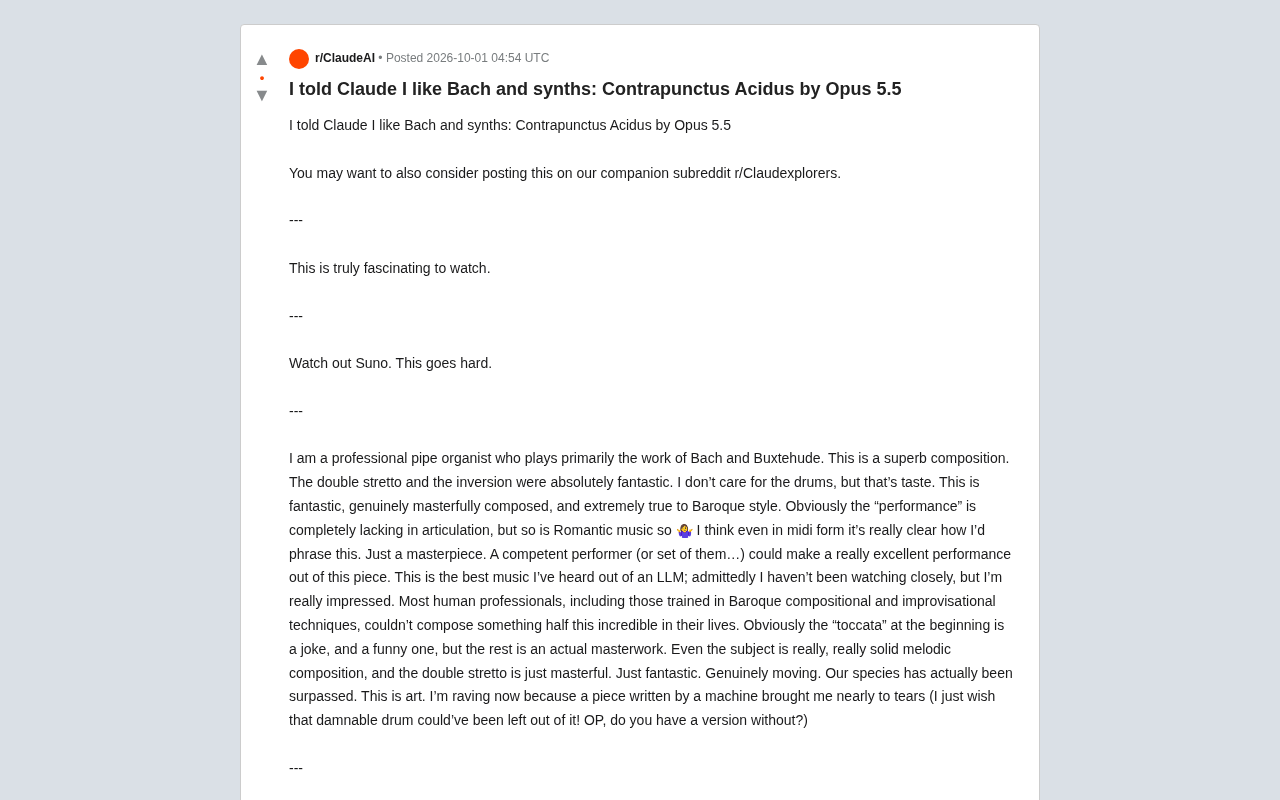
Claude Opus 5.5's Bach-style fugue moved a professional organist to near tears with masterful contrapuntal technique.
A Reddit user asked Claude Opus 5.5 to compose a Baroque-style fugue, 'Contrapunctus Acidus,' rendered via the Rust library FunDSP with a mathematical visualization. A professional organist gave a detailed technical assessment, praising its double stretto and inversion writing as 'extremely faithful to Baroque style' and calling it the best LLM-generated music he'd heard — admitting he 'almost cried.' The case highlights AI's growing maturity in handling the near-mathematical rule system of strict fugue composition, as well as its cross-modal ability to handle composition, synthesis, and visualization in a single pass.
A Reddit user shared their love of Bach and synthesizer music with Claude, then asked Opus 5.5 to compose a piece in Baroque style — a work titled Contrapunctus Acidus. The result sparked heated discussion in the community and moved a professional organist to say he "almost cried." The episode speaks to the remarkable capability large language models have developed for composing complex musical structures.

A Creative Experiment Born from Personal Taste
The starting point was refreshingly simple — the user just told Claude he liked Bach and synth timbres. What followed, however, was technically ambitious: he asked Claude to compose in Baroque style, render the audio using FunDSP (a Rust audio synthesis library), and generate a visual animation to illustrate the work's underlying mathematical structure.
Notably, this wasn't a real-time interactive performance — it was a one-shot generation task. As the creator put it: "There's no interaction here. I asked Claude to compose in that style, render audio with FunDSP, and create a visualization showing the mathematical properties of the piece." This means the model had to simultaneously handle compositional logic, audio synthesis code, and visual presentation — all within a single response.
FunDSP is an open-source Rust audio synthesis library built around a functional signal graph paradigm. Developers construct complex timbres by composing and chaining basic audio units — oscillators, filters, reverbs, and more — like functions, rather than relying on traditional MIDI sample playback. This approach offers extraordinary freedom in sound design, making it especially well-suited for analog synthesizer-style electronic timbres. Combining FunDSP with Baroque counterpoint means the model had to produce not only correct note sequences and contrapuntal logic, but also audio synthesis code that compiles and runs in a Rust environment — with both layers precisely aligned on the timeline. That demands both music theory knowledge and code generation ability in a specific programming language, simultaneously.
A Professional Organist's Assessment
The most authoritative praise came from someone who described himself as "a professional organist who primarily performs Bach and Buxtehude." His evaluation dissected the piece from a technical standpoint, going far beyond ordinary listener enthusiasm.
Accurate Use of Contrapuntal Technique
The professional specifically highlighted the work's double stretto and inversion writing as "absolutely brilliant." Stretto is one of the most demanding techniques in fugue writing — it requires the subject to enter in a second voice before it has finished stating in the first, creating a canonic "chase" effect that dramatically increases tension and contrapuntal density. Double stretto means two such overlapping entries are happening simultaneously across different voices, multiplying the complexity. Inversion requires the subject to reappear with every interval flipped in direction — what was ascending becomes descending — presenting a mirror image of the theme while maintaining harmonic coherence. Deploying both techniques simultaneously demands deep theoretical fluency and spatial imagination; throughout history, only a handful of composers have handled them with ease.
He also praised the subject itself as "very, very solid melodic writing" and described the piece as "extremely faithful to Baroque style." In his view, it was the best LLM-generated music he had ever heard.
Caveats and Limitations
That said, the organist wasn't without criticism. He explicitly said he disliked the drum track added to the piece — "that's a matter of taste" — and repeatedly expressed a wish for a drum-free version. He also acknowledged that MIDI rendering completely lacks real articulation, though he drew a comparison: "Romantic music is the same way," suggesting that a competent performer could take the score and deliver an excellent interpretation.
As for the "toccata" opening, he laughed it off as "clearly a joke — and a fun one."
A Technical Turning Point That Moves People
The professional's closing remarks carried real weight: "Most human professionals, including those trained in Baroque composition and improvisation, couldn't write half of this in a lifetime… Our species has genuinely been surpassed. This is art."
The creator himself responded that he's a longtime canon enthusiast who had intuitively suspected Opus could at least produce complex canons "in a formulaic way" — but said he was "very surprised by the quality and genuinely moved" when he actually heard the result. Another commenter turned to the AI music generation space: "Suno, watch out — this is serious competition."
What This Means for AI Music Creation
The significance of this case isn't simply that "AI can compose music" — it's that it directly engages the most rule-bound, rationally structured domain of musical composition: polyphonic counterpoint. Compared to melody writing or arrangement, strict fugue follows constraints that are almost mathematical in nature. Techniques like stretto, inversion, and subject transformation leave no room for logical inconsistency. The fact that a model can work within these constraints and produce something a professional performer finds credible is a meaningful indicator of how mature its handling of highly formalized structures has become.
Equally interesting is the end-to-end generation pipeline: composition, synthesis, and visualization in one pass. Claude didn't just produce notational logic — it translated that logic into audible audio via FunDSP code and visualized the mathematical properties of the work. This kind of cross-modal, cross-tool coordination is a microcosm of how general-purpose large models are expanding their capabilities.
That said, a measured view is warranted: this is a single community-shared case with a limited sample size. MIDI rendering lacks the expressiveness of live performance, and the drum arrangement sparked aesthetic disagreement. It reads more as an impressive capability demonstration than a wholesale replacement of professional composers. But for anyone tracking the boundaries of AI creativity, it's a signal well worth taking seriously.
Related articles

One Person Producing 90 Episodes of AI Anime Shorts: The Complete Production Workflow in 10 Hours for 10 Yuan
No screenwriting experience needed for AI anime shorts: 10 hours and 10 yuan in costs, 4,200 yuan earnings per work on Hongguo. This article breaks down the complete six-step workflow from AI-generated scripts and storyboard scripts to the finished film, with a universal questioning formula and beginner pitfall guide.
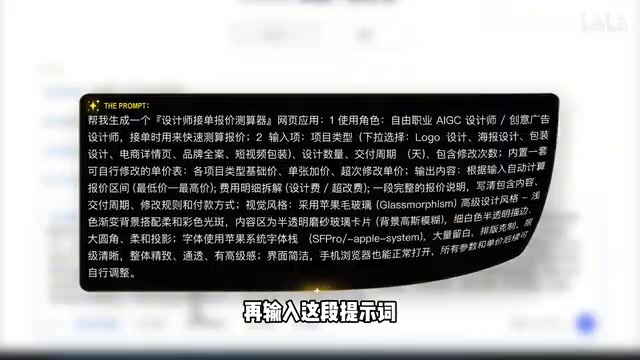
Build a Quote Calculator with Doubao Agent: Stop Guessing Your Freelance Rates
A Bilibili creator uses Doubao Agent to build a no-code quote calculator that auto-generates itemized quotes with rush and copyright buyout rates, one-click copy, and mobile quoting.

WorkBuddy Hands-On Tutorial: 10 Agent Projects from Beginner to Resume-Worthy
WorkBuddy tutorial: a Chinese-language AI work assistant with simpler setup than Codex or Claude Code. 10 hands-on Agent projects for beginners, resume-ready.