WorkBuddy Hands-On Tutorial: 10 Agent Projects from Beginner to Resume-Worthy
WorkBuddy is a Chinese-language, task-driven AI work assistant; its tutorial uses 10 hands-on projects to get beginners started fast.
Based on a Bilibili WorkBuddy tutorial, this article covers the positioning, learning path, and practical value of this "assign tasks in Chinese" AI assistant. WorkBuddy handles file organization, spreadsheet consolidation, and webpage generation directly from Chinese descriptions, with simpler setup than Codex or Claude Code. The beginner-friendly course spans a dozen lessons, each producing an openable result; getting started takes just three steps. The article cautions that capability limits aren't specified, so validate with real tasks first.
Title
WorkBuddy Hands-On Tutorial: 10 Agent Projects from Beginner to Resume-Worthy
AI tools keep multiplying, but few genuinely save you time—let alone make you money. A WorkBuddyAd hands-on tutorial series on Bilibili centers on an AI work assistant that lets you "hand off tasks in Chinese," and claims that after completing 10 Agent projects you'll have something you can put on your resume. This article draws on the core content of that tutorial to break down WorkBuddy's positioning, learning path, and practical value, so you can decide whether it's worth your time.
What Is WorkBuddy: A Chinese-Language, Task-Driven AI Work Assistant
According to the Bilibili creator, WorkBuddy's core logic is simple: you describe what you need in Chinese, and it gets it done. Tidying up cluttered files, consolidating scattered materials into spreadsheets, or generating a webpage from a functional description—none of it requires manual work from you.
The creator defines it as "an AI work assistant you can assign tasks to in Chinese." What matters about this positioning is that it lowers the barrier to outsourcing work to AI—you don't need to write code or master complex prompt engineering; you just need to state clearly what you want done.
How It Differs from Codex and Claude Code: Simpler Environment Setup
If you've used AI coding tools like Codex or Claude Code, you'll notice WorkBuddy follows a similar approach: hand the task to the AI and see how it does. But the creator specifically highlights one difference—WorkBuddy's environment setup is simpler, easier to get started with, and requires no extra environment configuration.
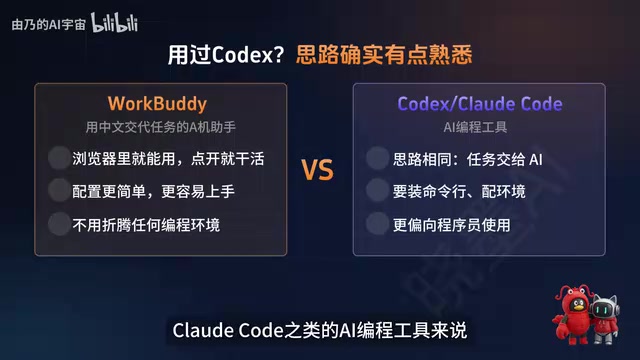
That difference is very practical for beginners. AI coding tools often require some baseline knowledge of environment configuration, whereas WorkBuddy compresses that step, making "download and install, log in, issue your first task" the starting point for success. The creator designed the course in a beginner-friendly order, so even people with zero background can follow along.
Agent here refers to an AI program that can plan autonomously, call tools, and execute multi-step tasks—not just a chatbot that passively answers questions. An Agent typically consists of a large language model, task-decomposition logic, and callable tools (such as file I/O, code execution, and web rendering). The "10 Agent projects" WorkBuddy promotes are essentially 10 agents with different preset tool combinations and task flows: after the user states a goal in Chinese, the Agent decides which tools to call and in what order. Understanding this helps you judge its limits: an Agent's performance depends heavily on the underlying model and tool permissions, and the more open-ended a task is—or the more domain knowledge it requires—the higher the chance of errors.
Course Design: Build Something Every Lesson, from Organizing Files to Images and Video
The tutorial's organizing principle is "learn by doing." The dozen or so lessons cover task types including:
- Organizing cluttered files
- Editing copy
- Consolidating data into spreadsheets
- Generating simple webpages
- Image- and video-related tasks

Each lesson walks you through producing a result you can open and inspect. The value of this design is that you don't finish at the conceptual level—you end up with a batch of real projects you can show off. The creator also notes that if you later want to take on client work, the path is viable: master and polish what the course teaches, then deliver it to others.

Prompt Engineering refers to the practice of carefully designing input text to steer a large model toward the desired output; common techniques include specifying a role, breaking down steps, giving examples, and constraining the output format. WorkBuddy's claim that you can simply "assign tasks in Chinese" effectively internalizes part of prompt engineering into the product (preset templates, tool-calling logic), lowering the learning curve. But that doesn't make prompting skills useless: the more specific your task description—where the input files are, the expected output format, the acceptance criteria—the more likely the Agent is to succeed. For beginners, learning to break vague needs into clear, verifiable small tasks is more practical than memorizing complex prompt templates.
How Beginners Get Started: Three Actions and You're Running
According to the tutorial, the barrier to entry is low: download and install, log in, and issue your first task. Completing these three steps counts as a successful start. If you've never used a similar tool, it's best to begin with the simplest file-organization task to get a feel for the "assign tasks in Chinese" interaction, then gradually move on to spreadsheet consolidation and webpage generation.
One caveat: the original material doesn't elaborate on WorkBuddy's actual capability boundaries or the ceiling of its output quality. The tutorial is more about task demos and operational guidance. If you want to judge whether it can replace your existing workflow, it's best to run two or three real tasks yourself before drawing conclusions.
Environment setup for AI coding tools usually means installing runtimes (such as Node.js or Python), configuring API keys, and setting up command-line tools and dependencies. Tools like Codex and Claude Code often require users to perform these operations in a terminal, which is a real barrier for people without development experience. WorkBuddy claims to simplify this layer by integrating installation, login, and task dispatch into a graphical interface, so users never touch the command line. But "simple setup" and "greater capability" are two different things: the more encapsulated a product is, the less room there usually is for customization, and with complex or non-standard tasks you may end up having to work around the product's preset flows.
In a Nutshell
What makes WorkBuddy worth attention isn't the raw power of its models—it's that it pushes the barrier to "AI does the work for you" down to the level of expressing yourself in Chinese. For people who want to use AI to earn extra income without wrestling with environment setup, this path of 10 hands-on Agent projects is a workable starting point.
One-line Summary
WorkBuddy is a Chinese-language, task-driven AI work assistant, and its tutorial uses 10 hands-on projects to get beginners up to speed fast.
Paragraph Summary
Based on a Bilibili WorkBuddy hands-on tutorial, this article covers the positioning, learning path, and practical value of this "assign tasks in Chinese" AI work assistant. WorkBuddy's core logic: users describe their needs in Chinese, and it directly handles tasks like organizing files, consolidating spreadsheets, and generating webpages—with simpler environment setup than Codex or Claude Code. The tutorial is arranged in beginner-friendly order across a dozen lessons, each producing an openable result, covering file organization, copy editing, spreadsheet consolidation, webpage generation, and image/video tasks; what you learn can go on a resume or be used for client work. Getting started takes just three steps: download and install, log in, and issue your first task. The article also cautions that the original material doesn't specify capability boundaries or output-quality limits, so it's best to validate with real tasks before deciding whether to replace your existing workflow.
Related articles

The Other Side of the Agricultural Revolution: How Disease Helped Farmers Defeat Hunter-Gatherers
Historian Kyle Harper explains how agricultural societies defeated hunter-gatherers: not only through population growth from superior energy extraction per unit of land, but also through pathogens bred by settled life that caused extra mortality during expansion—a dual replacement mechanism.

Why Is AI-Generated Language So Hard to Understand?
Why is AI-generated language fluent yet hard to understand? Based on a Hacker News discussion, this article analyzes the cognitive load of AI text from three angles—imbalanced semantic density, lack of common ground, and side effects of alignment training—and offers practical advice for getting along with AI language.

Progressive Disclosure Makes Agents 2.3x Faster: A New Approach to Context Engineering
A Hacker News discussion proposes using progressive disclosure to optimize AI agent context, achieving a 2.3x speedup. This article analyzes the three performance costs of context bloat and introduces practical approaches such as layered tool catalogs, on-demand retrieval, and history compression, along with implementation considerations.