One Person Producing 90 Episodes of AI Anime Shorts: The Complete Production Workflow in 10 Hours for 10 Yuan

AI anime short production has an extremely low barrier: six steps plus a universal questioning formula let one person mass-produce and earn continuous revenue shares.
The article breaks down a reproducible path for AI anime shorts from zero to finished film. AI anime shorts are essentially short dramas in anime form, earning compounding returns through ad revenue sharing or paid unlocks, with costs mainly one-time time and tool expenses. The six steps are story script, storyboard script, storyboard images, dynamic video, voiceover and music, and post-production editing—one person with one phone can run it all. Key methods include the universal questioning formula, writing the story script before the storyboard script to cut rework, and keeping visual descriptions objective to avoid misleading AI drawing. The three biggest pitfalls are runaway duration, skipping the script, and literary prompts. The case creator produced a first work in 10 hours for 10 yuan and earned 4,200 yuan on Hongguo, proving one-person mass production is viable, though story creativity and pacing remain the core competitiveness.
AI anime shorts are becoming a new traffic goldmine in the short-video space. A creator with no screenwriting experience and no directing background produced their first AI short film in 10 hours at a cost of 10 yuan. After publishing on the Hongguo platform, it has earned 4,200 yuan so far. This case reveals a fact most people overlook: the barrier to producing AI anime shorts is far lower than imagined, yet 90% of people can't even take the first step.
Most tutorials online only showcase the finished results without charting a viable path forward. Based on a Bilibili creator's full-workflow breakdown, combined with practical feedback from multiple AI creation communities, this article compiles a reproducible path from zero to a finished film.
The Monetization Logic of AI Anime Shorts: Why It's Worth Doing
AI anime shorts are essentially short dramas in anime form. Viewers either pay to unlock the next episode or watch a few seconds of ads so the creator receives a revenue share. According to feedback from the Bilibili creator and multiple Hongguo creator communities, the core advantage of this model is compounding returns—once a work is completed, it can continuously generate income, while production costs are mainly one-time time and tool expenses.
The creator's income figure (4,200 yuan per work) is not an isolated case. Multiple creators publishing AI anime shorts on platforms like Hongguo and Kuaishou have shared similar earnings in community discussions, cross-validating the feasibility of this model. The point of disagreement is the income ceiling: some believe per-work earnings are limited and volume is needed to stack returns; others believe a premium-quality approach yields higher per-work income. Both views have practical support, and there is currently no consensus.
Hongguo Platform is a free short-drama platform under ByteDance, and its revenue-sharing model differs from paid short dramas: users don't pay per episode but unlock content by watching ads, and the platform distributes ad revenue to creators based on valid play counts. This model is especially friendly to AI anime shorts—episodes typically run 1–3 minutes, the threshold for users to complete ad viewing is low, and creators can continuously earn long-tail revenue shares. Similar platforms include Kuaishou Xingmang Short Dramas and Douyin's short drama channel. The key to understanding the revenue-sharing logic lies in the definition of "valid play": it usually requires users to watch a certain percentage (e.g., over 80%) or stay for a sufficient duration, so the hook design and pacing control in the first 3 seconds directly determine earnings.
Six-Step Workflow Breakdown: From Story to Finished Film
The production logic of AI animated shorts is basically the same as traditional animation; the difference is that every step has AI tools replacing professional teams. The complete workflow consists of six steps: AI-generated story script, writing the storyboard script, batch-generating storyboard images, converting static images to dynamic video, matching music, sound effects, and voiceover, and post-production editing and refinement. One person with one phone can run the entire process.
Step 1: Use a Universal Formula to Get AI to Write a Usable Script
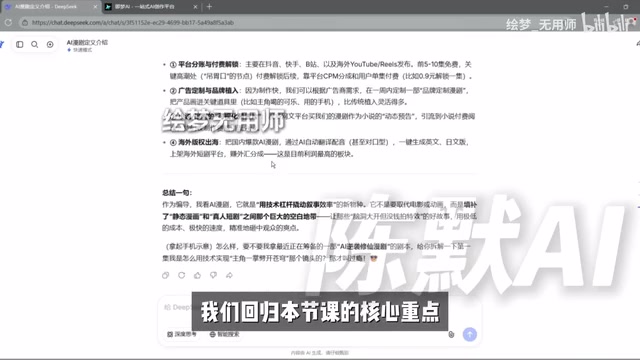
Most people get poor results from AI scripts, and the problem isn't AI itself but how they ask. The universal formula summarized by the Bilibili creator contains three core elements: setting the AI's identity, clarifying the core task, and fixing the output format.
Setting the identity is crucial because the AI's output perspective and professionalism depend entirely on the role setting. Ask "What are AI anime shorts?" with the setting "professional AI anime short director" and you'll get a structured answer covering form, production, and content; set it as "veteran micro-drama actor" and you'll get a down-to-earth, colloquial interpretation full of metaphors. Both outputs are decent, but they suit completely different scenarios.
The task requirements should be direct and specific—avoid vague instructions like "write a short script." Fixing the output format is key to making content organized and suitable for downstream use—for example, asking AI to output across four dimensions (core concept, core technology, content themes, monetization methods) using subheadings plus body text.

Step 2: Write the Story Script First, Then the Storyboard Script
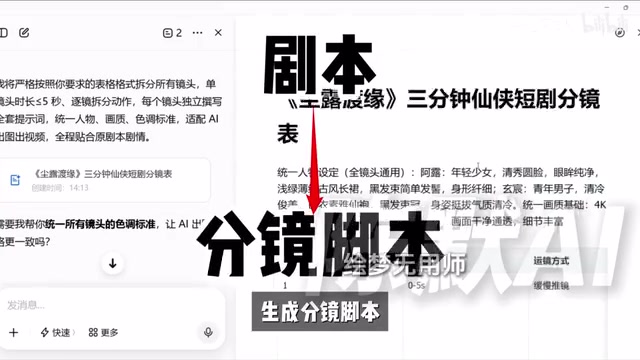
These two concepts are often confused, but their roles are vastly different. The story script is a concise short story whose core is telling the plot well—no professional parameters, and it reads like a novel. The storyboard script is a production manual, marking shot numbers, durations, shot sizes, and filming details, directly guiding how each segment should be shot.
Why can't you skip the story script and generate the storyboard script directly? The key is revision cost. The storyboard script is complex and parameter-dense, and directly fixing plot holes is extremely inefficient. Polish the concise story script first, sort out character relationships and plot logic, then have AI generate the storyboard script from the optimized script—post-production rework costs drop by an order of magnitude. Multiple AI animation creators emphasize the same order in their tutorials, and this workflow has become community consensus.
Step 3: Reserve Interfaces for AI Drawing When Writing the Script
An easily overlooked detail: the visual descriptions in the script must be objective and direct, avoiding ornate and lyrical rhetoric. Novel-style literary descriptions mislead AI drawing—write "eyes cold and sharp as a drawn blade" and AI will most likely literally draw a knife. Shot size, scene, image quality, character appearance and outfit, and other parameters should be as detailed as possible, described in concise realistic language, to ensure the accuracy of subsequent image generation.
Character consistency is the trickiest technical bottleneck in mass-producing AI anime shorts. Current mainstream AI drawing tools (such as Midjourney and Stable Diffusion) sample independently each time, so the same character easily drifts in face shape, hairstyle, and clothing across different storyboards. There are three common solutions: first, use Stable Diffusion's LoRA models, training dedicated weights with multi-angle images of the same character; second, fix the seed and pair it with ControlNet to constrain pose and composition; third, first generate a three-view character sheet as a reference image, then fine-tune shot by shot using img2img. Each method has its costs—LoRA training requires certain computing power and materials, while the reference-image approach is lighter but has a lower consistency ceiling.
The Three Biggest Pitfalls for Beginners
Runaway duration. AI-generated scripts tend to be lengthy and slow-paced. Daily AI animated shorts are basically one to two minutes, so the instruction must specify a duration cap, such as "within three minutes."
Skipping the script and going straight to storyboards. It seems to save a step, but you actually pay several times the price in post-production revisions.
Writing visual prompts in literary language. This is the main root cause of chaotic AI image output and visuals that don't match.
Who This Path Suits
People with no screenwriting experience, no knowledge of professional filming, and no animation production skills can fully complete an entire short film independently with existing AI tools. But one must clearly recognize that tools lower the execution barrier, while story creativity and pacing control still determine whether a work can break out. The 4,200-yuan earnings case proves the path is viable; the goal of mass-producing 90 episodes tests process capability and sustained output endurance, not any single-point technique.
The accompanying prompt templates and tool list have been compiled into a document by the creator for followers. The core challenge in the next stage is batch generation of storyboard images and character consistency control—also the most time-consuming and patience-testing part of the entire workflow.
One-line Summary
AI anime short production has an extremely low barrier: a six-step workflow plus a universal questioning formula lets a single person mass-produce and continuously earn revenue shares.
Paragraph Summary
The article breaks down a reproducible path for AI anime shorts from zero to finished film. The core idea: AI anime shorts are essentially short dramas in anime form, earning compounding returns through ad revenue sharing or paid unlocks, with production costs mainly one-time time and tool expenses. The six steps are story script, storyboard script, storyboard images, dynamic video, voiceover and music, and post-production editing—one person with one phone can run it all. Key methodologies include the universal questioning formula (set AI identity, clarify the task, fix the output format), writing the story script before generating the storyboard script to reduce rework costs, and keeping visual descriptions objective and realistic to avoid literary rhetoric misleading AI drawing. The three biggest pitfalls for beginners are runaway duration, skipping the script, and literary prompts. The case creator produced their first work in 10 hours at a cost of 10 yuan and earned 4,200 yuan on Hongguo, validating the feasibility of one-person mass production—but story creativity and pacing control remain the core competitiveness.
Related articles

The Other Side of the Agricultural Revolution: How Disease Helped Farmers Defeat Hunter-Gatherers
Historian Kyle Harper explains how agricultural societies defeated hunter-gatherers: not only through population growth from superior energy extraction per unit of land, but also through pathogens bred by settled life that caused extra mortality during expansion—a dual replacement mechanism.

Why Is AI-Generated Language So Hard to Understand?
Why is AI-generated language fluent yet hard to understand? Based on a Hacker News discussion, this article analyzes the cognitive load of AI text from three angles—imbalanced semantic density, lack of common ground, and side effects of alignment training—and offers practical advice for getting along with AI language.

Progressive Disclosure Makes Agents 2.3x Faster: A New Approach to Context Engineering
A Hacker News discussion proposes using progressive disclosure to optimize AI agent context, achieving a 2.3x speedup. This article analyzes the three performance costs of context bloat and introduces practical approaches such as layered tool catalogs, on-demand retrieval, and history compression, along with implementation considerations.