Claude Cowork Arrives on Mobile and Web, with Max Users Getting Early Access

Claude Cowork expands to mobile and web, with Max subscribers getting early access.
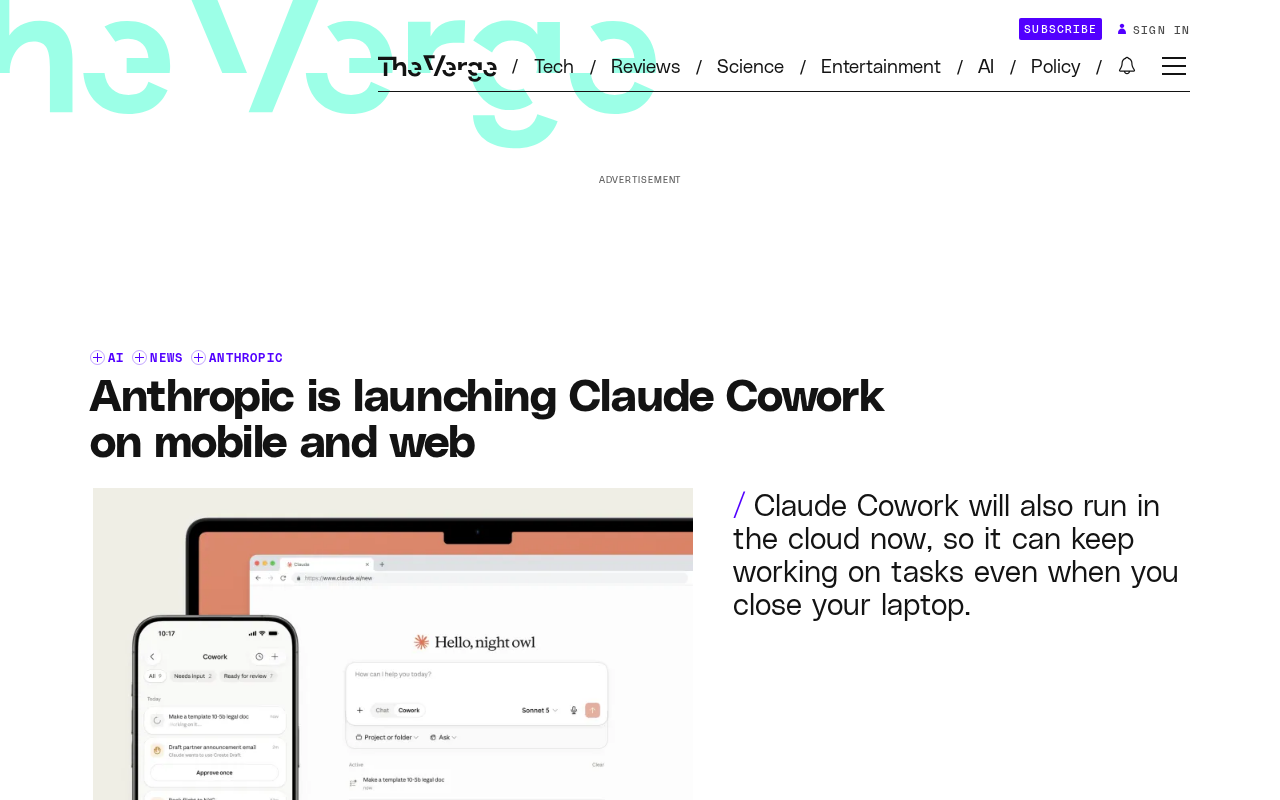
Anthropic's Claude Cowork debuts on mobile and web for the first time, ending its desktop-only limitation. Max subscribers get early access, with other plans following over the coming weeks. The cross-platform expansion aligns Claude with industry-standard accessibility and reflects the intensifying battle for AI entry points.
Anthropic Expands Access Channels for Claude Cowork
Anthropic is opening up new use cases for its AI collaboration platform, Claude Cowork. Starting this Tuesday, Claude Cowork will debut on mobile and web for the first time, marking the moment this once desktop-only tool officially reaches a broader audience.
Previously, Claude Cowork was only available through the macOS and Windows desktop clients, which somewhat limited real-world usage scenarios—users had to be sitting at their computers to use the feature. The addition of mobile and web access means users can now tap into Claude's AI collaboration capabilities anytime, anywhere, whether commuting or working from other devices.
Phased Rollout: Max Users Unlock First
You may not have noticed, but Anthropic is taking a classic batched, gradual release approach. This cross-platform expansion will first open to Max subscribers, then progressively roll out to Claude users on other plans "over the coming weeks."
Canary release (or gray release) is a standard risk-control practice in internet product engineering. The core logic is to push a new version to a small subset of users first, validating stability by monitoring error rates, performance metrics, and user feedback before gradually expanding coverage. This strategy was first systematically applied by tech giants like Google and has since become an industry norm for cloud services and SaaS products. For AI products, canary releases are especially important—model behavior under high-concurrency real-world conditions is often hard to fully predict in test environments, and batched launches help teams catch edge cases and load bottlenecks before a full-scale surge. Notably, AI inference services consume far more compute resources than traditional web applications: every conversation call requires large-scale matrix operations on GPU clusters, and the concurrency peaks from a full launch could cause inference latency to spike or even degrade the service. In this context, the canary strategy also serves a capacity planning function—by ramping traffic linearly and monitoring GPU utilization curves, teams can identify scaling thresholds in advance.
This practice of prioritizing premium paying users has become standard in AI product launches. On one hand, Max subscribers, as core paying users, can provide valuable early feedback on new features; on the other, batched rollouts help Anthropic stabilize server load and avoid the stability risks a full-scale release might bring.
On AI Inference Costs and Pricing Logic: Understanding the deeper logic behind the Max-users-first strategy requires grasping the cost structure of AI inference. Unlike the one-time high investment of the training phase, inference costs are ongoing operational expenses: every time a user calls the model, a forward-pass computation must be completed on GPU clusters, with costs scaling linearly with the number of input and output tokens. Take Claude 3.5 Sonnet, for example—its API pricing is roughly $3 per million input tokens and $15 per million output tokens. Agentic tasks, because they require multiple rounds of tool calls and context accumulation, can easily consume 10-50 times more tokens per task than ordinary conversations. This cost structure explains why Max subscribers (starting at $100/month) get Cowork functionality first—a higher ARPU (average revenue per user) is needed to cover the marginal inference costs of Agentic AI, which are far greater than those of ordinary chat.
It's worth mentioning that inference costs are declining at an accelerating pace. Speculative decoding uses a small "draft model" to pre-generate multiple candidate tokens, which the main model then verifies in parallel, reducing inference latency by 2-3x without sacrificing output quality. Quantization compresses weights from FP16 to INT8 or even INT4 representations, enabling the same GPU resources to serve more concurrent users. Combined with Flash Attention 2's memory-access optimizations and Continuous Batching's improvements to GPU utilization, leading AI providers' inference costs dropped by over 90% between 2023 and 2025, continuously paving the commercial-viability foundation for opening Agentic AI features to broader user bases.
What Is Claude Cowork
For users unfamiliar with the feature, Claude Cowork can be understood as Anthropic's deep exploration of AI collaboration modes. It goes beyond the traditional question-and-answer interaction of chatbots, aiming to make Claude a collaborative partner deeply integrated into users' workflows.
Claude Cowork represents the product direction of AI assistants evolving from "conversation tools" toward "workflow agents," backed by the entire industry's collective bet on the Agentic AI paradigm. Agentic AI refers to AI systems capable of autonomously planning, decomposing tasks, calling tools, and continuously executing multi-step operations—the fundamental difference from traditional Q&A-style AI lies in "proactivity" and "persistence." Anthropic has explicitly listed Agentic capabilities as a core development direction in its technical roadmap, releasing API interfaces that support Tool Use and Computer Use, allowing Claude to interact directly with external applications, browsers, and even operating systems.
At the technical implementation level, Claude Cowork's tool-calling capability is built on a structured function-calling protocol: developers define available tool sets (such as file read/write, web search, code execution) via JSON Schema, and the model dynamically decides during inference whether to call a tool, with what parameters, and integrates the tool's returned results into the subsequent reasoning chain. This "think-act-observe" loop is exactly the core implementation of the ReAct framework (Reasoning + Acting)—proposed by Google Research in 2022—which interleaves the language model's reasoning process with external actions. The model first generates a "Thought" about the current state, then outputs a concrete "Action," and finally integrates the tool's returned "Observation" into the next round of reasoning context, forming a closed-loop iteration. Compared to pure Chain-of-Thought, the ReAct framework significantly reduces model hallucination rates in multi-step tasks by introducing real-world feedback signals. Computer Use goes a step further—through screenshot recognition and simulated mouse/keyboard input, it allows Claude to operate any GUI application like a human user, without requiring the target software to provide a dedicated API. This technical path is highly homogeneous with OpenAI's GPT-4o Function Calling and Google DeepMind's Project Mariner, reflecting leading AI labs' shared judgment on "the next-generation AI assistant form": pure language understanding is no longer sufficient to build a moat, and agentic capabilities that can truly integrate into and automate users' workflows are the core battleground for differentiated competition.
The MCP Protocol: Standardized Infrastructure for Tool Calling: Claude Cowork's tool-calling capability reached an important standardization milestone in late 2024: Anthropic released the Model Context Protocol (MCP), an open standard aimed at unifying the communication interface between AI assistants and external data sources and tools. MCP uses JSON-RPC 2.0 as its underlying communication protocol, supports both stdio and HTTP/SSE transport modes, and breaks the tool ecosystem into three primitives: Resources (structured data exposure), Tools (executable function calls), and Prompts (reusable prompt templates). MCP's design philosophy resembles USB-C's unifying role for hardware interfaces—tools from different sources (databases, file systems, SaaS APIs, etc.) only need to implement one standardized server-side interface to be callable by any MCP-supporting AI client, without needing separate adaptations for each AI platform. As of early 2025, community-contributed MCP server implementations covered mainstream tools like PostgreSQL, GitHub, Slack, and Google Drive, numbering over 1,000. Developer-tool vendors such as Block, Replit, and Sourcegraph have also been among the first to announce MCP support, initially forming a tool-distribution network around the Claude ecosystem and laying the technical infrastructure foundation for Anthropic to build an App Store-like AI tool ecosystem.
Restricting it to the desktop client earlier was likely because early versions needed to access the local file system and execute complex tasks, operations more easily achieved in a desktop environment. Now expanding to mobile and web platforms shows Anthropic has completed key preparations in cross-platform adaptation and cloud capabilities.
It's worth mentioning that migrating an AI collaboration tool originally dependent on the local desktop environment to mobile and web involves multiple layers of deep technical rearchitecting. Desktop clients can typically access the local file system directly, call system-level APIs (such as macOS's Accessibility API or Windows' COM interface), and run background processes continuously. Mobile, however, is strictly limited by the sandbox mechanisms of iOS and Android—each app is isolated within an independent runtime environment, file access permissions must be explicitly authorized by the user, and background processes face system-level memory-reclamation pressure.
Specifically, the iOS sandbox security model is built on the dual foundation of DAC (Discretionary Access Control) and MAC (Mandatory Access Control), managing runtime authorization of sensitive permissions like camera and microphone through the TCC (Transparency, Consent, and Control) framework. Background execution is even more strictly constrained: iOS's Background Task framework allows only limited types of background operations, and the system dynamically adjusts the priority of background processes based on battery state and user usage patterns. This means that if an Agentic AI app needs to execute long-running tasks on mobile, it must adopt an asynchronous architecture—triggering server-side computation via push notifications and having the client poll for results—rather than a continuously running local background process. This architectural difference profoundly affects the product interaction design of Claude Cowork's mobile version. Similarly, the Scoped Storage introduced in Android 10 significantly narrowed apps' read/write permissions to external storage, and Android 13 further refined the granularity of categorized authorization for media files. The web side must additionally contend with multiple constraints imposed by browser security policies: Cross-Origin Resource Sharing (CORS) rules limit API call paths, Content Security Policy (CSP) blocks inline script execution, and the WebAssembly sandbox restricts calls to local compute capabilities. This means Anthropic must move core computation logic up to server-side APIs, with the client only handling interaction-layer rendering, thereby bypassing each platform's local permission barriers—this architectural transformation is itself a noteworthy engineering milestone and explains why such migrations typically require months or longer development cycles.
The Strategic Significance of a Cross-Platform Layout
The value of an AI assistant depends largely on its "accessibility." A tool usable only on specific devices, no matter how powerful, will lose potential users due to the barrier to entry.
The "battle for entry points" in the AI assistant space is essentially a battle for user attention and usage habits. According to Statcounter's 2024 statistics, mobile devices currently contribute over 58% of global internet traffic, and AI assistant apps generally have higher daily active retention rates on mobile than on desktop. OpenAI's ChatGPT mobile app quickly became a regular on the App Store and Google Play charts after launching in May 2023, garnering over 500,000 downloads in its first week. Google went even further, deeply integrating Gemini into Android's system-level entry point (replacing the original Google Assistant), forming an OS-level user touchpoint hard for competitors to replace. Apple, too, integrated ChatGPT into the Siri workflow in iOS 18, further strengthening the strategic position of mobile AI assistants.
From the perspective of distribution channels, competition among mobile AI apps has moved beyond product features themselves to become a battle for ecological niches. Google pre-installs Gemini on Pixel devices out of the box and provides a system-level shortcut (such as a long-press of the power button to invoke it), while Samsung deeply integrated its own suite of AI features under the Galaxy AI framework. These system-level integrations build extremely high replacement barriers for default AI assistants. By contrast, AI apps distributed independently through the App Store require users to actively download and repeatedly return, facing a higher churn risk before usage habits form. In this landscape, any AI product lacking a native mobile experience faces structural user churn risk—users won't switch to a desktop device just to use a particular AI tool, and once habits solidify on a competitor's product, migration costs rise exponentially.
OpenAI's ChatGPT and Google's Gemini long ago achieved full-platform coverage, letting users switch seamlessly between phone, tablet, and browser. By adding mobile and web, Anthropic is essentially aligning with the industry-standard user experience, ensuring Claude doesn't fall behind in competition due to access-channel limitations—while also making a defensively necessary move to prevent user habits from being locked in by rivals.
Impact on Users and the Industry
From a user perspective, the most direct value of this update is the liberation of use scenarios. Developers, content creators, and knowledge workers are no longer tied to the desktop of a specific operating system and can flexibly invoke Claude Cowork's collaboration capabilities across more devices and contexts.
From the standpoint of industry competition, this move reflects the increasingly fierce "battle for entry points" among AI companies. Whoever can put their product within reach in more scenarios gains an edge in cultivating user habits. Mobile is especially critical—phones are the devices modern people use most frequently, and whether a product can deliver a smooth AI collaboration experience on mobile often directly affects its daily active users and retention.
Retention is the core metric for measuring the health of an AI assistant product, and behind it lies a complex behavioral-economics logic. AI tools' retention curves typically exhibit a "two-phase decay" pattern: the high-frequency usage driven by initial novelty rapidly declines within two weeks, and whether a product can cross this "valley of death" into a habitual-use phase depends on whether it can form an irreplaceable value anchor in the user's high-frequency work scenarios. This is precisely the significance of mobile—fragmented scenarios like commutes and gaps between meetings create usage opportunities for AI tools that desktop cannot cover. Once users form a reflexive habit of invoking the tool in these scenarios, the product's retention curve flattens, and the customer lifetime value (LTV) rises significantly as a result. Notably, this habit-formation effect is especially pronounced for Agentic AI tools: after Claude Cowork has helped a user complete several substantive tasks, the user's working memory and operating habits become deeply coupled with the tool, forming a "muscle memory"-like cognitive dependency—a retention moat ordinary chatbots can hardly match.
Future Outlook
With Claude Cowork completing its cross-platform layout, we can expect Anthropic to next further deepen the collaboration features themselves. True competitiveness lies not just in "where you can use it" but more in "what it can help users do."
When access channels are no longer an obstacle, the competition among AI tools will return to core capabilities—the depth of task understanding, the reliability of execution, and the degree of integration with users' workflows. This platform expansion is an important step in Anthropic's groundwork for subsequent capability upgrades.
From a broader perspective, Claude Cowork's cross-platform expansion is also a microcosm of the evolution of Anthropic's business model. Anthropic was co-founded in 2021 by former OpenAI VP of Research Dario Amodei and his sister Daniela Amodei, with its core R&D built on two pillars: Constitutional AI and interpretability research. Constitutional AI is an alignment training methodology Anthropic proposed in 2022, whose core innovation lies in replacing the traditional RLHF step—which relies on large amounts of human-labeled preference data—with a set of explicit behavioral guidelines (a "constitution"): during the supervised learning phase, the model critiques and revises its own generated answers based on constitutional clauses; during the reinforcement learning phase, AI feedback replaces human feedback (RLAIF) to train the reward model. This reduces manual labeling costs while internalizing safety constraints into the model's weights, enabling Claude to give more persuasive explanations when handling sensitive requests rather than simply outputting refusal slogans. This methodology further evolved in 2024 into Claude's core specification document (Model Spec), which defines in a more structured way the priority-ranking logic Claude follows in different instruction-conflict situations—for example, the judgment framework the model should follow when conflicts arise among Anthropic's internal guidelines, the system prompts of paying enterprise customers, and end-user instructions. In terms of legal structure, Anthropic adopted the "Public Benefit Corporation" framework and established an independent Long-Term Benefit Trust as an oversight mechanism, attempting to build institutional balance between the commercial pressure of accepting over $7 billion in funding from strategic investors like Google and Amazon and its safety mission.
Against this backdrop, Claude Cowork's Agentic positioning distinguishes it from general-purpose chat assistants, directly targeting enterprise-grade knowledge-work scenarios—these users have significantly higher willingness to pay and stickiness for AI tools than the consumer market, and can better support the compute costs Anthropic needs to continuously invest in frontier model research. Cross-platform expansion lowers the barrier to entry for this core user group, potentially achieving steady growth in subscription revenue without relying on large-scale consumer-market promotion.
Summary
Claude Cowork's arrival on mobile and web is a key move by Anthropic to improve product accessibility. Although it's currently open only to Max subscribers first, a full rollout is just a matter of time. This update not only enhances convenience for existing users but is also a necessary move for Anthropic to close the experience gap in its competition with rivals like OpenAI and Google. For users following the development of AI collaboration tools, Claude Cowork's cross-platform upgrade is undoubtedly worth keeping an eye on.
Key Takeaways
Related articles

Free Unlimited Claude Code Solution: Agnes AI + CC Switch Setup Guide
No paid subscription needed — pair the free AI platform Agnes AI with the open-source tool CC Switch to provide a backend for Claude Code, enabling unlimited free calls to text, image, and video models. This guide covers the full setup, test results, and usage boundaries.

A Complete Zero-Cost Guide to Getting Started with Claude Code for Beginners in China
A beginner's guide to Claude Code for users in China: two installation methods (command line and IDE plugin), full configuration steps for replacing the official API with the free domestic LongCat model, and a hands-on demo of building a small tool with natural language, plus tips.

When the NSA Gets Involved: The AI Supply Chain Crisis Behind Open-Source CVEs and API Key Hijacking
Multiple open-source projects disclosed severe CVEs in one day, PHP flaws alarmed the FBI, and Railway and OpenCode were breached with API keys stolen. This article breaks down the vulnerability window, AI-accelerated exploitation, and the AI supply chain crisis behind the API key black market, with a developer defense checklist.