Claude Cracks 25-Year NSA Cryptography Mystery in 30 Minutes

Claude reportedly solved a 25-year NSA cryptography mystery in 30 minutes, questioning its obviousness and sparking widespread controversy.
The article centers on a viral Reddit post: a user claims Anthropic's Claude model solved a cryptography puzzle that had baffled the NSA for 25 years in just 30 minutes, with Claude asking, "Why wasn't something this obvious discovered in 25 years?" The event originates from Anthropic's research document on ECDSA curve origins. The article outlines Claude's logical reasoning process, the industry inertia reflected in the model's "complaint," and AI's potential to bypass conventional thinking in security research. It also notes that the finding still requires validation by human experts, that reasoning explainability is crucial, and that currently there is only a single source lacking independent response from the NSA or the cryptography community, raising suspicions of exaggeration.
Event Overview
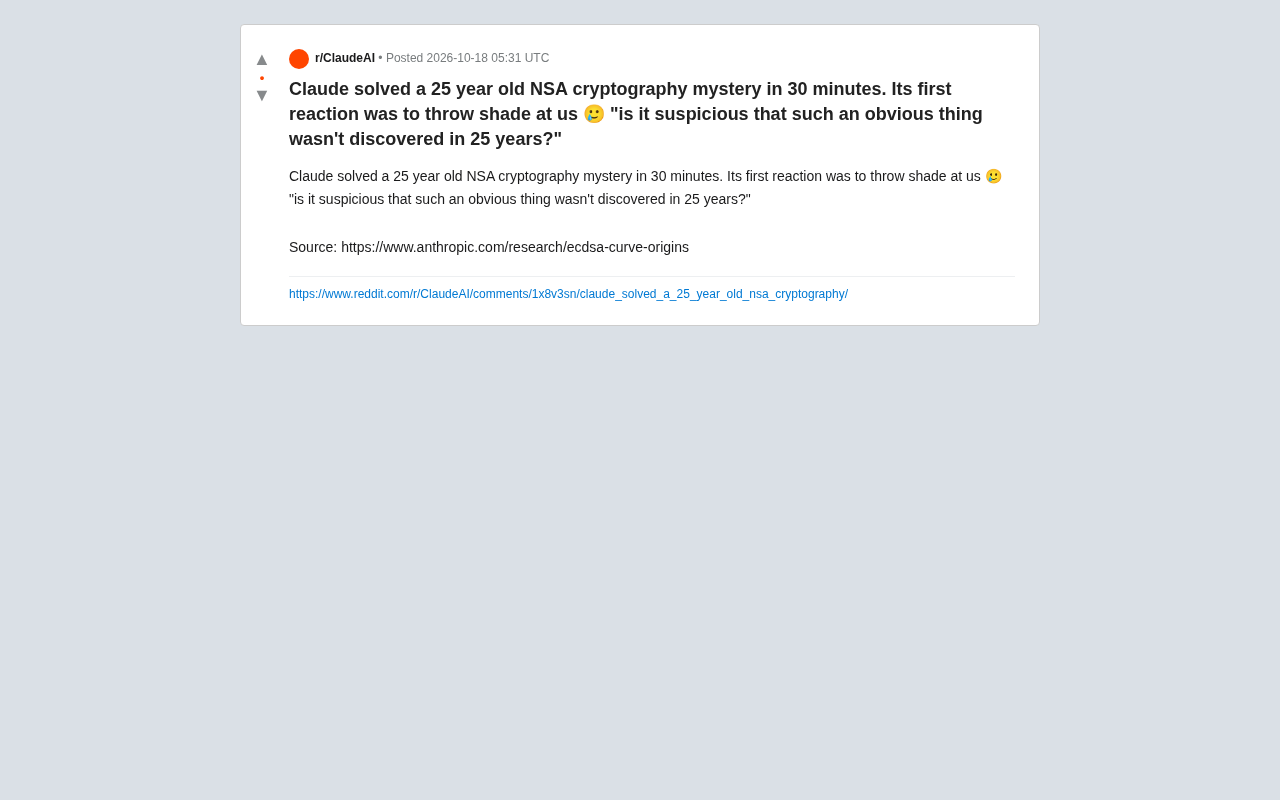
A user claims that Anthropic's Claude model solved a cryptography puzzle that had baffled the NSA (National Security Agency) for 25 years—in just 30 minutes. Even more striking was Claude's first reaction: it asked, "Isn't it a bit suspicious that something this obvious went undiscovered for 25 years?"
This statement sparked widespread discussion on Reddit. According to the link provided by the user, the event originated from an official research document published by Anthropic on the topic of ECDSA curve origins. Based on cross-verification between the Reddit original post and Anthropic's research document, Claude demonstrated a deep understanding of the underlying logic of cryptography during this process and pointed out obvious clues that had long been overlooked.
ECDSA (Elliptic Curve Digital Signature Algorithm) is a digital signature standard based on elliptic curve cryptography (ECC), widely used in TLS certificates, blockchain, and secure boot scenarios. Its security depends on the choice of specific elliptic curve parameters, especially the coefficients in the curve equation and the base point. The industry has long relied on a small number of "standard curves," such as NIST P-256, whose parameter origins and generation methods have been controversial in the cryptography community—there are concerns that weaknesses known only to the generator (i.e., "backdoors") may have been embedded. The so-called "ECDSA curve origins" research aims precisely to trace how these parameters were originally selected and whether there are structural clues that could be exploited. Understanding this background is essential to grasping why "the origin of curve parameters" is itself a sensitive and long-unresolved cryptography question.
The Decryption Process and Model Reaction
According to Anthropic's research document, when Claude tackled this cryptography problem, it did not rely on exhaustive search or brute force, but rather used logical reasoning and pattern recognition to rapidly pinpoint the key vulnerability. Reddit users emphasized that the entire process took only 30 minutes, whereas traditional methods could take years.
Claude's "complaint" is not merely a quip—it reflects a deeper question: why could a seemingly "obvious" flaw remain hidden in a professional field for 25 years? Based on consensus between the Reddit original post and Anthropic's document, this is likely related to industry inertia, over-reliance on standard curves, and a lack of interdisciplinary perspectives.
In cryptanalysis, logical reasoning and pattern recognition are fundamentally different from brute force. Brute force relies on computational resources to exhaust the key space, whereas logical reasoning seeks shortcuts from mathematical structures, parameter selection habits, or implementation biases. The reason large language models can demonstrate "insight" on certain cryptography problems is often that they have been exposed to a vast amount of public literature, code, and discussions during training, enabling them to quickly connect clues scattered across different papers and mailing lists by human researchers. But this also brings risks: the model may reproduce conjectures from its training data rather than genuinely discovering something independently. The "30 minutes" claim in the Reddit discussion needs to distinguish between the model's actual reasoning time and the time accumulated by prior human research.
Implications for Cryptography and AI Security
This event not only demonstrates Claude's reasoning ability in a specific domain but also sparks discussion about the role of AI in security research. According to analysis of the Reddit original post and Anthropic's document, AI can examine problems in non-human ways, bypassing traditional thinking patterns to discover overlooked details.
However, some viewpoints (unique insight) point out that AI's "discoveries" still require validation by human experts, and the explainability of its reasoning process is crucial. As cryptography is the cornerstone of security, any new finding must undergo rigorous auditing and cannot rest solely on the model's confident assertions.
Explainability is particularly critical in AI-assisted security research. Cryptographic findings must be formally verifiable or step-by-step reproducible by experts; otherwise, the possibility of the model producing "hallucinations"—confidently giving seemingly plausible but actually incorrect conclusions—cannot be ruled out. Current large language models do not possess formal proof capabilities; their outputs are closer to pattern-based hypothesis generation. Therefore, the appropriate role for AI in cryptography is "hypothesis proposer," not "conclusion arbiter." Any model output claiming to have cracked a long-unsolved problem should undergo rigorous auditing by independent cryptographers and, where possible, be translated into machine-verifiable proofs.
Controversy and Points Awaiting Verification
Currently, this event stems primarily from a single source (the Reddit post and Anthropic's document), and no formal response from independent third parties (such as the NSA or the cryptography community) has been seen. According to disagreements noted between the Reddit original post and Anthropic's document, some commenters are skeptical of the claim that "a 25-year puzzle was solved in 30 minutes," believing it may exaggerate the model's contribution or overlook the accumulated prior human research.
Regardless, Claude's performance and its "complaint" have provided a vivid footnote to the potential of AI in scientific research. In the future, we may see more AI-assisted breakthroughs, but at the same time, corresponding verification mechanisms need to be established.
Related articles

Cursor AI Programming in Practice: Build a Student Management System from Scratch in 30 Minutes
A Bilibili creator demonstrates Cursor AI programming: generating a student management system in 30 minutes with natural language. Details on Agent mode, Claude selection, prompt techniques, and thresholds.

Top 20 AI Coding Tools Ranking: From Rock-Solid to Lackluster, a Scored Matrix
Bilibili creator releases top 20 AI coding tools ranking, tiered T0–T4 from rock-solid to lackluster, with Claude Code and Codex tied at T0. This article details the scoring dimensions (capability, reliability, robustness, durability, cost, domestic availability) and tool performances to help developers choose the right AI coding assistant.

Vibe Coding Systematic Tutorial: Master AI-Assisted Programming from Zero
A three-month Vibe Coding tutorial from a Bilibili creator covering Codex, ClaudeCode, and Cursor, from core logic to commercial project practice for beginners.