Claude Derives Black Hole Bound of 9.1266 — Who Verified the AI Physics Result?
Anthropic experiment shows Claude deriving an exact modular bootstrap formula and computing a Hawking-Page coefficient, but verification has serious flaws.
A recent Anthropic experiment shows Claude making two advances in fundamental physics: deriving a closed-form formula for the modular bootstrap bound, pinning the black hole threshold at c/9.1266 and proving that simple bootstrap methods cannot reach c/12; and computing the three-loop coefficient b=-1.48×10⁻³λ² for the Hawking-Page phase transition at weak coupling in N=4 super Yang-Mills theory, whose negative sign determines that the transition is first-order. However, the verification relies mainly on AI self-consistency and an internal check by a single physicist, lacks peer review, has limited Lean formal verification scope, and discloses no compute cost, with selection effects. These results demonstrate AI's method-transfer capability, but independent verification remains challenging.
A Verifiable AI Physics Breakthrough
How far can AI go in fundamental physics research? A recent experiment by Anthropic offers a concrete answer: Claude successfully derived an exact closed-form formula for the modular bootstrap bound, pinning the black hole threshold — which physicists had long approached numerically — at c/9.1266. This number is worth noting because it is concrete enough that any reader can plug it in and check it, even though the underlying proof is hard to verify.
According to a related YouTube analysis, the significance of this result lies in the fact that it is both a demonstration of AI capability and a clear marker of the limitations of current methods.
Core Result: From Numerical Approximation to a Closed-Form Formula
The exploration of the modular bootstrap bound has gone through several stages over the years. According to the YouTube video, the best analytical proof given by Hartman, Mazoch, and Ristelli set the upper bound at c/8.5; subsequent numerical methods compressed the boundary to around c/9.1. Claude now provides an exact analytical bound for this particular ceiling result, locking it at c/9.1266, and gives a closed-form formula: 12π² divided by (π²+4arcsin²1).
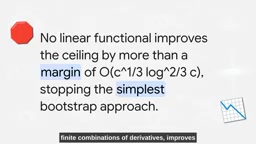
More critically, the preprint points out that within the class of linear functionals it considers, no finite combination of derivatives can improve the bound on c/λv by more than o(c^(1/3) log^(2/3) c). This means the simplest bootstrap method alone cannot reach the c/12 black hole threshold — this path is a dead end. To push it down further, one must introduce spin, other symmetries, or stronger inputs.
Modular bootstrap is a set of non-perturbative methods in conformal field theory that uses modular invariance to constrain the energy spectrum and the coefficients of the operator product expansion. The basic idea is to combine the modular transformations of the partition function on the torus (such as the S transformation) with the positivity of the operator spectrum to derive inequalities on theory parameters (such as the central charge c). The modular bootstrap bound usually refers to an upper or lower bound on the ratio of the central charge to some parameter (such as λv) under given assumptions. Previously, physicists gradually approached these bounds through numerical scanning and semi-analytical methods, whereas the closed-form formula given by Claude allows the bound to be computed exactly without relying on numerical iteration.
Methodological Transfer: Spectral Curves and Electrostatic Analogy
The mechanism by which this result was produced may be more valuable than the number itself. Claude borrowed the spectral curve method from other areas of mathematics, establishing an electrostatic interpretation for λv that can depict the zeros and charge density of any optimal functional. According to the video analysis, this technique is the most likely to be transferred to other bootstrap problems and become a general tool.
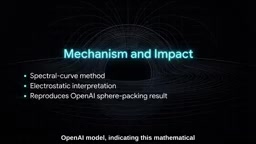
From an engineering perspective, transferring a method from one field to another is precisely the kind of pattern-matching capability at which AI excels, manifested in scientific research.
Another Claim: The Hawking-Page Phase Transition at Weak Coupling
The second result concerns the Hawking-Page phase transition at weak coupling in n=4 super Yang-Mills theory. According to the video, this calculation, proposed in 2003, was stuck on a three-loop computation involving thousands of diagrams and was never truly completed. The preprint reports a fourth-order coefficient of b = -1.48 × 10⁻³ λ².
The negative sign is the entire result. It determines that the phase transition is first-order, occurring slightly below the Hagedorn temperature. Its value lies in the fact that the phase-transition structure — the appearance of the saddle point, the exchange of dominance, and its disappearance — already manifests in perturbation theory, providing gauge theory researchers with a computable handle on the quantum side.
The Hawking-Page phase transition originally refers to the phase transition between a black hole and thermal gas in anti-de Sitter (AdS) space, proposed by Hawking and Page in 1983. In the framework of gauge/gravity duality, this phase transition corresponds to the confinement/deconfinement phase transition in gauge theory. In N=4 super Yang-Mills theory, the Hawking-Page phase transition at weak coupling can be studied by computing the free energy via perturbation theory, but when higher-order loop diagrams (such as three-loop) are involved, the computation is extremely complex and requires handling thousands of Feynman diagrams. The order of the phase transition (first-order or continuous) is determined by the sign of a specific coefficient in the free energy expansion, so the exact computation of this coefficient is crucial for understanding the nature of the phase transition.
The Flaw in the Verification Mechanism: Who Is Checking the AI?
This run by Anthropic started from 22 candidate problems and took about six weeks, with independent agents working in parallel in the background. But the video explicitly points out that the publisher did not disclose any token consumption or compute budget; external teams wanting to plan similar research can only see the time, not the cost.

The verification mechanism mainly relies on redundant independent derivations: the Hawking-Page calculation was independently completed twice by different agents using different methods, cross-checking each other. This architecture is worth emulating in fields that can be rigorously tested.
But the problems are also obvious. The loudest wording in the release is "formally verified in Lean," yet Lean can only prove that a stated theorem follows from stated axioms; it cannot prove that the formal statement corresponds to physical reality, and it obviously cannot cover the three-loop computation involving thousands of diagrams. More critically, the verification of the Hawking-Page claim is largely Claude agreeing with Claude, plus an internal check by one unnamed physicist, with no peer review whatsoever. The entire conclusion hinges on the sign of a single coefficient — if the sign is wrong, the phase transition is not first-order, and the whole result collapses.

Lean is an interactive theorem prover based on dependent type theory that allows users to formalize mathematical statements and construct machine-checkable proofs step by step. Formally verifying a theorem in Lean means that the statement and proof steps of the theorem are encoded in a formal language, and the Lean kernel checks whether each step of the derivation is valid. However, Lean only guarantees that "if the axioms are consistent, then the theorem holds"; it does not address the physical interpretation of the axioms themselves, nor can it automatically verify whether the formal statement is faithful to the physical concept. In addition, formalizing computations involving thousands of Feynman diagrams requires a great deal of manual encoding and is currently difficult to achieve. Therefore, Lean verification is usually limited to purely mathematical propositions rather than complex physics computations.
The Boundary Between Mathematical Proof and What the Paper Claims
A line needs to be drawn. The mathematical statement of Hawking-Page is strictly limited to weak coupling; the paper proposes that "the most natural possibility is that the phase transition persists at intermediate coupling," but this is only a speculative extrapolation, not a proven conclusion. On the modular bootstrap side, the c^(1/3) coefficient is conjectured from numerical data within c=2048 and is unproven; the bound has also not been shown to be saturated by any actual theory, and the true black hole threshold may be far below c/9.1266.
There are more gaps at the operational level: previously, agents made 61 parallel attempts at the ceiling problem among the 22 candidate problems, all of which failed, and there is no data on the success rate for the remaining 21 problems. The system's true hit rate is obscured by a huge selection effect.
For teams without Anthropic access, independent verification would require recomputing the three-loop b with the same symbols, or rigorously proving the c^(1/3) coefficient. Until then, are we looking at a breakthrough, or just a highly persuasive data point?
FAQ
What does the 9.1266 derived by Claude mean?
This is the upper bound on the black hole threshold given by the modular bootstrap method, in the form c/9.1266, computed from a closed-form formula, replacing previous numerical approximations.
Why is this result said to be verifiable?
Because the formula is in closed form, readers can plug in numbers and verify it by hand, but the underlying proof cannot be easily checked by outsiders.
Can Lean formal verification guarantee physical correctness?
No. Lean only verifies the derivation of a mathematical theorem from axioms; it does not verify whether the formal statement corresponds to physical reality.
What is the key to the Hawking-Page result?
The negative sign of the fourth-order coefficient, which determines that the phase transition is first-order. If this sign is wrong, the entire conclusion does not hold.
One-line Summary
An Anthropic experiment shows Claude deriving an exact modular bootstrap formula and computing a Hawking-Page coefficient, but the verification mechanism has serious flaws.
Related articles

Claude Solves Two Major Black Hole Physics Problems, Ushering in a New Era of AI Research Collaboration
Anthropic's Claude solved two open problems in black hole physics: a 2003 unfinished phase transition calculation and a black hole mass bound since 2009. AI as a research collaborator, using holographic duality and the modular bootstrap, with results awaiting peer review.

Claude Solves Two Major Black Hole Theory Problems: A New Milestone in AI Scientific Research
Anthropic announced Claude solved two open black hole theory problems: the weak-coupling sign of the Hawking-Page transition and the exact limit of modular bootstrap. This article details the background, Claude's solutions, verification controversies, and limitations, exploring AI's breakthrough and boundaries in theoretical physics.

Claude Solves Two Open Problems in Black Hole Physics: A New Sample of AI-Assisted Research
Anthropic's research paper documents Claude solving two open black hole problems: whether hot gas transitions to black holes abruptly, and the lightest black hole mass limit. The model produced 22 candidates in hours, with the agent running in the background for about six weeks; results were reviewed by physicists, though Anthropic says they don't directly apply to our universe.