Claude Solves Two Major Black Hole Physics Problems, Ushering in a New Era of AI Research Collaboration

Claude solves two open black hole physics problems, showcasing a new paradigm of AI as a research collaborator.
Anthropic's Claude model achieved a breakthrough in theoretical physics by solving two long-standing open problems in black hole physics. The first concerns whether the Hawking-Page phase transition remains sudden at the quantum gravity level; Claude confirmed it is sudden by completing a three-loop calculation proposed in 2003 but never executed. The second concerns the modular bootstrap's upper bound on the lightest black hole mass; Claude discovered a numerical pattern and introduced the spectral curve tool, proving the bound is C/λ (λ≈9.1266) and optimal. These results were completed autonomously by multiple Claude agents over six weeks, with some formally verified in Lean. Although all are preprints that do not directly describe the real universe and have no practical applications, they mark AI's emergence as a research collaborator capable of long-range computation and discovering patterns humans missed, while underscoring the importance of independent verification.
In the latest episode of the Bin He Talks podcast, host Bin and Sophia discussed a remarkable development: Anthropic's Claude model solved two open problems in black hole physics. This is not only a demonstration of AI capabilities but may also mark a shift in AI's role as a research collaborator.
Background: Quantum Gravity and Black Holes
Modern physics rests on two major frameworks: general relativity describes large-scale phenomena, while quantum mechanics describes the microscopic world. Both are extremely precise in their respective domains but are mathematically incompatible with each other. Finding a theory of quantum gravity that unifies the two is one of physics' greatest goals. Black holes, as extreme scenarios where both frameworks come into play, are naturally an ideal testing ground.
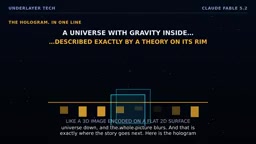
Physicists often use the tool of "holographic duality" to describe a universe containing gravity using a quantum theory on the boundary. A difficult problem about gravity can be translated into a quantum physics problem, which is sometimes easier to solve.
Holographic Duality is one of the most important tools in quantum gravity research, and its most famous concrete realization is the AdS/CFT correspondence, proposed by Juan Maldacena in 1997. Its core idea is that the physics in a d-dimensional spacetime containing gravity can be completely equivalently described by a quantum field theory without gravity defined on its (d-1)-dimensional boundary. It is like all the information of a three-dimensional object being encoded in a hologram on its two-dimensional surface.
The power of this duality lies in the fact that when calculations on the gravity side are difficult due to strong coupling, one can instead solve the quantum field theory on the boundary; and vice versa. Both black hole problems in the article rely on this strategy: translating the gravitational problem of black hole formation into a computable problem on the quantum side. Holographic duality has not yet been rigorously proven, but it has passed consistency checks in a large number of scenarios and is regarded as a core clue to understanding quantum gravity.
Problem One: Is the Phase Transition Sudden?
The first problem concerns the behavior of a model universe as it heats up. At low temperatures, the universe is filled with a gas of particles; above a certain temperature, a black hole forms. In 1983, Hawking and Page proved that this transition is a sudden phase transition, similar to water suddenly boiling. But their calculation relied on general relativity and holds only when the universe is very large. When the universe shrinks to a scale where spacetime loses its definite shape, calculations on the gravity side become infeasible.
In principle, the quantum side can be calculated. In 1999, physicists discovered that a phase transition also exists in this region, but could not determine its nature. In 2003, a group of physicists proposed a calculation scheme, the key being a number that appears only in a three-loop calculation, involving thousands of terms, which is nearly impossible to compute by hand and therefore was never completed.
Claude completed this calculation. It organized a group of its own copies as a research team, independently completed almost every part, and cross-validated against known results. The results showed that the phase transition is sudden. The same sudden transition appears at both the smooth end and the fuzzy end, suggesting that black hole formation is an intrinsic feature of the underlying quantum theory, not merely a product of relativity.
A few weeks later, another physicist independently using Claude to study the same problem shared results, and a colleague discovered that the agent had already arrived at the same answer through a different method, constituting a useful independent verification.
Hawking-Page transition is a classic result proposed by Stephen Hawking and Don Page in 1983. In anti-de Sitter (AdS) space with a negative cosmological constant, at low temperatures the system is in a state of thermal radiation gas (no black hole); when the temperature exceeds a critical value, a large AdS black hole suddenly forms. This phase transition is first-order on the gravity side, similar to the sudden release of latent heat when ice melts into water, rather than a continuous transition.
The Hawking-Page calculation is based on the semiclassical approximation, i.e., it holds when the gravitational coupling is very weak and the spacetime curvature is much larger than the Planck scale. When the size of the universe shrinks to near the Planck scale, the classical geometric description of spacetime fails, and the semiclassical approximation is no longer reliable. Therefore, one needs to use holographic duality to judge whether the phase transition remains sudden based on the behavior of the boundary quantum field theory under strong coupling. The three-loop calculation in the article is precisely to determine this precisely on the quantum side.
Problem Two: Modular Bootstrap and the Black Hole Mass Upper Bound
The second problem concerns the "modular bootstrap," a method for testing candidate theories of quantum gravity in a simplified two-dimensional universe. Physicists do not directly construct the correct theory but instead exclude wrong options by proving that candidate theories are self-contradictory. Since 2009, this method has been used to set an upper bound on the mass of the lightest black hole; any theory violating the bound is excluded, and each lowering of the bound narrows the search space.
The numbers tell the story of the chase. In the original paper, Simeon Hellerman proved that the mass of the lightest black hole does not exceed C/6, where C roughly counts the number of microscopic building blocks of the universe. Numerical calculations suggested the bound might drop to about C/9.1, but computers could not determine it. On the analytical side, Tom Hartman, Dalimil Mazac, and Leonardo Rastelli proved a bound of C/8.5, higher than the numerical hint, indicating room for improvement in the method.
Claude discovered in the numerical results a pattern that physicists had missed, concerning the way the bound shifts slightly as C grows. It borrowed a tool known in other areas of mathematics and physics but never used for this problem—the spectral curve. Using it, Claude proved that the mass of the lightest black hole does not exceed C/λ, where λ is given by an exact formula approximately equal to 9.1266, and proved that this bound is optimal, the lowest value achievable by this version of the method. This also shows that the method itself cannot push the bound to C/12, the mass at which black holes first appear, which would require other elements.

The second result had an interesting origin: one agent discovered the pattern while surveying the bootstrap literature, another agent studying a related problem about sphere packing in higher dimensions transformed it into a method, and two other agents independently arrived at the same answer. In September, the result was formally verified in the Lean proof assistant, and Claude then wrote the paper with minimal guidance, with physicists checking every major result.

Modular Bootstrap is a method for non-perturbatively constraining quantum field theories, originating from the study of conformal field theories (CFTs). Its basic idea is not to directly construct the theory but to use the self-consistency conditions that quantum field theories must satisfy—such as unitarity (probabilities are positive), crossing symmetry (different scattering channels are equivalent), and modular invariance (the partition function on a torus is invariant under modular transformations)—to derive the allowed range of observables.
Around 2009, Tom Hartman, Simeon Hellerman, and others applied this idea to two-dimensional conformal field theories and found that the self-consistency conditions impose a strict upper bound on the lowest-mass state in the theory (corresponding to the lightest black hole). As the method improved, this bound was continually lowered, thereby excluding more and more candidate theories. The spectral curve was originally a tool in mathematics for studying integrable systems and algebraic curves; here it was used to exactly solve the bootstrap equations, thereby giving the optimal bound.
Method: How AI Became a Research Collaborator
This is not only a physics story but also an AI story. In August, Anthropic researcher Hongbin Chen tested Claude's capabilities in a side project, asking it to list interesting open problems in theoretical physics, focusing on black holes and bootstrap methods. Claude returned 22 candidate problems within a few hours, and Hongbin set up independent agents to study them separately. The agents could read each other's progress posts and collaborate on related problems. These agents ran in the background without special setup for about six weeks.
Lean proof assistant is an interactive theorem prover initiated by Leonardo de Moura of Microsoft Research in 2013. It is based on dependent type theory, allowing users to write mathematical propositions and proofs in a formal language, with the computer checking line by line whether each step of reasoning conforms to logical rules. Unlike traditional computer algebra systems, Lean does not automatically search for proofs but ensures that proofs written by humans or AI are absolutely correct.
In recent years, Lean has gained significant attention in the mathematics community, for example, the Liquid Tensor Experiment initiated by Peter Scholze in 2021, which used Lean to verify complex frontier mathematics. In this article, Claude's second result was formalized in Lean, meaning its proof logic was machine-verified, independent of the ambiguity of natural language formulations. This provides a stronger guarantee of certainty for AI-generated mathematical results than peer review, although the formalization itself still depends on the formalizer's correct translation of the proposition.
Limitations and Significance
Anthropic explicitly pointed out the limitations: neither result directly describes our universe—the first concerns a model universe, the second a two-dimensional spatial universe; neither has practical applications; both are preprints that have not undergone peer review, and independent verification remains to be done. These are contributions to long-term theoretical efforts, not an established theory of quantum gravity, nor a step toward anything buildable.

This echoes two earlier events: Episode 237 on Claude reading Gödel's notes, and Episode 212 on DeepMind using mathematics to prove signal encryption. The pattern is the same and strengthening: AI systems are becoming research collaborators, capable of completing tasks that are too long and error-prone for humans to compute by hand, and sometimes discovering patterns that humans have missed.
According to analysis by Bilibili UP host Bin and the YouTube channel Bin He Talks, this progress highlights the potential of AI in theoretical physics, but its limitations must be viewed with caution. Cross-validation from multiple sources shows that Claude's methods are innovative, but independent verification is crucial.
As AI's role in scientific research deepens, we may be entering a new paradigm of human-machine collaboration, accelerating scientific discovery while also requiring the establishment of verification mechanisms to ensure reliability.
One-line Summary
Claude solves two open problems in black hole physics, demonstrating a new paradigm of AI as a research collaborator.
Paragraph Summary
Anthropic's Claude model has made a breakthrough in theoretical physics, solving two long-standing open problems in black hole physics. The first concerns whether the Hawking-Page phase transition remains sudden at the quantum gravity level; Claude confirmed that the transition is sudden by completing a three-loop calculation proposed in 2003 but never carried out. The second concerns the upper bound on the mass of the lightest black hole from the modular bootstrap method; Claude discovered a numerical pattern and introduced the spectral curve tool, proving that the bound is C/λ (λ≈9.1266) and is optimal. These results were completed autonomously by multiple Claude agents collaborating over six weeks, with some results formally verified in Lean. Although the results are preprints, do not directly describe the real universe, and have no practical applications, they mark AI's emergence as a research collaborator capable of completing long-range calculations and discovering patterns humans have missed, while also highlighting the importance of independent verification.
Related articles

The FBI-Flagged AI Hacking Tool ARTEX: From Open-Source Project to Global Threat in 110 Days
The FBI-flagged AI hacking tool ARTEX went from a GitHub project to a global threat in 110 days, breaching South Korean financial institutions, Japanese companies, and the European Commission. This article explains ARTEX's agentic framework, its use of low-cost models, attack characteristics, and defense priorities.

Anthropic Releases Claude Fable 5.2 and Mythos 5.2: AI Tackles Black Hole Physics Problems
Anthropic releases Claude Fable 5.2 and Mythos 5.2, claiming to solve two open black hole physics problems and outperform GPT-6 Cyber in hacking tests. This article examines the new models' capabilities, security risks, and the credibility of the scientific claims.
Claude Solves a Physicist's 23-Year-Old Unfinished Calculation, Heralding a New AI Research Paradigm
Claude ran in the background for about six weeks to complete a black hole phase transition calculation shelved by physicists for 23 years, and used sphere-packing methods to prove an exact upper bound for modular bootstrap. The results were formally verified in Lean and a preprint made public, though not yet peer-reviewed. This article analyzes the holographic principle behind the calculation, the multi-agent collaboration method, and the shift in the AI research paradigm.