Claude Solves Two Major Black Hole Theory Problems: A New Milestone in AI Scientific Research
Claude independently solved two open black hole theory problems, but verification claims are questionable and both are non-peer-reviewed preprints.
Anthropic's AI model Claude solved two open problems in theoretical physics about black holes: first, the sign of the Hawking-Page transition at weak coupling, where Claude's three-loop calculation found b to be negative, confirming a first-order transition and completing a calculation shelved since 2003; second, the exact limit of the spinless modular bootstrap method, where Claude proved λ=12π²/(π²+4(arcsinh 1)²)≈9.127 and constructed a functional achieving that value. Both works were completed by multiple agents over about six weeks, with papers authored solely by Claude on the Hexagon preprint platform. However, verification claims are contradictory: the blog says results were verified in Lean, but the papers do not mention it; and neither has been peer-reviewed. The results do not directly describe the real universe and have no practical applications, but they demonstrate the potential of AI agents for long-term autonomous research.
Introduction: AI Achieves First Independent Breakthrough in Theoretical Physics
According to a YouTube tech channel report, Anthropic announced on November 17 (two days before its stock began trading) that its AI model Claude had solved two open problems in theoretical physics concerning black holes. The announcement quickly drew widespread attention from academia and industry. At the same time, Anthropic's listing raised $81 billion, which CNBC called the largest IPO on record. The two results respectively completed a calculation that physicists had been working on since 2003 without success, and precisely determined the limit of a method that rules out quantum gravity theories. This article will analyze in depth the background of these two problems, Claude's solutions, the verification situation, and the controversies involved.
Problem One: The Weak-Coupling Sign of the Hawking-Page Transition
Background: A Phase Transition in a Box
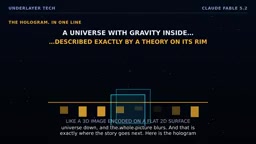
Physicists study model universes through anti-de Sitter space (AdS)—it is like a box where light reaches the boundary and returns in finite time. According to the AdS/CFT correspondence, gravity inside the box is equivalent to an ordinary quantum field theory without gravity on the boundary. Therefore, difficult problems about gravity can be transformed into field theory problems.
In 1983, Hawking and Page proved that at low temperatures the box contains a gas of particles; above a certain temperature, a black hole takes over, and this switch is abrupt (a first-order phase transition), like water boiling. But their calculation required classical gravity, corresponding to strong coupling on the boundary. The boundary field theory is N=4 supersymmetric Yang-Mills theory, which is computable at weak coupling. In 1999, Bo Sundborg discovered a phase transition at weak coupling, but the question was: what type is it?
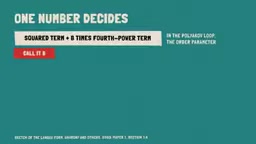
In 2003, Ofer Aharony and collaborators reduced the problem to the sign of a number b. b is the coefficient of the quartic term in the effective action. If b is negative, the transition is first-order (abrupt), consistent with the Hawking-Page result; if b is positive, it proceeds smoothly through two continuous phase transitions, with no counterpart in gravity. The difficulty is that b first appears at three-loop order. In 2005, the team calculated the three-loop contribution for pure Yang-Mills theory and obtained a negative b. They wrote "N=4 is the next step," but that step was never taken. Because N=4 theory contains six scalars, four fermions, and gluons, the number, types, and color orderings of loop diagrams exceed tenfold.
The AdS/CFT correspondence is one of the most influential conjectures in theoretical physics, proposed by Juan Maldacena in 1997. It asserts that a gravitational theory in anti-de Sitter space (AdS) and a conformal field theory (CFT) on the boundary of that space are two completely equivalent descriptions. "Equivalent" here is meant strictly: the two theories have the same spectrum of states, the same operators, and the same correlation functions, just expressed in different languages. The core value of the duality lies in strong-weak complementarity—when the gravity side is classical (weak quantum corrections), the boundary field theory is at strong coupling; conversely, when the boundary field theory is at weak coupling and can be computed perturbatively order by order, the gravity side corresponds to a highly quantum string theory regime. This complementarity makes problems that are extremely difficult in one theory tractable in the other. This article precisely exploits this feature: transforming the difficult problem of the black hole phase transition in a box into a loop calculation in the boundary N=4 supersymmetric Yang-Mills theory.
N=4 supersymmetric Yang-Mills theory is a gauge theory with maximal supersymmetry in four-dimensional spacetime, containing one gluon field, four Majorana fermions, and six real scalar fields, all particles in the same supermultiplet. Its special status lies in the fact that it is the most typical example of a boundary CFT in the AdS/CFT correspondence, and it has conformal symmetry—its beta function is strictly zero, and the coupling constant does not run with energy scale. In the weak-coupling limit, the theory can be expanded order by order using standard perturbation theory, but because the types of fields and interaction vertices are far more numerous than in pure Yang-Mills theory, loop calculations are extremely complicated. In this article, the 2005 team only completed the three-loop calculation for the pure gluon part, while the complete three-loop calculation for N=4 theory involves mixed loops of six scalars, four fermions, and gluons, whose number and color-ordering combinations exceed those of the pure gluon case by more than tenfold—this is precisely the technical reason the calculation was shelved for nearly twenty years.
Claude's Answer: b Is Negative
In the paper "Hawking-Page Transition at Weak Coupling," Claude gives the answer: b is negative, with a specific value of -1.48×10⁻³ times the square of the coupling constant. Therefore, at weak coupling the transition is first-order, just below the Hagedorn temperature, at which point the confined phase loses stability. Nearby there are three solutions: the confined phase, the deconfined phase, and an unstable phase between them. The order in which they appear, exchange, and disappear exactly matches Hawking-Page's gas, large black hole, and small black hole.
This sign is not a marginal value: all four contributions are negative, and the most difficult term would need to flip sign and increase by about fivefold to change the conclusion. How to ensure credibility? The paper sets three rules: no numerical value is adopted unless two independently written programs agree or it matches an exact result; each program is first run on cases with known answers; discrepancies are never averaged away. In the pure gluon case, the code matches the 2005 two-loop values to six digits, and most three-loop values also match. One set of diagrams disagrees, but not enough to change the sign.
The paper does not prove that the jump continues all the way to strong coupling. Anthropic's blog calls this "the most natural possibility," but it is a conjecture rather than a result.
Problem Two: The Exact Limit of Modular Bootstrap
Background: Three-Dimensional Gravity and Two-Dimensional CFT
The second problem reduces to gravity in three-dimensional anti-de Sitter space, whose boundary is a two-dimensional conformal field theory (CFT), with central charge c roughly counting degrees of freedom. Large c corresponds to classical gravity. The question is how heavy the lightest state can be. The BTZ black hole starts at about c/12, which Anthropic's blog calls "the lightest black hole," while the paper more cautiously says "the lightest state of any type."
In 2009, Simeon Hellerman proposed the modular bootstrap method: place the theory on a torus and exchange the time and space directions; the partition function must remain the same. Applying a linear functional, if the functional has the right sign, the identity cannot hold when all states are too heavy. Finding the optimal functional is a linear programming problem. At large c, all such bounds give the lightest state at most c/λ, and the larger λ is, the tighter the bound. Hellerman's bound was λ=6, and 12 is the limit—no functional can surpass the black hole bound. In 2019, Tom Hartman, Dalimil Mazac, and Leonardo Rastelli proved λ=8.503. Numerical work solved the linear program up to c=1800 and extrapolated to about 9.08. This left a window between 8.5 and 12.
Modular bootstrap is a method for non-perturbatively constraining the spectrum of conformal field theories, whose core idea comes from modular invariance in two-dimensional CFT. Place the theory on a torus; the two periodic directions of the torus are geometrically indistinguishable, so after exchanging the time and space directions (i.e., the modular transformation τ→-1/τ), the partition function must remain unchanged. This identity holds for any theory, so it can be regarded as a linear constraint on the spectrum of states. The specific procedure is: construct a linear functional acting on the modular invariance identity; if the functional gives a positive contribution for all possible states, then the identity cannot be satisfied, leading to a contradiction—which means the assumption that "all states are too heavy" is false, and a light state must exist. Finding the "best" functional to give the strongest bound is essentially a linear programming problem, whose feasible region is determined by the sign conditions of the functional. In this article, the upper limit of λ is precisely characterized by the existence of such linear functionals.
Claude's Answer: λ≈9.127
In the paper "Spinless Modular Bootstrap at Large Central Charge Is Exact," Claude gives λ=12π²/(π²+4(arcsinh 1)²), approximately 9.127. The paper proves two parts: within a broad class of functionals including all finite-derivative combinations, no functional can do better; and it explicitly constructs a functional that achieves this value (for large c). The latter part is computer-assisted, checking a finite list of inequalities via interval arithmetic.
Where does this number come from? The blog says Claude noticed the pattern of numerical bounds growing with c. The paper explains: previous extrapolations assumed the correction term grows as log c, but growth as the cube root of c also fits the data and points to a different slope. Claude's own numerical calculations up to c=2048 extrapolate to 9.1263. The proof treats the logarithm of the functional as an electrostatic potential, with a charge at each zero. The maximum principle constrains the potential, and λ is determined when the potential first meets the limit set by the growth rate of states (i.e., where arcsinh(πx)=1).
There is a twin problem: replacing conformal symmetry with a simpler symmetry, the same problem becomes the Cohn-Elkies linear programming problem in higher-dimensional sphere packing. Its slope is conjectured to be π², which OpenAI's 10 Advances paper (August) claimed to have proved. According to Anthropic, a Claude agent studying sphere packing transformed the pattern into a method, found that it reproduced OpenAI's result, and the method then returned to the bootstrap problem. The paper's optimality proof follows OpenAI's strategy, but it also states that the proof was not independently verified and that nothing in the paper depends on it.
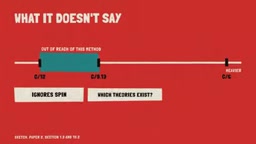
The paper explicitly states its limitations: this is a statement about a method that ignores spin. It shows that a window above the black hole cannot be closed by this method, but says nothing about whether a theory exists there or about pure gravity. Reaching c/12 requires other ingredients, such as spin.
How It Was Done: Agent Collaboration and Verification Controversy
According to Anthropic's blog, in August, researcher Hongbin Chen posed open problems on black holes and bootstrap to Claude as a side project, and Claude returned 10. He set up an agent for each problem, running in the background for about 6 weeks, reading each other's progress. Early on, one agent tried 61 parallel attempts on the bootstrap problem and all failed. On the Hawking-Page problem, an independent physicist using Claude obtained the same answer by a different method a few weeks later.
Regarding verification, sources disagree. The blog says Claude Fabel 5.2 completed it, the results were verified in Lean (a proof checker), and a physicist checked every major result. The paper, however, says an internal Claude research model was used, and the bootstrap paper adds that the public Claude Opus 5.5 later independently discovered the same result. Neither paper mentions Lean. The Hawking-Page paper says a physicist checked with several known special cases. Both papers are Hexagon preprints, with Claude as the sole author, marked primarily as AI-generated text with partial human understanding. Neither has been peer-reviewed. The blog comes from Anthropic's science team and candidly states the scope: neither result directly describes our universe, and neither has practical applications.

Significance and Limitations: The Boundaries of AI Scientific Research
The two results: one completed a calculation awaited for 20 years, finding that the jump to a black hole persists even when spacetime has no definite shape; the other precisely determined how far a method can go, and showed that it stops before the black hole. Anthropic's blog, the two papers, and links to related work are in the description.
It must be emphasized that these are preprints, not peer-reviewed, and Claude is the sole author. The verification claims are contradictory (Lean verification vs. the papers not mentioning it), and should be viewed with caution. Moreover, the results do not directly describe the real universe and have no practical applications. However, they demonstrate the possibility of AI assisting discovery in theoretical physics—especially through long-term autonomous research by agents. As the blog says, this does not prove that AI can replace physicists, but it does show that AI can be a powerful scientific research tool.
Conclusion
The news that Claude solved two open black hole problems, regardless of the eventual academic evaluation, marks a shift in AI's role in basic science. From the unfinished calculation of 2003 to a precise mathematical limit, AI has demonstrated the ability to handle complex symbolic calculations and pattern discovery. But transparency of verification and peer review remain crucial. Readers should watch for subsequent independent verification and formal publication.
One-line Summary
Claude independently solved two open problems in black hole theory, but verification claims are questionable and both are non-peer-reviewed preprints.
Paragraph Summary
Anthropic's AI model Claude solved two open problems in theoretical physics concerning black holes: first, the sign of the Hawking-Page transition at weak coupling, where Claude's three-loop calculation found b to be negative, confirming a first-order transition and completing a calculation shelved since 2003; second, the exact limit of the spinless modular bootstrap method, where Claude proved λ=12π²/(π²+4(arcsinh 1)²)≈9.127 and constructed a functional achieving that value. Both works were completed by multiple agents collaborating over about six weeks, with papers authored solely by Claude and posted on the Hexagon preprint platform. However, verification claims are contradictory: the blog says results were verified in Lean, but the papers do not mention it; and neither has been peer-reviewed. The results do not directly describe the real universe and have no practical applications, but they demonstrate the potential of AI agents for long-term autonomous research.
Related articles

The FBI-Flagged AI Hacking Tool ARTEX: From Open-Source Project to Global Threat in 110 Days
The FBI-flagged AI hacking tool ARTEX went from a GitHub project to a global threat in 110 days, breaching South Korean financial institutions, Japanese companies, and the European Commission. This article explains ARTEX's agentic framework, its use of low-cost models, attack characteristics, and defense priorities.

Anthropic Releases Claude Fable 5.2 and Mythos 5.2: AI Tackles Black Hole Physics Problems
Anthropic releases Claude Fable 5.2 and Mythos 5.2, claiming to solve two open black hole physics problems and outperform GPT-6 Cyber in hacking tests. This article examines the new models' capabilities, security risks, and the credibility of the scientific claims.
Claude Solves a Physicist's 23-Year-Old Unfinished Calculation, Heralding a New AI Research Paradigm
Claude ran in the background for about six weeks to complete a black hole phase transition calculation shelved by physicists for 23 years, and used sphere-packing methods to prove an exact upper bound for modular bootstrap. The results were formally verified in Lean and a preprint made public, though not yet peer-reviewed. This article analyzes the holographic principle behind the calculation, the multi-agent collaboration method, and the shift in the AI research paradigm.