Claude Solves Two Open Problems in Black Hole Physics: A New Sample of AI-Assisted Research

Claude took part in solving two open black hole problems, showcasing AI bulk candidate generation with human validation.
A short YouTube video revealed that Anthropic's paper documented Claude's involvement in solving two open problems in black hole physics. After researcher Hong Bin Chen posed the problems, Claude produced 22 candidates in hours, and an agent ran in the background for about six weeks for deepening and verification. The paper was written by Claude and reviewed by physicists. The first problem's conclusion is that the hot gas to black hole transition is abrupt in both cases; for the second, the lightest black hole mass limit is about 9.1266 in the simplest version, with bootstrap results verified at the linear level. Anthropic qualified that the results don't directly apply to our universe. The article argues the case's real value is the human-AI workflow—candidate generation, long background computation, self-consistency verification, and human review—not a claim that AI solved physics.
Claude Solves Two Open Problems in Black Hole Physics: A New Sample of AI-Assisted Research
A short video from YouTube revealed that Anthropic documented, in a research paper, Claude's involvement in solving two open problems in black hole physics. According to the video's narrative, researcher Hong Bin Chen posed the open problems to Claude, and the model produced 22 candidate solutions within hours. An agent then ran continuously in the background for about six weeks, and the final results were reviewed by physicists. The value of this case lies not in declaring that "AI has solved physics problems," but in demonstrating a human-AI collaborative research workflow: AI handles large-scale candidate generation and computation, while humans handle problem framing and result validation.
Problem One: Is the Transition from Hot Gas to Black Hole Abrupt or Gradual?
The first open problem focuses on the process by which hot gas transitions into a black hole—whether this transition happens suddenly or gradually. This is a classic dynamical problem in black hole physics, involving state changes of matter under extreme gravitational conditions.
According to the video, Claude's answer is that the transition is "abrupt" in both cases. In other words, the model does not believe there is a smooth, gradual intermediate stage; rather, it argues that the transition has abrupt characteristics. The video screenshot likewise presents "Claude's answer is abrupt in both cases" as the key point.
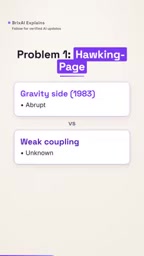
It should be noted that the short video does not elaborate on the derivation details or physical assumptions behind this conclusion, so we can only confirm the qualitative judgment the model provided and cannot assess the strength of its argument. For problems of this kind, the sheer number of candidates itself indicates a large solution space, and the final conclusion depends on subsequent independent verification.
Problem Two: The Lower Mass Limit of the Lightest Black Hole
The second problem concerns the mass limit of the lightest black hole. The video states that in the simplest version this limit is approximately 9.1266—a value that appears directly in the source material without units, presumably related to theoretical calculations of the black hole mass lower bound.
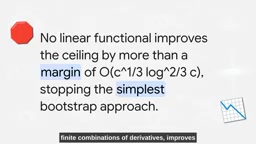
Regarding this result, the video mentions that the agent recalculated and verified it on the "bootstrap result line." The screenshot caption reads "bootstrap results verified at the linear level." This means the model not only produced a numerical value but also cross-checked the conclusion through some self-consistency verification path.

From a methodological perspective, this workflow of "generate candidates—long background runs—self-consistency verification" is closer to search and validation in computational physics than to a single Q&A session. The video emphasizes that the agent ran in the background for about six weeks, a time span indicating that the task could not be completed in a single inference pass but required sustained iterative computation.
The bootstrap method is a self-consistency solution framework in theoretical physics that does not rely on perturbative expansion. Its core idea is: rather than directly solving the full dynamical equations, one uses fundamental constraints that physical quantities must satisfy—such as symmetry, unitarity, and analyticity—to construct a set of self-consistency equations, then numerically iterates to find solutions satisfying all constraints. In black hole physics and quantum gravity research, bootstrap is often used to constrain theoretical parameter spaces or to verify the self-consistency of candidate solutions. The "bootstrap results verified at the linear level" mentioned in the video most likely means that the mass lower bound value produced by the model passed self-consistency checks under the linear approximation of the bootstrap equations—but this is not equivalent to the value also holding in the full nonlinear framework. Understanding this point helps assess the strength of the verification—passing at the linear level is a necessary but not sufficient condition.
22 Candidates and Six Weeks of Background Running: The Process Matters More Than the Conclusion
The most informative part of the video is the process description rather than the conclusions themselves. After the researcher posed the problems, Claude produced 22 candidate solutions within hours; an agent then spent about six weeks running in the background to deepen and verify them; finally, the paper was written by Claude and the results were checked by physicists.
This division of labor is noteworthy: humans posed the problems, AI generated candidates in bulk, AI completed verification in the background, and human physicists performed the final review. For open problems, a large number of candidates does not equal a correct answer—the real filtering happens in the verification and human review stages. The video does not state how many of the 22 candidates were ultimately retained, nor does it disclose the specific verification criteria; these omissions limit our ability to judge the reliability of the results.
Agent background running differs from ordinary conversational Q&A in a key way: an agent can autonomously plan task steps, invoke computational tools, preserve intermediate states across multiple iterations, and adjust subsequent strategies based on intermediate results. The "approximately six weeks of background running" in the video means the model did not output an answer in one shot but instead repeatedly generated candidates, performed numerical computations, checked self-consistency, and filtered solutions within a sustained computational loop. This mode resembles automated search workflows in computational physics; its advantage is the ability to cover a large candidate space, but the cost is significantly increased compute consumption and time, and the quality of the final results depends heavily on the design of verification criteria.
Anthropic's Self-Qualification: Not Directly Applicable to Our Universe
An easily overlooked but important detail in the video is that Anthropic itself stated these results do not directly apply to our universe—they have no practical use and are not the answer to quantum gravity.
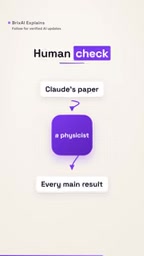
This qualification makes the nature of the achievement clear—it is a theoretical exercise, not a breakthrough that can be directly observed or applied in engineering. For discussions of AI-assisted scientific research, this candor is actually more valuable as a reference: models can generate self-consistent results within formalized problem spaces, but the correspondence between those results and the real physical world still needs to be established separately. Reducing "AI solved open problems" to "AI surpasses physicists" is a misreading of this kind of work.
Quantum gravity is a theoretical framework that attempts to unify general relativity and quantum mechanics; there is currently no experimentally verified complete theory. Many open problems in black hole physics are essentially posed within formalized models under specific simplifying assumptions (such as specific spacetime dimensions or specific matter field configurations), and their solutions are meaningful only within those models. When Anthropic says "not directly applicable to our universe," it means precisely that these results depend on the theoretical model's setup rather than being a direct description of the real physical world. Distinguishing between "self-consistent within a formalized model" and "valid in the real universe" is a basic prerequisite for evaluating this kind of AI-assisted research.
How to View This Kind of AI-Assisted Research
Taken together, the video's information offers at least three observations. First, AI's role in open problems is more like an efficient candidate generator and computation executor than a final arbiter. Second, long background runs and self-consistency verification constitute key parts of the workflow; a single answer is insufficient to support a conclusion. Third, the researchers' self-qualification indicates that the results have limited scope of applicability, and evaluation should distinguish between "formal solution" and "physical discovery."
For readers interested in AI for Science, what is more worth tracking is whether such workflows can be reproduced, whether verification criteria can be made public, and what the physicists' specific review conclusions were. The short video provides clues, but the full paper's details are what's needed for judgment.
One-line Summary
Claude took part in solving two open problems in black hole physics, demonstrating a collaborative workflow of AI bulk candidate generation and human validation.
Paragraph Summary
A short YouTube video revealed that Anthropic documented in a paper Claude's involvement in solving two open problems in black hole physics. After researcher Hong Bin Chen posed the problems, Claude produced 22 candidate solutions within hours, and an agent then ran in the background for about six weeks to deepen and verify them; the paper was written by Claude and reviewed by physicists. The first problem's conclusion is that the transition from hot gas to black hole is abrupt in both cases; for the second problem, the lower mass limit of the lightest black hole is approximately 9.1266 in the simplest version, with bootstrap results verified at the linear level. Anthropic self-qualified that the results do not directly apply to our universe. The article argues that the real value of this case lies in demonstrating a human-AI collaborative workflow—candidate generation, long background computation, self-consistency verification, and human review—rather than in declaring that AI has solved physics problems.
Related articles

Claude Solves Two Major Black Hole Physics Problems, Ushering in a New Era of AI Research Collaboration
Anthropic's Claude solved two open problems in black hole physics: a 2003 unfinished phase transition calculation and a black hole mass bound since 2009. AI as a research collaborator, using holographic duality and the modular bootstrap, with results awaiting peer review.

Claude Solves Two Major Black Hole Theory Problems: A New Milestone in AI Scientific Research
Anthropic announced Claude solved two open black hole theory problems: the weak-coupling sign of the Hawking-Page transition and the exact limit of modular bootstrap. This article details the background, Claude's solutions, verification controversies, and limitations, exploring AI's breakthrough and boundaries in theoretical physics.
Claude Derives Black Hole Bound of 9.1266 — Who Verified the AI Physics Result?
Claude derives an exact closed-form modular bootstrap bound, pinning the black hole threshold at c/9.1266, and completes a three-loop Hawking-Page calculation. But verification has flaws: Lean formalization scope is undefined, key conclusions rest on a single sign, and there is no peer review. This article dissects the verifiability and limits of the AI physics results.