GPT-6 Designs Proteins Autonomously; SenseTime Open-Sources Self-Correcting Image Model
GPT-6 designs proteins via reasoning but trails in wet lab hit rate; SenseTime open-sources self-correcting 8B image model; LM Arena reshuffles; AI stocks under pressure again.
OpenAI's preprint shows GPT-6 designs proteins using only reasoning and general code tools, with 35 of 322 designs confirmed binding (10.9% hit rate), below RF Diffusion's 19%; it leads on MotiveBench at 43.7% but 3D structure prediction remains weak. SenseTime open-sources 8B Sansnova U1.6, the first U-series model with native image self-correction, boosting Ultra Text Bench from 86.04 to 92.0. LM Arena's top three were swept by one company; Neon debuted second on the Agent leaderboard at 53% lower cost than Opus 5.5. AI stocks rebounded for just one day, and short bets on AI cloud providers rose to about $11 billion. Domestically, China Electronics Cloud raised 990 million yuan in Series B, and Kuxinwei Electronics passed the HKEX hearing.
A preprint published by OpenAI gives the old question of "can general-purpose models replace specialized scientific models" a new empirical test case. Meanwhile, SenseTime has open-sourced an 8B image model with native self-correction capability, the LM Arena leaderboard landscape has shifted, and AI concept stocks came under pressure again after a brief rebound. Here is a breakdown along three lines: technology, products, and markets.
OpenAI: GPT-6 Designs Proteins via Reasoning, but Hit Rate Still Trails Specialized Models
According to a preprint released by OpenAI on November 24, the GPT-6 series can complete protein structure design without calling any specialized biological models, relying solely on reasoning capability and general-purpose code tools. In the first round of experiments targeting 5 targets, 35 of 322 designs were confirmed to bind in the lab, a hit rate of 10.9%.
The sequence redesign data is even more noteworthy: 128 of 182 nanobody sequences bound, and 179 of 272 antibody fragments retained binding ability. This shows that general-purpose models perform noticeably better on tasks like "rewriting existing sequences while preserving function" than on de novo design.
At the computational evaluation level, 43.7% of designs on MotiveBench simultaneously met structural and shape requirements, higher than RF Diffusion's 27.8%. But OpenAI also acknowledged two weaknesses: 3D structure prediction remains a weak point, and the actual experimental hit rate is lower than the 19% reported in the RF Diffusion paper. In other words, general reasoning models can lead on computational metrics, but when it comes to wet lab experiments, specialized models still have the edge.
The significance of this approach is not "yet another model that can do biology," but rather validating a possibility: decomposing protein design into general reasoning and code execution problems, letting the model write scripts, call tools, and iterate on solutions on its own. It lowers the barrier to building biological design capabilities, but also shifts evaluation pressure to the experimental validation stage—you can pile up design numbers, but hit rate is the hard metric.
RF Diffusion is a protein design-specific diffusion model released by the Baker Lab in 2023, full name RoseTTAFold Diffusion, trained on the RoseTTAFold structure prediction network, capable of directly generating protein backbones and sequences that satisfy specific functions from noise. It represents the "specialized scientific model" route: models specially trained on massive structural data, with outputs naturally conforming to physical constraints, thus typically having an advantage in wet lab hit rates. This article uses it as a comparison baseline for GPT-6 precisely to illustrate that general reasoning models can lead on computational metrics but still struggle to surpass domain-specific models in real experimental settings.
Wet lab refers to the stage of actually synthesizing and testing molecules on the bench (e.g., protein expression, binding affinity assays), as opposed to dry lab (pure computational simulation). The "hit rate" that appears repeatedly in the article refers to the ratio of designed sequences that, upon wet lab validation, indeed possess the target function. Computational evaluation (such as structure scoring, shape matching) is low-cost and can be scaled in batch, but only wet lab can confirm whether a design is truly usable, making it the final arbiter that separates general models from specialized ones.
SenseTime Open-Sources Sansnova U1.6: First 8B Model with Native Image Self-Correction
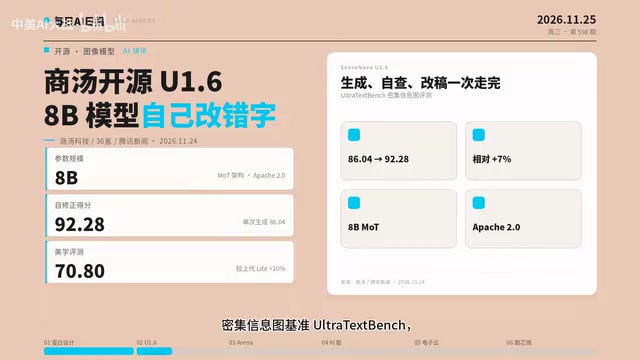
SenseTime released and open-sourced Sansnova U1.6 on November 24, with 8B parameters, MOT architecture, and Apache 2.0 license. For the first time, it adds native image self-correction capability to the U-series open-source models: it first outputs a draft, then checks against the prompt item by item for typos, garbled text, and numbering misalignment, and provides a corrected version within the same round.
On the dense infographic benchmark Ultra Text Bench, single-generation score is 86.04, rising to 92.0 with self-correction enabled, a relative improvement of about 7%. Internal aesthetic evaluation scores 70.80, about 10% higher than the previous Lite generation. Horizontally, it has surpassed Minimax H3 Image and Quan Image 3.0, but still has a notable gap to GPT Image 2's 99.42.
Weights are open-sourced on GitHub, Hugging Face, and ModelScope, and the Lite version is already integrated into Xiaohuanxiong and Comfy UI. For content creators and design workflows, the "generate, self-check, then revise" pattern is more practical than simply improving single-generation quality—dense text images have always been a pain point for image models, and self-correction targets precisely these high-frequency rework scenarios.
Native self-correction means the model, after generating an image, does not rely on external tools or human intervention, but checks against the prompt item by item (typos, garbled text, numbering misalignment) within the same inference process and directly outputs a corrected version. It differs from the traditional "generate first, then manually rework" workflow, and also differs from stitching solutions that call external OCR or editing models, because both checking and correction are done by the same model, resulting in lower latency and engineering complexity. For dense-text infographics, this pattern directly targets high-frequency rework scenarios, improving usability rather than the absolute quality of single generation.
LM Arena Landscape Shifts: One Company Sweeps Top Three, Neon Debuts
The LM Arena text leaderboard has been fermenting over the past two days, with the top three being swept by the same company for the first time. Gemini 4 Carbon leads with 1527 points, Argon is second with 1520, and newly listed Neon is third with 1513. Meta's Muse Wonder is pushed to fourth, and Cloud Opus 5.5 drops to fifth. Just two months ago, the top six on this leaderboard were all Cloud.
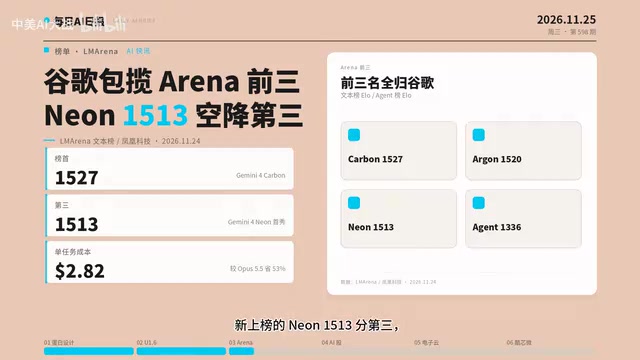
On the Agent leaderboard, Neon debuts at second with 1336 points, one point above third-place Opus 5.5. Even more striking are the cost data: median cost per task run is only $2.82, 53% cheaper than Opus 5.5; Cursor Bench 4.1 scores 60%, higher than Opus 5.5's 58.1%. Performance close while cost halved—such combinations often change developer choices more than leaderboard rankings alone.
The frequency of leaderboard reshuffling is accelerating; two months is enough to rearrange the top six. For users, the window for model selection is getting shorter, and the hidden cost of locking into a single vendor is rising.
LM Arena (formerly Chatbot Arena) is a crowdsourced blind-test leaderboard maintained by the LMArena team. Users vote on responses from two anonymous models, and Bradley-Terry models convert win rates into Elo-style scores, so scores reflect human preferences rather than standard benchmark results. It has multiple sub-leaderboards including text and Agent, and the "median cost per task" in the article comes from the cost statistics attached to the Agent leaderboard. Since votes come from real users and models can be added at any time, the leaderboard reshuffles quickly, and rearranging the top six in two months is not uncommon—this is also the basis for the article's reminder that "the hidden cost of locking into a single vendor is rising."
Capital Markets: AI Stock Rebound Lasts Only One Day, Short Bets Heat Up
In US stocks on November 24, the AI stock rebound lasted only one day. Nvidia had surged 31.48% the previous day, adding about $952 billion in market cap, but closed down nearly 6% that day; newly IPO'd Enthropic fell over 6%, breaking below its $83 issue price to around $79 at its lowest, with market cap falling back to about $1.03 trillion. Micron fell 11%, AMD fell nearly 9%, Broadcom fell 10%, Oracle and Netcom dropped about 4%, and the Nasdaq fell 1.48%.
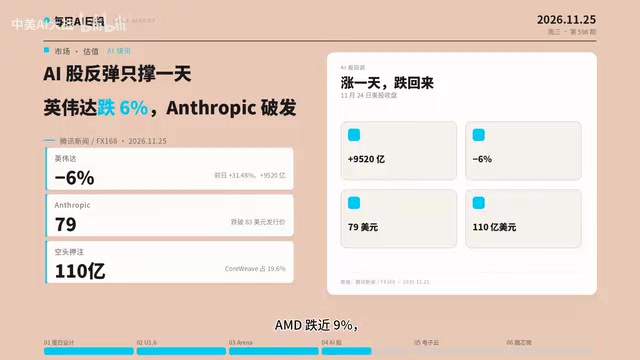
On the same day, short bets against AI cloud providers rose to about $11 billion, with CoreWeb being shorted $3.6 billion, accounting for 19.6% of float. Jensen Huang apologized at his first all-hands meeting after returning and said Nvidia doesn't need a succession plan. Market cap volatility and short interest scale expanding in tandem shows that market分歧 over AI infrastructure valuation is becoming public.
Short interest as % of float refers to the proportion of shorted shares to float, a common metric for measuring the concentration of short bets. In the article, CoreWeb being shorted $3.6 billion, accounting for 19.6% of float, is a fairly high level, typically meaning that funds are explicitly betting on its stock price falling. The simultaneous expansion of short interest and market cap volatility reflects the public divergence in market views on AI infrastructure valuation: bulls see long-term growth in computing demand, while bears question whether current pricing has already front-run expectations, with both sides clashing head-on over the same targets.
Domestic Developments: Dedicated Cloud Financing and Edge Chip Passes Hearing
On November 24, China Electronics Cloud completed a 990 million yuan Series B financing, led by the National Industrial Investment Fund Phase II, with funds directed toward R&D and business expansion of dedicated AI cloud. This financing comes at a node when computing power investment is being repriced: on the same day, the US AI sector fell again, but domestic intelligent computing centers and dedicated cloud construction have not stopped, and government and enterprise customers are treating dedicated cloud as the main entry point for LLM deployment. This is also the backdrop against which this round of financing is viewed favorably.

On the edge side, AI and wireless communication chip company Kuxinwei Electronics passed the Hong Kong Stock Exchange listing hearing. Prospectus data shows revenue grew from 105 million yuan in 2023 to 498 million yuan in 2025, a compound annual growth of about 118%, gross margin rose from 11.2% to 44.2%, and adjusted net profit in 2025 was 70.41 million yuan, achieving a turnaround. Its SoC for AR and AI glasses consumes about 250 milliwatts, lower than the industry average of 300 to 600 milliwatts, and sales of such chips grew 1.7x year-over-year in 2025. Edge low power and cloud dedicatedization are becoming two parallel paths for domestic AI hardware deployment.
Observation: The Boundaries of General Capability Become Visible at the Bench
Looking at today's news together, a common thread is "general capabilities penetrating specialized domains, but the validation stage determines success." GPT-6's protein design surpasses specialized models on computational evaluation but lags in wet lab hit rate; Sansnova U1.6's self-correction improves the usability of dense text images but still has a gap to the leaders; Neon approaches the top of the Agent leaderboard by cost rather than absolute performance. Capabilities are expanding quickly, but what truly determines deployment are the unglamorous stages: experiments, rework, and cost.
One-line Summary
GPT-6 designs proteins via reasoning but trails in wet lab hit rate, SenseTime open-sources 8B self-correcting image model, LM Arena reshuffles, AI stocks under pressure again.
Paragraph Summary
An OpenAI preprint shows GPT-6 can design proteins without specialized biological models, relying solely on reasoning and general code tools; 35 of 322 designs were confirmed to bind in the lab, a 10.9% hit rate, below the 19% reported in the RF Diffusion paper; it leads on MotiveBench at 43.7% but 3D structure prediction remains weak. SenseTime open-sources 8B Sansnova U1.6, the first U-series model with native image self-correction, improving Ultra Text Bench from 86.04 to 92.0. LM Arena's text top three were swept by one company for the first time, and newly listed Neon debuted second on the Agent leaderboard with per-task cost 53% lower than Opus 5.5. In capital markets, the AI stock rebound lasted only one day, Nvidia gave back its surge, and short bets against AI cloud providers rose to about $11 billion. Domestically, China Electronics Cloud completed a 990 million yuan Series B, and Kuxinwei Electronics passed the HKEX hearing.
Related articles
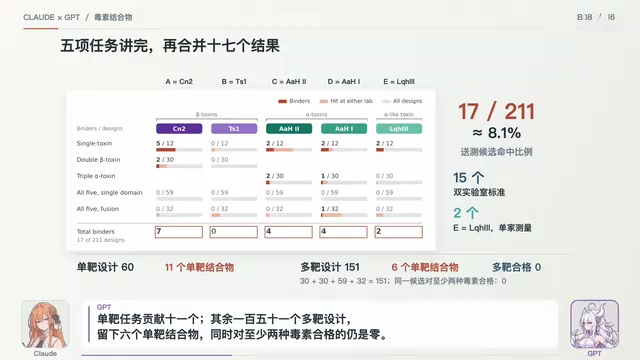
Claude Designs Scorpion Venom-Neutralizing Proteins: With 17 Binders, How Far Are We From an Antidote?
Anthropic's Claude helped design scorpion venom-neutralizing proteins: only 17 of 211 candidates passed, multi-target coverage failed, and channel function and animal testing remain absent.
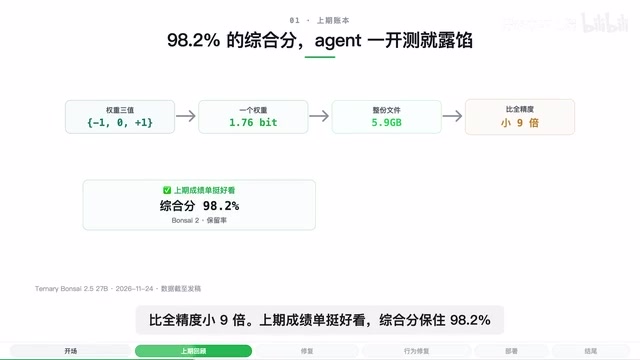
Fitting a 27B Model into 5.9GB: Ternary Bonsai 2.5 Fixes Its Agent Weaknesses
Prism ML releases Ternary Bonsai 2.5: a 27B model in just 5.9GB, with ternary quantization compressing weights to 1.76 bits. The new version focuses on fixing Agent capabilities, raising Tao3Bench Verify to 75.6 and Upworld from 51.2 to 90.5, hitting 291 tokens/s on a single A700, open-sourced under Apache 2.0.

GPT-6-Designed Proteins Validated in Lab; ERNIE 5.5 Preview Open-Sourced
GPT-6 designed proteins using reasoning and code alone, with lab binding evidence across five targets; Baidu open-sourced ERNIE 5.5 Flash Preview under Apache 2.0 with 280B parameters and 1M context.