Claude Desktop Gets a Built-in Browser as AI Agents Level Up Across the Board
Claude Desktop gains a built-in browser as AI agents advance across software, hardware, and commercial fronts.
Anthropic launched a sandboxed built-in browser for Claude Desktop, enabling autonomous web operations. NVIDIA began mass-shipping Vera, its first agent-optimized CPU. Alibaba Cloud cut Qwen3 Flash pricing, Microsoft launched Azure DevOps Remote MCP, and Anthropic published the MHS hardware interoperability standard. Tencent demonstrated near-lossless 87% model compression, while MiniMax's $800M ARR validated enterprise agent demand. AI is rapidly shifting from conversational tools to autonomous agents.
Over the past 24 hours, the AI world saw a flurry of major updates: Anthropic launched a built-in browser for Claude Desktop, NVIDIA began mass-shipping its first agent-optimized CPU, and breakthroughs emerged in model compression and hardware interoperability standards. These developments share a common thread — AI is rapidly evolving from "conversational generation" to the era of autonomous "Agents" capable of independent execution. This article breaks down and analyzes these key developments.
Claude Desktop's Built-in Browser: A Critical Leap in Agent Capabilities
Anthropic officially launched a built-in browser feature for Claude Desktop today. The core value of this upgrade: Claude can now autonomously perform web navigation, form filling, element extraction, and dynamic data parsing within an isolated, sandboxed browser — no longer requiring users to manually click through authorization prompts at every step.
Sandboxing is a security mechanism that runs programs in an isolated environment, originally popularized in browser security (such as Chrome's multi-process sandbox architecture). In an AI Agent context, a sandboxed browser means Claude's web operations are confined to a virtual environment isolated from the user's main system — even if the automation process exhibits abnormal behavior, it won't directly affect the host operating system's files, credentials, or processes. This shares the same philosophy as traditional headless browser automation tools like Playwright and Puppeteer, but with a crucial difference: traditional tools require developers to write precise DOM selectors and operational scripts, whereas Claude's built-in browser is driven by the large model's semantic understanding, enabling it to handle scenarios like page structure changes and dynamic loading that would typically break traditional scripts.
For developers who regularly perform web automation testing, competitive intelligence monitoring, or cross-site data entry, this means previously tedious multi-step operations can now be bundled into a seamless automated workflow. The old inefficient pattern of "click one step, authorize one step" has been fundamentally transformed.
That said, there's an important security boundary that cannot be overlooked. Operations involving financial payments and high-privilege accounts should still undergo manual review and confirmation. While sandboxing isolates the execution environment, semantic misjudgments in automated workflows could lead to irreversible actions. Between control and efficiency, Anthropic's default answer is: retain human control at critical checkpoints.
The Evolution from Coding Assistant to Web Agent
Here's an interesting detail: this feature continues Anthropic's consistent approach to Agent capabilities — enabling the model not just to "understand" tasks but to "operate" in real environments. The built-in browser essentially gives Claude a pair of "hands" to interact with the web, marking an expansion of desktop AI's operational radius from code editors to the entire internet.
LLM Cost Reductions and Developer Ecosystem Protocol Progress
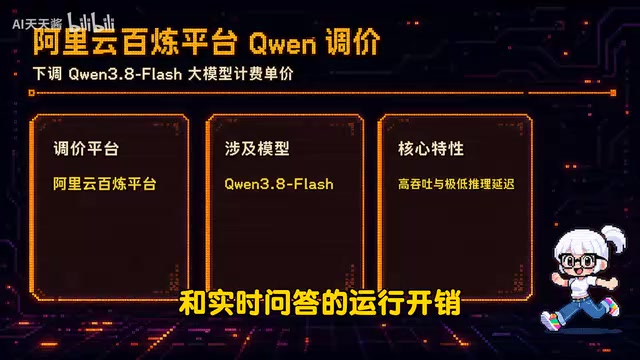
On the model pricing front, Alibaba Cloud today announced an official reduction in API pricing for Qwen3 lightweight models (Flash series) on its Bailian platform. Qwen3 is the third generation of Alibaba Cloud's Tongyi Qianwen large language model series, with the Flash series specifically designed for high-throughput, low-latency online inference scenarios. It typically uses smaller parameter sizes combined with inference optimization techniques (such as KV Cache quantization, speculative decoding, etc.) to dramatically reduce per-inference compute costs while maintaining core capabilities. As the go-to lightweight model for high throughput and low latency, this price cut directly lowers operational costs for high-concurrency, agent invocation, and real-time Q&A use cases.
Notably, in agent scenarios, a single complex task may require dozens or even hundreds of consecutive inference calls (including task planning, tool selection, result verification, etc.), so changes in lightweight model pricing get amplified tenfold in the final bill. This is precisely why the Flash series price cut has a far greater practical impact on Agent developers than on regular conversational use case users.
For developer teams building automated customer service, processing massive document batches, or consuming tokens at high frequency, this price reduction tangibly alleviates monthly billing pressure. Especially for latency-sensitive, budget-constrained engineering projects, now is the right time to test the new pricing.
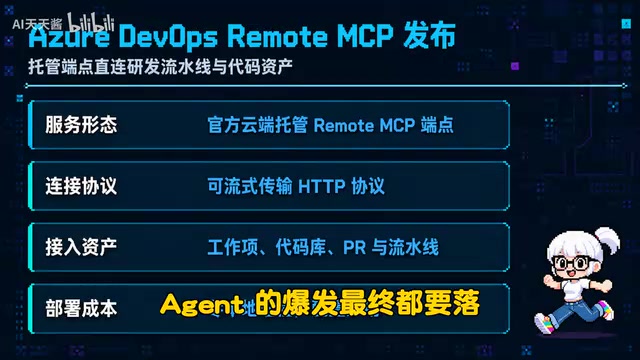
Meanwhile, Microsoft officially launched the Azure DevOps Remote MCP managed server. MCP (Model Context Protocol) is an open standard proposed by Anthropic in late 2024, designed to establish a unified communication interface between AI models and external tools and data sources. Similar to how the USB protocol standardized hardware device connections, MCP aims to standardize how AI Agents invoke various tools (code repositories, databases, API services, file systems, etc.). The protocol defines core specifications for tool descriptions, parameter passing, permission declarations, and streaming responses.
Microsoft's newly launched service provides a standard cloud endpoint, allowing AI agents to securely read work items, code repositories, pull PRs, and CI/CD pipelines directly via streaming HTTP — completely eliminating the cumbersome setup of installing local daemon processes.
However, there's a subtle compatibility issue: since Microsoft's server uses the newer Streamable HTTP transport method of the MCP protocol — as opposed to the earlier stdio (standard input/output) local mode — it supports cloud deployment but introduces client compatibility challenges. Currently, Claude Desktop, Claude Code, GPT-series tools, and Cursor cannot directly connect to this remote endpoint. Only toolchains with native HTTP remote MCP support are recommended for early adoption, and full support from mainstream development environments will require subsequent patches. This also reflects the fragmentation issues that remain in the MCP ecosystem during the standard implementation phase, with different tools at varying stages of implementing protocol versions and transport layers.
Hardware Foundation: NVIDIA's Agent CPU Enters Mass Production
The agent explosion ultimately needs to be backed by underlying compute power. NVIDIA announced today that its first CPU chip specifically designed for AI agent architectures — Vera — has officially entered mass production and delivery, with the first batch of systems being shipped to ecosystem partners.
Vera is NVIDIA's in-house data center CPU based on the ARM architecture, designed to achieve deep synergy with NVIDIA's own GPUs (such as the Blackwell series), forming a complete CPU-GPU heterogeneous computing platform. This signals an important shift: hardware vendors are moving beyond solely pursuing training compute to specifically optimizing for agent systems that require multi-step reasoning, environment interaction, and tool invocation. On another front, OpenAI and NVIDIA also announced an expanded deep partnership, deploying approximately 2 million additional GPUs and next-generation infrastructure, with a focus on supporting the high-frequency computation and logic routing demands of Agents and reasoning intelligence.
Agent workloads are fundamentally different from traditional training workloads. Training workloads involve highly parallel, sustained matrix operations with extreme demands on GPU peak throughput. Agent inference workloads, by contrast, are a hybrid of multi-step serial decision-making and parallel tool invocation — after each inference step, the CPU side may need to perform logic routing (deciding which tool to call next), context management (maintaining multi-turn interaction state), and security validation (checking operation permissions). These tasks place higher demands on CPU single-thread performance, memory bandwidth, and I/O latency. CPU/GPU co-designed architectures built specifically for these scenarios will directly accelerate the commercial deployment of complex engineering agents.
Physical World Connection: MHS Hardware Standard and On-Device Model Compression
Agents don't just control software — they also need to reach physical devices. Anthropic, in collaboration with leading research institutions, published a research preview of the Model Hardware Standard (MHS). This standard aims to provide a unified interaction specification for AI agents to safely take over physical devices, enabling agents to orchestrate complex scientific and industrial equipment such as microscopes, automated pipettes, and robotic arms in parallel.
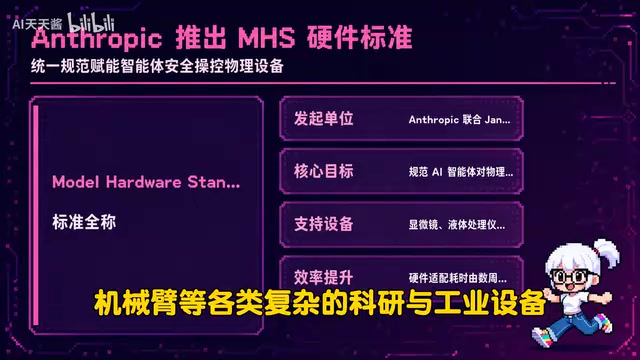
The core problem MHS seeks to solve is the extreme fragmentation of physical device control interfaces. Microscopes, pipettes, and robotic arms from different manufacturers each use proprietary communication protocols (such as SCPI, Modbus, ROS, etc.), and even different models from the same manufacturer may have incompatible interfaces. The traditional approach is to write dedicated drivers and control scripts for each device, requiring engineers to master both device protocols and business logic simultaneously. MHS's design philosophy is to build an abstraction layer on top of devices' native control protocols, using standardized semantic descriptions to define device functions, parameter ranges, and safety constraints, enabling AI Agents to understand and control different devices through a unified interface. Notably, unlike software API standardization, physical device operations involve real-world irreversible consequences (such as robotic arm collisions or reagent mismatches), so MHS's safety verification and operation confirmation mechanisms are far more complex than those for software APIs.
Previously, building a hardware integration system often took engineers weeks or even months writing custom drivers; under the MHS specification, this adaptation cycle could be shortened to minutes. For research laboratories and advanced manufacturing, the barrier between the physical world and large models is truly being broken down.
On the edge computing front, a Tencent-affiliated team demonstrated an ultra-low-bit translation model compression approach, successfully compressing a 3.3GB model down to just 440MB — a compression ratio approaching 87%. Most impressively, in multilingual translation quality benchmarks, the model's BLEU scores showed virtually no visible degradation, achieving near-lossless compression.
BLEU (Bilingual Evaluation Understudy) is the most classic automated evaluation metric in machine translation, quantifying translation quality by calculating the n-gram overlap between machine translation output and human reference translations, with scores ranging from 0-100 (higher is better). The "ultra-low-bit compression" technique used by the Tencent team falls under model quantization — compressing model weights from the standard 16-bit or 32-bit floating point to extremely low bit widths (such as 2-3 bits), dramatically reducing model size and memory footprint. Compressing from 3.3GB to 440MB means each parameter is represented by approximately 1.5-2 bits on average, which is technically extremely challenging since excessively low bit widths typically cause severe accuracy loss. Achieving near-lossless compression typically relies on a combination of mixed-precision strategies (retaining higher bit widths for sensitive layers), calibration dataset optimization, and quantization-aware training.
This means smaller, lower-power edge devices can now run high-quality offline real-time translation smoothly. For professionals working overseas who prioritize data privacy and need to operate in offline environments, as well as mobile developers, this lightweight technology is well worth watching.
AI Coding Toolchain Upgrades and Commercial Validation
In the programming domain, Alibaba officially released a new tool, evolving it from a simple code completion assistant into a full-lifecycle agent workstation. The new version features enhanced multi-agent collaborative architecture, with capabilities for whole-project code comprehension, automatic task decomposition, and automated debugging and execution.

This marks AI coding's transition from "single-point code generation" to "full-project autonomous orchestration." Multi-agent collaboration means the system doesn't rely on a single model to handle all tasks; instead, different responsibilities (such as requirements analysis, code generation, test writing, and bug fixing) are assigned to multiple specialized Agents that coordinate through structured message passing, each contributing in their area of expertise. For full-stack developers and engineering teams, AI is no longer just completing the next line of code — it's becoming a collaborative partner that understands the entire project structure and drives feature development end-to-end.
Commercial Scorecard: MiniMax Revenue Validates the Agent Trend
Finally, here's a compelling set of commercial data. Chinese LLM unicorn MiniMax released its mid-2026 performance: Annual Recurring Revenue (ARR) has officially surpassed $800 million, with enterprise and developer business contributing over 80% of that figure, representing a year-over-year growth rate of 703%. The company also disclosed that July's token consumption was 20 times that of January.
ARR (Annual Recurring Revenue) is the core metric for measuring commercial health in the SaaS and cloud services industry, representing the expected revenue over the next 12 months based on current subscription contracts. Unlike one-time revenue, ARR reflects sustainable, predictable revenue capacity. MiniMax's ARR surpassing $800 million with over 80% from B2B means that LLM companies are escaping the early trap of relying on C2C applications (like chatbots and AI social products) to acquire users without clear monetization, and are instead establishing stable revenue streams through API usage billing and enterprise deployment subscriptions. The correlation between 703% YoY growth and the 20x increase in token consumption also indicates that revenue growth is primarily driven by actual usage rather than pure price increases — a much healthier commercialization signal.
This data clearly shows: The center of gravity for LLM commercialization is rapidly shifting from consumer entertainment products to robust developer platforms and enterprise-grade agent infrastructure. When the vast majority of revenue comes from B2B and developers, it signals that the industry's ability to generate sustainable revenue is entering a critical validation phase.
Conclusion
Looking across these 24 hours of developments, a clear thread runs throughout: Agents are becoming the core paradigm for AI deployment. On the software side, there's Claude's built-in browser and MCP protocol standardization. On the hardware side, there's NVIDIA's dedicated CPU and the MHS physical device standard. On the cost side, there's Alibaba Cloud's price cuts and on-device model compression. On the commercial side, there's MiniMax's revenue validation. From compute infrastructure to application ecosystems, the complete stack around intelligent agents is rapidly taking shape.
Related articles
Deep Dive into Multi-Agent System Design Patterns and Common Pitfalls
In-depth analysis of multi-agent system design patterns—Orchestrator-Worker, Debate & Review, Hierarchical Delegation—and key pitfalls like error accumulation, communication costs, and state management.

Kira Community: How an AI Creation Tool Is Transforming Into a Creator Community
Kira Community pivots from an AI image/video generation tool to a creator community, using hashtags to organize content and help creators build portfolios and find peers.
DeepSeek V4 Pro Real-World Test: 7 Projects Reveal Its True Coding Ability and Value
Real-world test of DeepSeek V4 Pro across 7 projects covering frontend, backend, 3D games, and long tasks. Frontend lags behind Claude, but at 1/180th the cost.