Claude Duet Hands-On Review: The Most Proactive Personal Agent — Full Analysis of Its Strengths and Weaknesses
Anthropic's personal agent Claude Duet launches with strong proactivity but shortcomings in browser operation and skill management.
Anthropic's personal agent Claude Duet launched as a research preview and, by reusing the Claude account and a built-in 3-hour check-in mechanism, has become the most proactive personal agent out of the box. It supports standalone channels and a slash-triggered skill library, with standout skills like writing style learning, morning briefings, and email triage. Testing exposed two major gaps: no cloud browser control for CAPTCHAs and no local skill isolation. Grokbot remains the reviewer's top choice; Duet has great potential but is currently best as a Claude ecosystem supplement.
Anthropic's personal agent Claude Duet has officially launched. According to a Bilibili creator, he received early access to the beta and called it "the most proactive agent I've ever tried." Compared with existing products like Grokbot, Muse, and ChatGPT-Dots, Duet has charted its own path in terms of proactivity and task orchestration, but as a research preview, it also exposes some key shortcomings.
A Proactive Assistant That Works Out of the Box
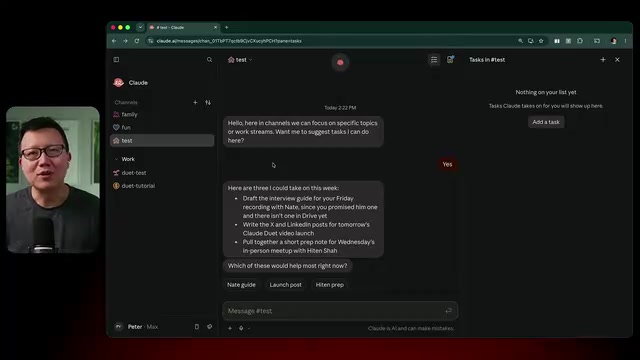
Duet has its own dedicated mobile app and standalone web interface, and Anthropic positions it as an around-the-clock work assistant. The most effortless part of the setup process is that it directly reuses the user's Claude account connection — email, calendar, and connected apps require no re-authorization. After the creator opened the app, Duet immediately read his email, calendar, and app data, got a sense of how he works, and then proactively suggested several places it could help: preparing for a sponsor call, organizing a podcast interview outline, and sorting party RSVP information.
This proactivity comes from Duet's built-in Check-in mechanism. By default, it runs every 3 hours from 9 AM to 10 PM, checking email, calendar, and connected apps for work it can complete on the user's behalf. One check-in result the creator showed read: "Good morning Peter, here's the sponsorship deal you're working on with Diana, plus a video that should go live, and you need to prepare for Nate's Friday podcast recording." In his words, it's like a chief of staff that brings things to your attention. That said, he admitted that five check-ins a day is too frequent and that he'd prefer once in the morning and once in the evening — users can simply ask Claude to change this schedule.
Research Preview is a product release format Anthropic commonly uses, referring to opening features to a small group of users before they're fully mature in order to collect real feedback, validate the product direction, and then decide whether to expand access or merge into the main product. Unlike a public beta, a research preview is typically explicitly exploratory in nature — features may be adjusted or discontinued at any time, and access often requires waiting in line or applying. Anthropic has previously used a similar approach for Claude features like Computer Use and Artifacts, and the Cowork and Chat features mentioned in this article also first tested the waters as standalone offerings before returning to the main app once validated.
Tasks, Channels, and Interface Design
Duet's interaction structure resembles Claude's Projects feature: the main chat window is the main thread, and each task is a sub-thread within it. The left navigation bar shows folders for in-progress, upcoming, scheduled, and resolved tasks. Unlike Muse and Grokbot, Duet doesn't allow customization of the main conversation interface or avatar — there's just an animated dot there, and Anthropic clearly wants to preserve its iconic brand style.
Users can create standalone channels with custom icons and colors, and the system will suggest actionable tasks within a channel based on email content. The creator believes this design serves workplace scenarios, which is why it uses icons rather than animated avatars. He also noted that making Duet a completely separate app from Claude is an interesting choice, but consistent with Anthropic's usual approach: ship a research preview, iterate continuously, and merge back into the main app once validated — the same path taken by the previous Cowork and Chat features.
Skills and Artifacts: Writing Style Learning Is the Highlight
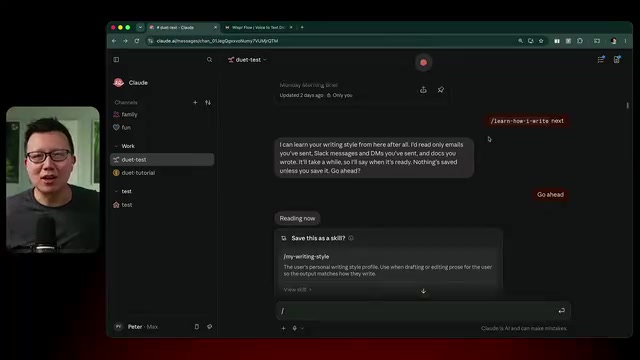
Typing a slash in Duet's input box reveals all runnable skills. The creator highlighted several:
- Morning Briefing skill: Renders the briefing into a beautifully typeset HTML artifact, continuing Claude's visual aesthetic, and flags schedule insights like "two short meetings before 9 AM, then the rest of the day is open."
- Writing Style Learning skill: After reading 33 sent emails, 9 Slack messages, 47 DMs, and 11 posts, it generates a writing guide — get straight to the point, organize requests into numbered lists, use lowercase when communicating with the team. This guide was then used to draft emails and replies.
- Email Triage skill: Prioritizes emails awaiting replies and can directly generate reply drafts. The creator emphasized that he still reviews important emails himself and can edit and adjust before sending.
- YouTube Channel Analysis Report: Reads a full year of public video data and generates insights on subscriber counts, video counts, breakout directions, and performance charts sorted by publish date. The creator discovered that his solo videos perform noticeably better than podcast videos.
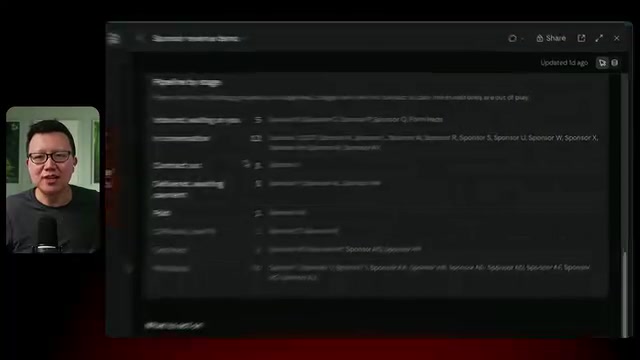
- Sponsorship Revenue Dashboard: Built with mock data, breaking down revenue by sponsor, tracking negotiations, signed contracts, and even setting up scheduled tasks to auto-update weekly or push via email.
He also built an AI exploration club with his kid using Duet, including robot companions, animated text, and an adventure-path curriculum. He admitted the content was too text-heavy for children, but that Claude could be further prompted to improve the visuals.
Skill in the agent context refers to a pre-packaged, callable capability module — akin to a "plugin" or "shortcut" installed on an agent. Users trigger specific skills via slash commands, and the agent then invokes the corresponding tools, reads data, and produces results. Duet's skill system is in the same lineage as Anthropic's previously proposed Agent Skills concept: skills are organized as folders containing instructions, scripts, and resources that the model can load on demand. This design lets the agent avoid cramming all capabilities into one giant prompt, instead dynamically composing them by scenario — reducing context overhead while making it easy for users to extend and reuse.
Two Obvious Shortcomings
The creator candidly tested failure scenarios. He asked Duet to book a ride through the built-in Uber skill; after asking for the pickup location and time, Duet got stuck on the Uber page's CAPTCHA — it couldn't click through the verification. The user had to open the cloud browser and handle it manually, and currently Duet doesn't support viewing or interacting with the browser interface. The product manager said this feature is being developed at full speed and will launch soon.
Another issue is that the skills library directly shows all skills installed on the user's local computer, and there's no way to cleanly isolate personal skills or add them to the cloud environment. The creator considers these two shortcomings — inability to operate the cloud browser and inability to manage local skills — to be the most obvious gaps at present.
CAPTCHA is a security mechanism websites use to distinguish real users from automated programs, commonly in the form of clicking a checkbox, identifying text or objects in images, or completing a slider puzzle. For agents, this is a structural obstacle: CAPTCHAs are designed to block non-human operation, so even if an agent can control a browser, it often can't pass verification. Duet getting stuck on the Uber page's CAPTCHA reflects exactly this contradiction — the agent can complete the information gathering before placing an order, but gets blocked by a security mechanism at the final step, requiring the user to take over manually. This is also a common challenge facing all browser-operating agents today.
Side-by-Side Comparison: Grokbot Still Leads, Duet Has the Most Potential
The creator evaluated each agent as if it were an employee. His conclusion: Grokbot is still his favorite agent — free access to X for market research is great, but its email functionality is poor, it won't respond when @-mentioned in email, and it's no longer free. Muse has excellent design, and its killer feature is making phone calls to businesses on the user's behalf — like contacting a tree removal service or negotiating cable TV bills — but it doesn't use top-tier models like Opus or Astra. ChatGPT-Dots lives inside ChatGPT and can call native capabilities like image generation, but had many bugs and was slow early on, making it less practical than simply using the chief-of-staff features directly in ChatGPT.

Duet's advantages are that it's the most proactive out of the box, has high product maturity, and carries the Claude aesthetic — plus Claude itself is the creator's primary framework and model, storing a wealth of memories about his work habits. He predicts Anthropic will continue to improve Duet and eventually integrate it into the main Claude app, covering desktop, web, and mobile. Duet is currently available as a research preview, with Pro and Max subscribers needing to wait in line.
For users following the personal agent space, Duet is worth queuing up for, but in the short term it's better suited as a supplement to the Claude ecosystem rather than a replacement for existing workflows like Grokbot.
Opus and Astra are shorthand for flagship models from Anthropic and another vendor, respectively. Opus is the most capable model tier in the Claude series, aimed at complex reasoning tasks, forming a gradient from strong to fast alongside Sonnet and Haiku. The mention that Muse "doesn't use top-tier models like Opus or Astra" means its underlying model capability is below the first tier, potentially limiting performance on tasks requiring deep reasoning or multi-step planning. Model capability directly determines an agent's task orchestration ceiling, making this a key product-tiering dimension in side-by-side comparisons.
One-line Summary
Anthropic's personal agent Claude Duet launches with strong proactivity but shortcomings in browser operation and skill management.
Paragraph Summary
Anthropic's personal agent Claude Duet launched as a research preview and, by reusing the Claude account and a built-in check-in mechanism running every 3 hours, has become the most proactive personal agent out of the box. It uses a main chat plus task sub-thread interaction structure, supports standalone channels and a slash-triggered skill library, and shines with skills like writing style learning, morning briefings, and email triage. But testing also exposed two major shortcomings: inability to operate the cloud browser to complete CAPTCHAs, and inability to isolate and manage locally installed skills. In side-by-side comparisons, Grokbot remains the reviewer's top choice; Duet has high product maturity and great potential, but in the short term is better suited as a supplement to the Claude ecosystem.
Related articles

OneMemory 1.4.2 Released: A Self-Hosted Shared Memory Tool Built for AI Agents
OneMemory 1.4.2 released: a self-hosted shared memory server supporting MCP and REST, with writer tracking, distrusted list, offline command queuing, and safer upgrade backups. Ideal for individual developers and AI agents.

How Can RAG Debugging Knowledge Be Retained? The Knowledge Management Pain of AI Teams
How can AI teams effectively retain and reuse knowledge from RAG debugging and audits? This article analyzes three current knowledge management modes and their pain points, and explores the technical feasibility and business challenges of an evidence-supported case memory system.

Reactive Optimizers: Rewriting Optimizer Source Code During Training — A New Paradigm for Performance Gains
Reactive Optimizers dynamically rewrites optimizer source code during training for code-level adaptivity. This article explains its core mechanism, differences from meta-learning, and challenges in stability and reproducibility, and explores its potential impact on AI training frameworks.