How Can RAG Debugging Knowledge Be Retained? The Knowledge Management Pain of AI Teams

RAG debugging knowledge is scattered and hard to reuse; teams need an evidence-supported case memory system.
The article draws from a Reddit question: Where does the knowledge from RAG debugging and audits go? It summarizes three current practices—report archiving, ticketing systems, and scattered notes—each flawed in retrieval, semantic linking, or retention. The original poster proposes a private, evidence-supported case memory system with symptom similarity retrieval, root cause tracking, regression test generation, and AI-assisted comparison, emphasizing separation of AI models and evaluation engines. However, the product is still conceptual, and the real challenge is engineers' behavioral habits. The article suggests AI engineering is shifting from building models to operating systems, making knowledge asset management increasingly critical.
When the RAG Audit Ends, Where Does the Knowledge Go?
Recently, a developer raised a pointed question on Reddit: Where does the knowledge generated by AI teams during RAG (Retrieval-Augmented Generation) debugging and audits ultimately go? Each investigation reveals retrieval failures, query-level regressions, citation errors, configuration changes, failed hypotheses, and occasionally confirmed fixes. But do these lessons just end up as a report in a folder? Does the next engineer have to start investigating similar issues from scratch?
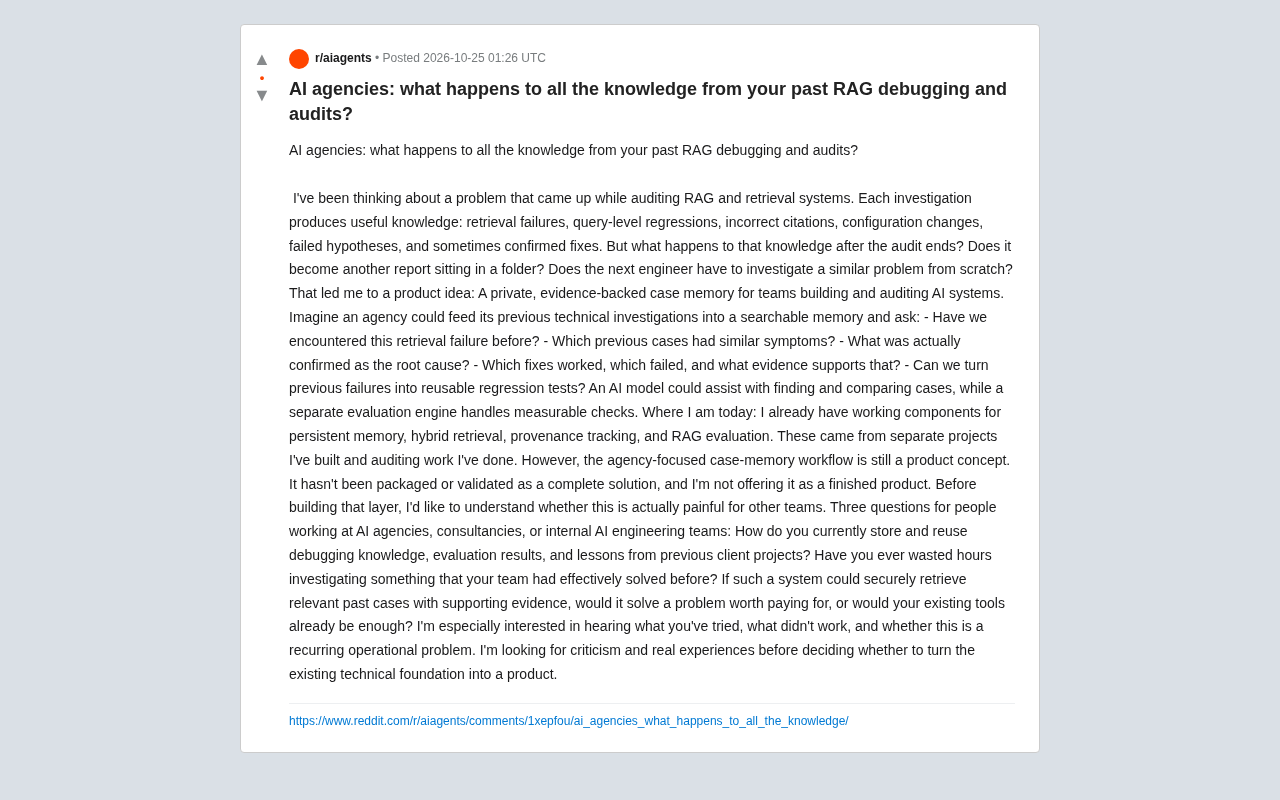
The post quickly sparked discussion because it touches on a common yet often overlooked pain point for AI engineering teams: the fragmentation and loss of debugging knowledge. As RAG systems become widespread in enterprises, how to systematically accumulate and reuse debugging experience is becoming a key bottleneck for team efficiency.
Current Practices: Three Typical Modes of Knowledge Storage
Based on the original discussion and industry observations, AI teams currently handle debugging knowledge in roughly three ways:
1. Report Archiving: Knowledge Sleeps in Folders
The most common approach is to compile each audit result into a static document and store it in a shared drive or knowledge base. This seems standard but has a fatal flaw: knowledge cannot be actively retrieved and linked. When a new problem arises, engineers struggle to quickly locate relevant historical cases from a vast number of documents, let alone confirm whether a fix actually worked.
The original poster noted that in this mode, "the next investigation often starts from zero," and the cost of repeating mistakes is extremely high.
RAG (Retrieval-Augmented Generation) is a technical architecture that combines external knowledge retrieval with large language model generation. The basic process is: after a user inputs a query, the system first retrieves relevant snippets from a vector database or document library, then passes these snippets as context to the generation model, which produces the final answer. The core value of RAG lies in mitigating the knowledge staleness and hallucination problems of large models, enabling answers to be based on the latest, private materials. But precisely because it introduces multiple stages such as retrieval, embedding, indexing, and re-ranking, system behavior is highly composite—any configuration deviation in any stage can manifest as "wrong answer," making debugging and auditing exceptionally complex. This is also the technical root cause emphasized in the article for why debugging knowledge is difficult to reuse.
2. Ticket System: Lack of Semantic Association
Some teams use ticketing tools like Jira or Linear to record problems and fixes, but ticketing systems are good at tracking task status, not at expressing semantic relationships between technical cases. For example, "retrieval failure" can be caused by many reasons—embedding model bias, index configuration errors, query rewriting logic flaws, etc. These are often only coarsely labeled in tickets, making deep reuse difficult.
An embedding model is a neural network model that maps text into dense vectors, where semantically similar texts are closer in vector space. In RAG, both document snippets and user queries are encoded by the same embedding model and then retrieved via vector similarity (e.g., cosine similarity). The choice, version, and fine-tuning state of the embedding model directly affect retrieval quality: switching to a different model changes the vector space, requiring old indexes to be rebuilt; model bias may prevent certain queries from recalling the correct documents. The "embedding model bias" mentioned in the article is a typical root cause of retrieval failure, and such root causes are often recorded in ticketing systems merely as "poor retrieval performance," losing reusable technical details.
3. Scattered Notes: Personal Experience Hard to Organize
More often, debugging knowledge is scattered across engineers' personal notes, chat logs, or even memory. Personnel turnover directly leads to knowledge loss, a problem particularly prominent during rapid expansion of AI teams.
Pain Point Validation: Repeated Investigations Waste Significant Time
The three questions raised in the original post get to the core, and the second one—"Have you ever wasted hours investigating a problem your team already solved?"—resonated strongly in the discussion.
Multiple practitioners stated that debugging RAG systems is highly context-dependent: the same symptom may correspond to different root causes, and the process of confirming the root cause often requires combining logs, evaluation metrics, and human judgment. Without structured historical case references, engineers can only re-walk the troubleshooting path.
An AI lead at a consulting firm mentioned that they once spent two days locating a retrieval regression issue in a client project, only to later discover that another team had solved a similar architecture half a year earlier, but that conclusion had never been effectively communicated. Such cross-project knowledge silos are particularly common in AI consulting firms because each client environment is independent and experience is hard to transfer.
Product Concept: Evidence-Supported Case Memory System
Based on his technical accumulation in persistent memory, hybrid retrieval, provenance tracking, and RAG evaluation, the original poster proposed a product concept: a private, evidence-supported case memory system for AI teams.
The core capabilities of this system include:
- Symptom similarity retrieval: Input a description of the current problem and return historical cases with similar symptoms
- Root cause and fix tracking: Record the confirmed root cause, attempted fixes, and their effect evidence for each case
- Regression test generation: Convert historical failure cases into reusable regression tests to prevent recurrence of similar issues
- AI-assisted comparison: AI models assist in finding and comparing cases, but quantifiable checks are handled by an independent evaluation engine to avoid conflating generation with verification
The author particularly emphasizes that separating AI models from the evaluation engine is key to the design: the former is responsible for semantic matching and case recommendation, while the latter is responsible for objective measurement. This division avoids the circular reasoning problem of "letting the model prove itself."
Hybrid retrieval refers to using both sparse retrieval (e.g., BM25 keyword matching) and dense vector retrieval simultaneously, and fusing the ranking of the two result sets. Sparse retrieval excels at exact term matching, while dense retrieval excels at semantic generalization; their complementarity can improve recall. In a case memory system, hybrid retrieval means users can search using keywords like "retrieval failure" or use a natural language description of symptoms for semantic matching. Provenance tracking records the source and modification history of each piece of knowledge or answer, making the "root cause—fix—evidence" chain auditable. These two capabilities, combined with RAG evaluation components, form the technical foundation of the system envisioned by the author, but as the original article points out, having all components does not mean the workflow is viable.
The Gap Between Technical Feasibility and Business Validation
You may not have noticed that the author explicitly states the product is still in the concept stage. His existing persistent memory, hybrid retrieval, provenance tracking, and RAG evaluation components come from previous independent projects, but the case memory workflow for organizations has not been packaged or validated.
This raises a key question: Can stacking technical components constitute real product value? From an engineering perspective, building a searchable case library is not difficult; the hard part is getting engineers willing to continuously input high-quality cases and actively query them in their actual work. The core challenge of knowledge management has never been technology, but behavioral habits.
The original poster is also aware of this, so he seeks validation before investing in development, especially wanting to know whether existing tools (such as Notion, Confluence, internal wikis) are already sufficient. This cautious attitude is commendable, but it also hints at the uncertainty of productization.
Industry Significance: AI Engineering Enters the Knowledge Management Stage
Setting aside the success or failure of a single product, this discussion reflects a broader trend: AI engineering is shifting from "building models" to "operating systems". As RAG, Agent, and other systems enter production environments, and debugging, auditing, and continuous improvement become daily work, the ability of teams to manage knowledge as an asset will directly affect delivery efficiency and quality.
For AI consulting firms and internal AI teams, establishing a lightweight, searchable, evidence-traceable case memory mechanism may be more urgent than introducing yet another new framework. Existing tools are not impossible to adapt—for example, creating structured case templates in Notion with semantic search plugins—but the integrated solution proposed in the original post does point to a real gap in demand.
Ultimately, this question is worth every AI team asking themselves: The retrieval bug we fixed last week—can anyone still find its root cause and fix evidence three months from now?
One-line Summary
RAG debugging knowledge is scattered and hard to reuse; teams urgently need an evidence-supported case memory system.
Paragraph Summary
The article is prompted by a Reddit question: Where does the knowledge generated by AI teams during RAG debugging and audits ultimately go? The author summarizes three typical current practices—report archiving, ticketing systems, and scattered notes—pointing out their respective flaws: inability to actively retrieve, lack of semantic association, and loss with personnel turnover, leading to repeated investigations of already-solved problems. The original poster then proposes a private, evidence-supported case memory system concept with capabilities such as symptom similarity retrieval, root cause and fix tracking, regression test generation, and AI-assisted comparison, emphasizing the separation of AI models and evaluation engines to avoid circular reasoning. However, the product is still in the concept stage, and the real challenge lies in engineers' behavioral habits of continuous input and querying. The article suggests this reflects AI engineering's shift from building models to operating systems, making knowledge asset management increasingly critical.
Related articles
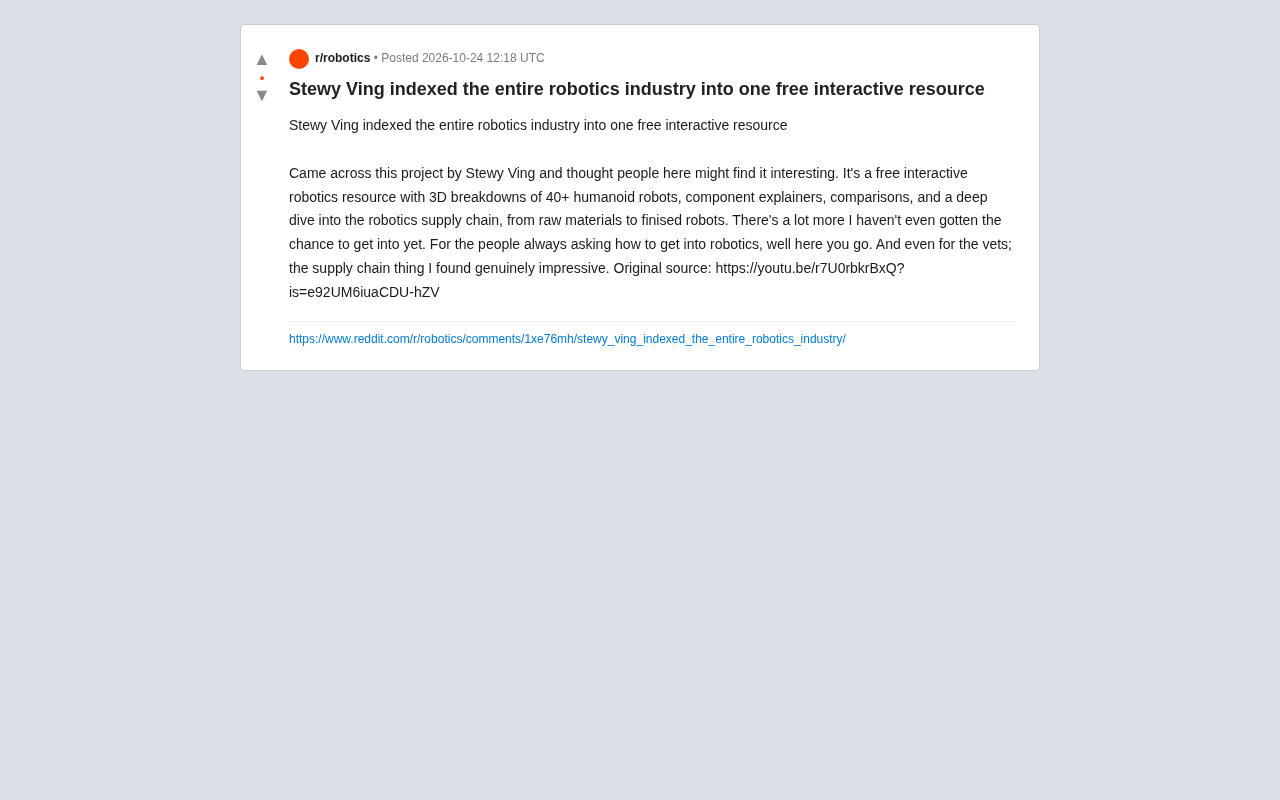
Free Interactive Resource: 3D Teardowns of 40+ Humanoid Robots and a Full Supply Chain Overview
Stewy Ving created a free interactive robotics resource featuring 3D teardowns of 40+ humanoid robots, component explanations, comparisons, and a full supply chain overview from raw materials to finished products—ideal for beginners and professionals alike.
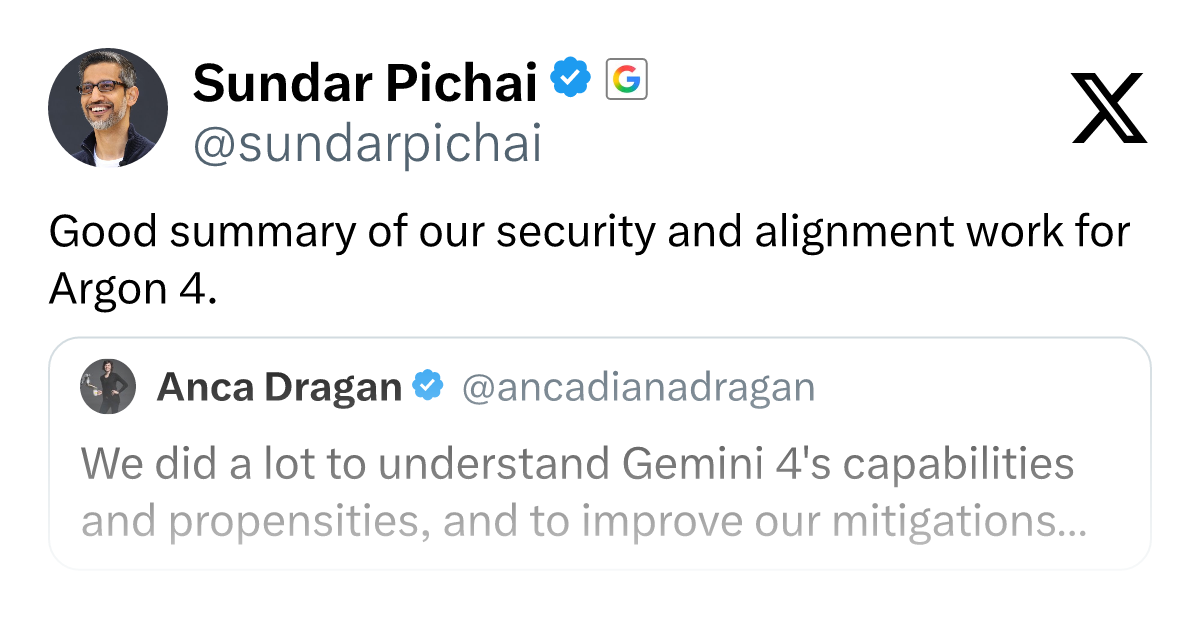
An In-Depth Analysis of Argon 4's Security and Alignment Work Summary
Based on a tweet clue, this article analyzes Argon 4's security and alignment work, discussing AI safety frameworks, alignment practices, and industry implications for readers interested in AI governance.

How Can Prompts Unlock AI Creativity? A Case Worth Watching Repeatedly
Starting from a tweet, this piece explores how prompt design unlocks LLM creativity, analyzing prompt engineering layers, model capability ceilings, and practical takeaways for content creators.