OneMemory 1.4.2 Released: A Self-Hosted Shared Memory Tool Built for AI Agents

OneMemory 1.4.2 released: a self-hosted shared memory server for AI agents, adding writer tracking, a distrusted list, and offline command queuing.
OneMemory 1.4.2 is a self-hosted, single-user shared memory server for AI agents, supporting MCP and REST interfaces, designed to solve the persistence problem of agent session context. The new version adds three key improvements based on community feedback: server-enforced recording of note writer tokens (unforgeable) with filtering by writer; administrators can mark suspicious writers as distrusted, whose notes are hidden by default and never executed as commands; and a runner-status command and command queuing mechanism for host offline scenarios. It also performs validated backups before upgrades and runs 1313 tests cross-platform. The author explicitly limits it as a personal tool, not suitable for multi-tenant or strong security isolation scenarios.
Title
OneMemory 1.4.2 Released: A Self-Hosted Shared Memory Tool Built for AI Agents
Meta Description
OneMemory 1.4.2 is out: a self-hosted shared memory server supporting MCP and REST interfaces, adding writer tracking, a distrusted list, offline command queuing, and safer upgrade backups. Ideal for individual developers and AI agent scenarios.
Article Content
The memory problem for AI agents has always been a pain point: every session starts from scratch, and context cannot persist across agents or sessions. Developer Daniel Calas released OneMemory 1.4.2 on Reddit, a self-hosted shared memory server that supports both MCP and REST interfaces, attempting to solve this problem in the lightest way possible.
What Is OneMemory
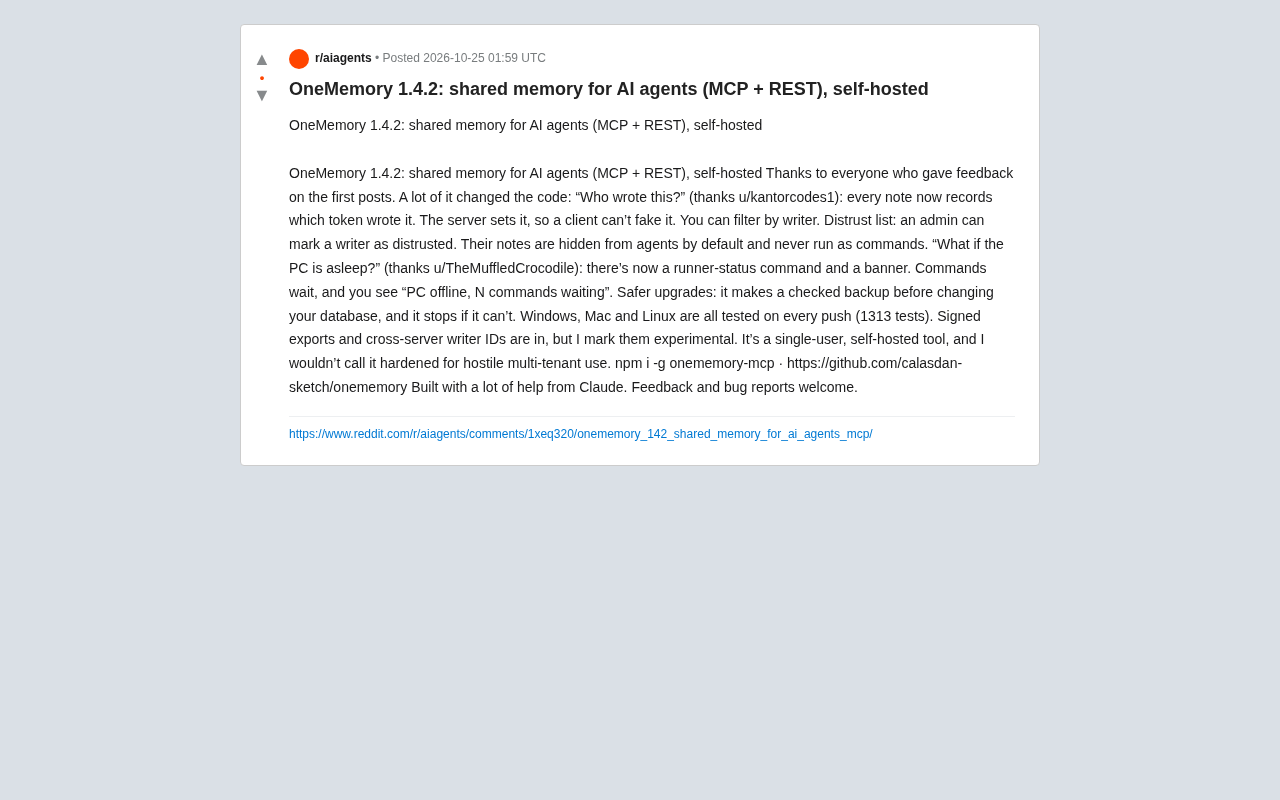
OneMemory has a clear positioning: a single-user, self-hosted shared memory layer for AI agents. It exposes capabilities through two interfaces—MCP (Model Context Protocol) and REST—allowing agents to write notes, read notes, filter by conditions, and even execute certain notes as commands. Installation is a single command: npm i -g onememory-mcp, and the project is hosted on GitHub as open source.
The author is candid about the boundaries in the post: this is a single-user tool, not suitable for hostile multi-tenant scenarios, and no security hardening has been done. This self-limitation actually makes its applicable scenarios clearer—for individual developers and small teams internally, not as enterprise-grade shared infrastructure.
Core Changes in Version 1.4.2
Most of the changes in this version came from community feedback, and the author listed item by item in the post whose opinions directly changed the code. This kind of responsiveness is uncommon in personal open-source projects.
Traceable Sources: Every Note Records Its Writer
A key previous flaw was the inability to know who wrote a note. After user kantorcodes1 raised this issue, 1.4.2 makes every note record the token that wrote it, enforced by the server so clients cannot forge it. Administrators can also filter notes by writer.
This design choice is noteworthy—writer identity is assigned by the server rather than reported by the client, meaning the trust model treats clients as untrusted. For a self-hosted tool, this is a reasonable default stance.
Distrusted List: Isolating Suspicious Sources
Building on writer tracking, administrators can mark a writer as "distrusted." Notes from marked writers are hidden from agents by default and will never be executed as commands. This effectively adds a source allow/deny list to shared memory, preventing a compromised agent from injecting instructions into the entire system.
Considering the emerging prompt injection attack surface in the AI agent field, this feature, while experimental, is headed in the right direction: memory sharing naturally expands the attack surface, and source control is a necessary mitigation.
Prompt Injection Attacks are an emerging security threat in the AI agent field: attackers embed malicious instructions in data read by agents (such as web pages, documents, or memory notes) to induce agents to perform unintended actions. In shared memory scenarios, the risk is amplified—if one agent is compromised and writes malicious notes, other agents reading that memory could be "infected." OneMemory's distrusted list mechanism targets exactly this attack surface: hiding notes from marked sources from agents and prohibiting their execution as commands, thereby blocking the spread of the injection chain. This is similar to source reputation mechanisms in traditional security, but is still early exploration in agent memory systems.
Offline State Handling: Commands Queued Rather Than Lost
User TheMuffledCrocodile raised a very practical question: "What if the PC goes to sleep?" 1.4.2 adds a runner-status command and status banner. When the host carrying command execution goes offline, commands enter a waiting queue, and the interface displays "PC offline, N commands waiting."
For a self-hosted service running on a personal computer, this problem is almost inevitable. Queuing commands rather than failing outright means the agent's automation workflow won't silently break because the host goes to sleep.
Safer Upgrades: Backup Before Changes
The new version performs a validated backup before modifying the database, and halts the upgrade process if the backup fails. Tests cover Windows, Mac, and Linux, running 1313 tests on each push. For a personal project, this test scale shows the author has invested considerable effort in cross-platform compatibility.
Experimental Features: Signed Export and Cross-Server Writer IDs
Signed export and cross-server writer IDs have entered the codebase, but the author explicitly marks them as experimental. These two features point toward multi-server collaboration scenarios, which somewhat tension with the current "single-user self-hosted" positioning—they seem more like preparation for future multi-instance deployments.
Technical Observation: Why MCP + REST Dual Interfaces Matter
MCP is an agent-tool connection protocol promoted by Anthropic and has seen practical adoption in the Claude ecosystem. OneMemory provides both MCP and REST, meaning it can be called directly by MCP-supporting clients and also used by any script or agent that can send HTTP requests. This "dual-track" design lowers the barrier to entry: there's no need to modify existing agent frameworks just to use shared memory.
The author mentions the project was "built with a lot of help from Claude." This itself is an interesting signal—a memory tool for AI agents, developed with AI assistance. This bootstrapping development model is increasingly common in today's indie developer community, but few explicitly mention it in release notes.
MCP (Model Context Protocol) is an open protocol launched by Anthropic in late 2024, aimed at standardizing how AI agents connect to external tools and data sources. It uses a client-server architecture: agents act as clients, calling tools, resources, or prompt templates exposed by servers via JSON-RPC messages. The core value of MCP is decoupling—tool providers only need to implement an MCP server once to be usable by all agent frameworks supporting the protocol, without adapting to each framework separately. Currently, Claude Desktop, Claude Code, and some open-source agent frameworks natively support MCP.
REST interfaces are a universal HTTP-style API that almost any programming language or script can call. OneMemory providing both interfaces essentially covers two types of use cases: MCP for "agent-native" integration, and REST for "scripted" or "legacy system" integration. This dual-track design is increasingly common in tool-type projects, because the MCP ecosystem is still early, and REST as a fallback ensures usability.
Applicable Scenarios and Limitations
Scenarios where OneMemory fits: individual developers wanting multiple agent sessions to share context; small teams needing a simple memory hub internally; those wanting to quickly experiment with agent memory mechanisms in a local environment.
Scenarios where it doesn't fit: multi-tenant SaaS, production environments requiring strong security isolation, systems requiring high availability. The author's own explanation has drawn this line clearly, and it should be taken seriously before use.
A detail worth mentioning: a tool's maturity depends not only on its feature list but also on how it handles exceptional paths. The improvements in 1.4.2 regarding backups, offline queuing, and unforgeable sources are exactly about shoring up exceptional paths.
Summary
The update cadence and feedback loop of OneMemory 1.4.2 are what make this project most noteworthy: the three types of issues raised by users—source attribution, offline handling, and upgrade safety—all received concrete responses within one version. For developers wanting to add a shared memory layer to AI agents, this is a self-hosted solution worth trying, but please use it with the expectation of a "personal tool" rather than "infrastructure."
One-line Summary
OneMemory 1.4.2 released: a self-hosted shared memory server for AI agents, adding writer tracking, a distrusted list, and offline command queuing.
Paragraph Summary
OneMemory 1.4.2 is a self-hosted, single-user shared memory server for AI agents, supporting both MCP and REST interfaces, designed to solve the problem of agent session context not persisting. The new version adds three key improvements based on community feedback: server-enforced recording of note writer tokens (unforgeable) with filtering by writer; administrators can mark suspicious writers as distrusted, whose notes are hidden by default and never executed as commands; and a runner-status command and command queuing mechanism for host offline scenarios. Additionally, validated backups are made before upgrades, and 1313 tests run cross-platform. The author explicitly limits it as a personal tool, not suitable for multi-tenant or strong security isolation scenarios.
Related articles
Underdog Saluki 27B: A Practical Guide to Tool Calling Under 2-Bit Quantization
An in-depth look at Underdog Saluki 27B's GSQ-RCO-based 2-bit quantization, covering GGUF header structure, memory usage analysis, and BFCL tool-calling test points under native llama.cpp.

GPU-unlock: Unlocking the FP/BF16 Instruction Issue Rate of Nvidia 3000-Series GPUs
gpu-unlock explores the FP16/BF16 instruction issue rate limits of Nvidia 3000-series GPUs, covering measurement methods, unlocking approaches, community debates, and implications for GPU performance optimization.

Cognition Open-Sources Devin Vulnerability Fixes Plugin: AI Agent Automatically Patches Critical PHP/Node.js/GitLab RCE Flaws
Cognition open-sources Devin Vulnerability Fixes, with 3 MIT-licensed agent skills targeting critical RCE flaws in PHP, Node.js, and self-hosted GitLab—automating inventory, patching, testing, and one PR per repo.