Claude Duet In-Depth Review: The Most Proactive AI Personal Assistant Has Arrived

Anthropic launches Claude Duet, its most proactive personal Agent, with Artifacts as the killer feature but clear browser-interaction gaps.
Anthropic releases Claude Duet, a personal Agent positioned as a 7×24 proactive work assistant. It checks email and calendar every three hours by default and proactively suggests tasks, organizing interaction around 'tasks—channels—workflows.' Its core highlight is Artifacts, turning data into product-grade interfaces like morning briefings, email triage, channel data reports, and sponsorship revenue dashboards. But as a research preview, Duet can't let users step into browser operations, so an Uber booking got stuck at human verification, and it can't import local skills. In comparisons, Grokbot remains the top choice, Muse's phone-call feature stands out, and Duet is the most proactive but needs feature completion. Anthropic continues its path of testing standalone first, then merging into the main app.
Anthropic Finally Launches Its Own Personal Agent, Claude Duet
According to early hands-on impressions shared by a Bilibili creator, it may be the most "proactive" AI assistant on the market today—so proactive that it checks your schedule every hour and figures out what you should do next.
An Assistant That's Proactive by Nature
Duet has its own standalone mobile app and a dedicated interface on Claude Web, positioned as a 7×24 assistant that helps you get work done. Its out-of-the-box experience is a major highlight: because it's directly tied to your Claude account, you don't need to reconnect email, calendar, or other apps.
Anthropic officially says Duet is "proactive by design," and in practice that's exactly how it feels. On the first conversation, it reads your email, calendar, and connected apps, quickly gets a sense of your work patterns, and then proactively suggests where it can start helping.
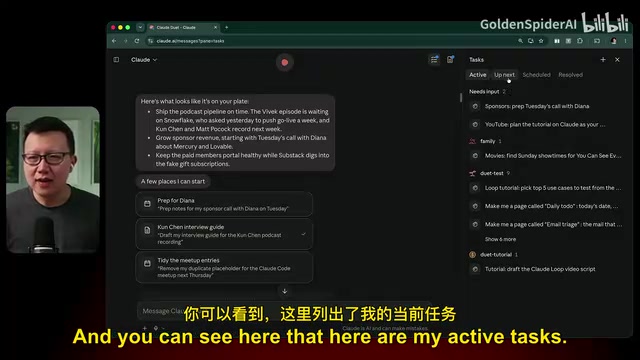
Its proactivity comes from a scheduled check task that's enabled by default: every day from 9 a.m. to 10 p.m., it automatically runs once every three hours, scanning your email and calendar to find work it can do for you. Like a chief of staff, it regularly pushes your to-dos in front of you. That said, the creator admits five checks a day is a bit frequent—fortunately, you can ask it to adjust the frequency at any time.
Tasks, Channels, and Workflow Design
Duet's core interaction revolves around "tasks." Each task is a sub-thread within the main thread, and there's a task folder on the right, divided into active tasks, scheduled tasks, and completed tasks. Scheduled tasks are like recurring routines that run automatically daily or weekly—the overall logic is very close to Claude Projects.
The left navigation area lets you create separate channels and customize icons and colors. The main thread itself, however, can't be customized—that animated little dot is its entire persona. The creator feels this is a bit conservative compared with Muse's customizable animated avatars, but given that Duet targets work scenarios, this restrained design makes sense.
Interestingly, Anthropic built Duet as an app completely independent of Claude. This fits its consistent product rhythm: ship a research preview first, validate feasibility, then merge it back into the main app—co-work and chat both followed this path.
The Real Killer Feature: Artifacts
If proactivity is Duet's personality, Artifacts is its strength. Typing a slash in the input box reveals a series of built-in skills, among which the "morning" skill renders a morning briefing into a styled HTML page, continuing Claude's signature aesthetic.
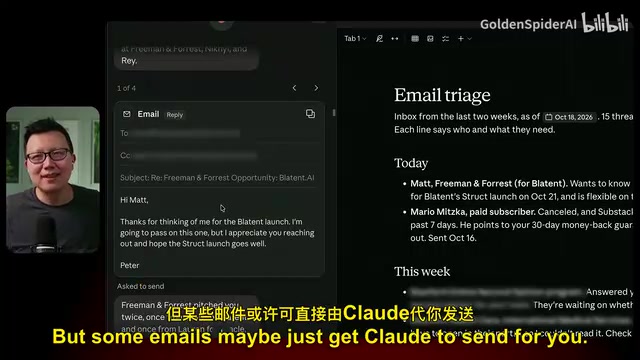
The creator demonstrated several practical scenarios:
- Learning writing style: Duet read 33 sent emails, 1 Slack message, 47 DMs, and 11 documents, summarized a set of writing guidelines, and can subsequently draft emails in that style.
- Email triage: It automatically ranks emails that should be replied to first and drafts responses; important emails still need human review before sending.
- YouTube data report: Given just one sentence—"help me make a channel data insights dashboard"—Duet analyzed a year of video data, identified conclusions such as personal AI Agent content being the breakout direction and single-person videos outperforming guest videos, and generated visualization charts.
- Sponsorship revenue dashboard: It displays signed revenue, pending conversations, and contract status, and can be set to auto-update weekly with email push notifications.
The logic behind these capabilities is clear: Duet doesn't just answer questions—it turns data into ready-to-use, product-grade interfaces. The creator also built an AI exploration club with their child, using animated robots and level-based paths to teach kids AI concepts; although it's text-heavy, you can keep asking it to improve the visual presentation.
Artifacts is the mechanism in the Claude product line for generating and previewing interactive content in real time, first introduced with Claude 3.5 Sonnet. Users can see rendered results of code, web pages, charts, or documents in a side window and iterate based on feedback. Unlike ordinary conversational text, an Artifact is a persistent, editable standalone object that can be saved, shared, and invoked later. Duet extends this mechanism from "code/document generation" to "workflow output"—for example, rendering morning briefings into HTML pages and turning data analysis results into interactive dashboards—upgrading the Agent's output from plain text to ready-to-use, product-grade interfaces.
Shortcomings: Browser Interaction and Local Skills
Duet is still a research preview, and its shortcomings are obvious. The creator tried to book a ride using the built-in Uber skill; Duet successfully clarified the pickup point and destination, but got stuck at Uber's human verification step—it can't let the user step into browser operations, and there's no entry point anywhere in the app to take over the browser.
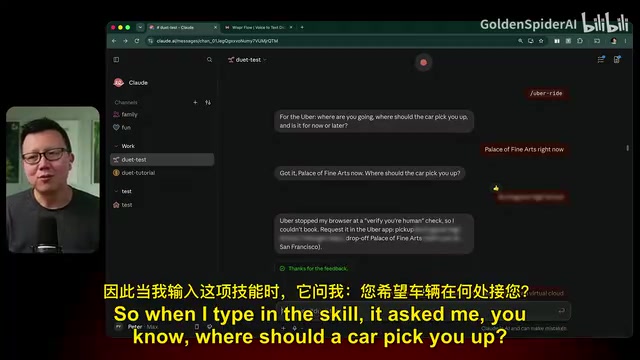
For a personal Agent running on a cloud computer, this is almost a fatal flaw. For steps that must be completed by a real person—such as CAPTCHAs and e-signatures—if there's no interaction channel, the task simply breaks. Another minor issue: Duet can't see the skills library on your local computer and can't add custom skills, which is expected to be resolved only when the desktop version launches.
The "human verification" mentioned in the article refers to CAPTCHA or similar anti-automation challenges used to distinguish real users from scripts, commonly seen at critical steps like login, registration, and checkout. When a personal Agent runs in a cloud browser, once it encounters such verification, it usually needs to hand control back to the user so a real person can complete the click or recognition. If the product provides no interaction channel to "take over the browser," the task gets stuck. This exposes a common shortcoming of cloud Agents in scenarios requiring human intervention: it can't directly operate the user's own browser session like local automation tools, and it struggles with e-signatures, SMS verification codes, and other steps requiring physical devices or biometric confirmation.
Side-by-Side Comparison with Competitors
The creator had previously reviewed Grokbot, Muse, and ChatGPT Dots, and this time gave their own ranking:
Grokbot remains the top choice. The creator uses it like an employee; the free X integration is very useful for market research. The downsides are that its email functionality isn't great and it isn't free.
Muse has the best design and is free. Its killer feature is making phone calls on your behalf—for example, contacting a tree company to come cut down trees or haggling with a carrier—saving a lot of time. The limitation is that it doesn't use frontier models, so complex tasks are prone to errors.
ChatGPT Dots' biggest advantage is being born inside ChatGPT, sharing memory and conversations, but its launch state was quite unstable; even after multiple rounds of fixes, the creator still finds it less useful than their own hand-written chief-of-staff thread.
Claude Duet is the most proactive out of the box, with fairly high polish; what's missing is the two puzzle pieces of browser interaction and local skills. Once it exits the research preview stage, the creator will likely use it heavily—after all, Claude is already their primary model and has accumulated the most personal work memory.
The products compared in the article represent different product forms of personal Agents. Grokbot relies on X platform data and social integration, suiting market research tasks; Muse features customizable animated avatars and outbound calling, emphasizing anthropomorphic interaction; ChatGPT Dots leverages ChatGPT's existing memory and conversation system to try to seamlessly connect the Agent with the user's existing context. Claude Duet takes another path: a standalone app, proactive scheduled checks by default, and Artifacts outputting usable interfaces. These differences show that competition among personal Agents has already diverged along dimensions including platform integration, anthropomorphism, memory continuity, and proactive execution capability—rather than simply the strength of a single model.
What This Means
Duet's launch sends a clear signal: competition among personal Agents has shifted from "can chat" to "can proactively get work done." Capabilities like scheduled checks, task triage, and data dashboards are essentially about capturing the entry point to users' workflows.
Anthropic's approach of testing the waters with a standalone app and then gradually merging into the main client both validates product hypotheses quickly and avoids affecting the Claude experience itself. Duet is currently available as a research preview, with Pro and Max subscribers needing to wait in line. For anyone following AI productivity tools, it's worth adding to the watchlist.
Related articles
DeepSeek Open-Sources DeepInfer: What Is an Inference Framework Actually For?
DeepSeek open-sources its inference framework DeepInfer under Apache 2.0, supporting DeepSeek V4.1 Flash offline inference. This article explains its request scheduling, FlashMLA/DeepGEMM compute optimization, DSPark speculative verification acceleration, and what it means for developers and ordinary users.
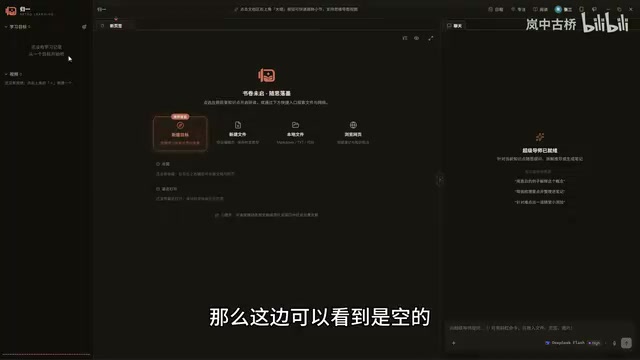
Open-Source AI Learning Agent: A Full Workflow Experience from Topology Graphs to Exam Generation
Explore an open-source AI learning agent: built on DeepSeek API, it constructs knowledge systems via topology graphs, with automatic document generation, notes, super documents, and exams. Learn about its Agent workflow and design highlights.

DeepSeek Whale Girl Open-Source MV Meme: AI Industry Coded Slang About Pivoting to Closed Source
Bilibili's DeepSeek Whale Girl rap MV uses fictional memes to tease the AI open-source vs. closed-source debate, with lyrics full of industry slang. This article explains the meme culture, the Whale Girl symbol, and the open/closed tension.