Claude + ElevenLabs in Practice: Automatically Turning Technical Articles into Videos

A pipeline practice using Claude to rewrite scripts and ElevenLabs to synthesize narration, converting long technical articles into videos at low cost.
The article breaks down a developer's practice of using Claude and ElevenLabs to convert technical articles into videos. The core idea is not to read the original text aloud, but to have a long-context large model perform structured secondary creation of the article—extracting arguments, using colloquial expression, and reserving segments for visual transitions—then having speech synthesis complete the narration, bypassing the high labor costs of human voiceover and editing. In practice, three points are emphasized: giving clear constraints at the script stage such as target duration, visual types, and terminology retention; generating speech chapter by chapter and having humans review logic; and letting visual rhythm follow script segments rather than piling up materials. The article also points out that this method suits creators with existing high-quality long articles to expand distribution, but carries risks of losing argumentative details and single-voice fatigue, and ultimately text asset reuse should be designed as an iterable engineering pipeline.
When Technical Articles Meet the AI Video Pipeline
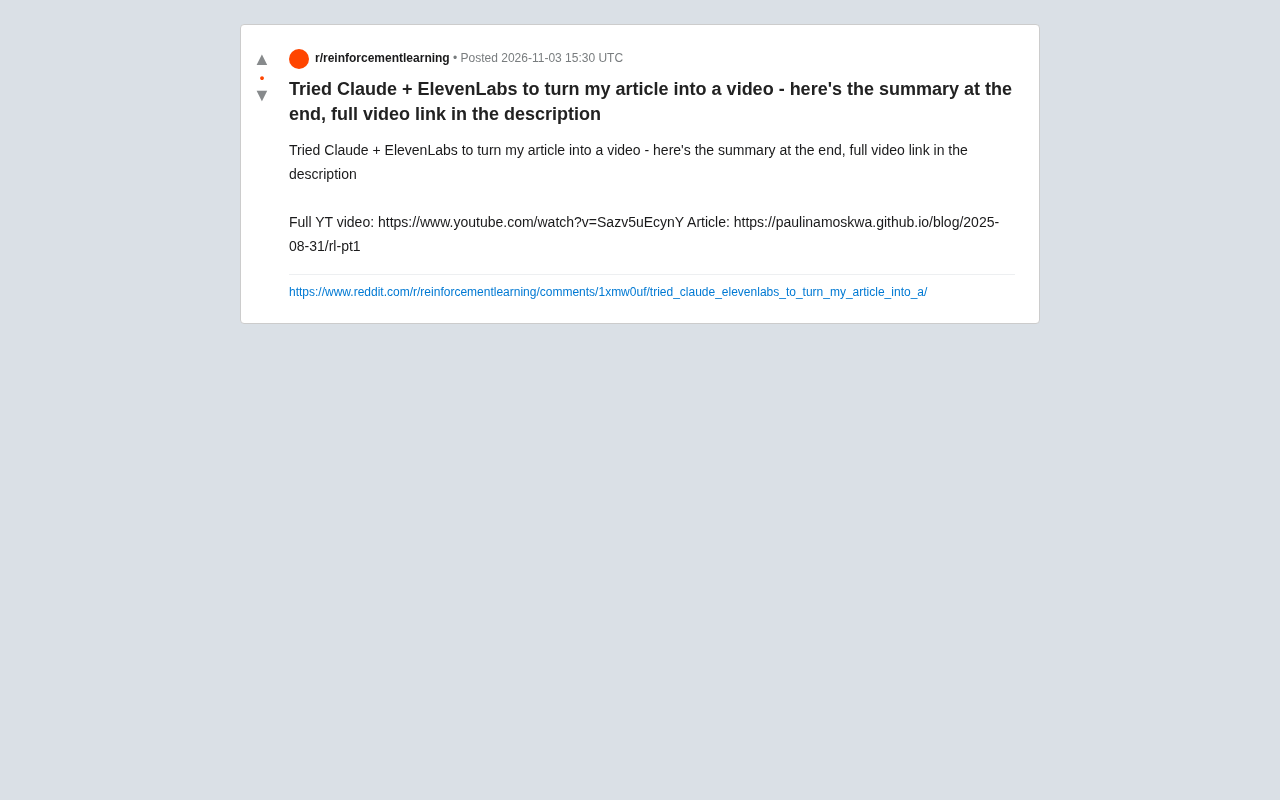
A developer recently shared on Reddit their practice of using Claude and ElevenLabs to convert technical articles into videos, along with the finished YouTube video and a link to the original article. This experiment points to an increasingly clear demand: in an era where content consumption is increasingly video-oriented, how can existing text assets be "translated" into video language at a lower cost?
This is not simply screen recording plus voiceover. It involves handing the article to a large model for structured rewriting, then having speech synthesis complete the narration, forming a reusable automated pipeline. Although the original post only provides a summary and links, from a technical perspective, it's worth breaking down the key stages and potential pitfalls.
Why the Claude + ElevenLabs Combination
Claude's Role in Script Rewriting
Reading a technical article written for reading aloud directly would be a poor experience: dense long sentences, code and diagrams that can't be expressed through sound, and paragraph rhythms unsuitable for auditory absorption. The value of long-context models like Claude lies in "secondary creation"—extracting core arguments, converting complex derivations into colloquial narration, and reserving segment hints for visual transitions.
From the original author's practice, the article itself is technical content about reinforcement learning. Such material has high requirements for concept order and explanation clarity, which precisely tests the model's understanding of technical context rather than mere text polishing.
Long context capability refers to the upper limit of tokens a large language model can process in a single inference. The Claude series pushed this to the 100,000 to 200,000 token level relatively early. For the scenario of converting technical articles to videos, its significance lies in: the model can read the entire long article at once, maintaining consistency of terminology, symbols, and argument chains without concept misalignment caused by segmented truncation. Compared to cutting the article into small chunks for separate summarization and then splicing, long-context models are better at identifying which paragraphs are铺垫 (groundwork) and which are core conclusions, thereby making reasonable choices of detail and brevity when rewriting scripts. It should be noted that a large context window does not mean the model will uniformly utilize all information; content in the middle of the article may still be weakened, so key terminology lists and chapter constraints should preferably be explicitly reiterated in the prompt.
ElevenLabs Completes the Auditory Experience
After the script is written, ElevenLabs is responsible for turning the text into relatively natural narration. The quality of speech synthesis directly determines whether viewers are willing to keep watching; timbre, pauses, and intonation all affect the comprehensibility of technical content. Chaining these two steps together bypasses the high labor costs of human voiceover and editing.
Text-to-Speech (TTS) has evolved from concatenative synthesis and statistical parametric synthesis to neural TTS. ElevenLabs is a representative product of neural TTS, characterized by its ability to clone voices from small samples and maintain relatively natural prosody and pauses in long sentences. For technical content, the difficulty of TTS lies in the pronunciation of proper nouns, abbreviations, and mathematical symbols: the model may not know whether "RL" should be read as two letters or as "reinforcement learning," and intonation breaks often occur on formulas and variable names. In practice, pronunciation dictionaries or SSML tags are usually needed to specify pronunciations, and segment-by-segment listening tests should be conducted after generation rather than throwing the entire script in at once.
Practical Breakdown of the Pipeline
Step 1: "Translating" the Article into a Video Script
An effective approach is not to have the model summarize the entire text, but to give clear constraints: target duration, the type of visuals corresponding to each paragraph, key terms to retain, and mathematical expressions that must be simplified. Formulas and code blocks in technical articles should either be converted into descriptions of animated demonstrations or compressed into a single conclusion; otherwise, the narration will fall into the awkwardness of reading symbols aloud.
Step 2: Segmented Generation and Human Review
Generating the entire piece at once easily leads to loss of rhythm control. Generating speech chapter by chapter and then splicing makes mid-course modifications easier and facilitates alignment with visuals. Topics like Reinforcement Learning have high concept density; having humans check logical coherence at the script stage is often much cheaper than reworking later.
Reinforcement Learning (RL) is a machine learning paradigm in which an agent interacts with an environment and adjusts its policy based on reward signals. Core concepts include state, action, reward, policy, and value function. Such content has high concept density and interdependent definitions; if explained in the wrong order, it becomes difficult to understand. Therefore, when rewriting scripts, the order of concept introduction and the length of explanation when each term first appears are particularly sensitive. For this reason, article-to-video conversion on this topic is more likely to expose the problem of "over-simplification": compressing derivations such as policy gradients and value estimation into a single conclusion sounds smooth but may lose preconditions, making viewers familiar with the field perceive it as imprecise.
Step 3: Assembling Visuals and Audio Track
The original post does not elaborate on visual production details, but what is certain is that voice is only the skeleton; what truly makes the video work is the synchronization of visuals and narration. A common approach is to use slide-style graphics with keyword animations, with the key being to let visual rhythm follow script segments rather than piling up materials.
Who This Method Suits and Who It Doesn't
Suitable Scenarios
Creators who already have high-quality long-form articles and hope to expand content distribution channels are the most direct beneficiaries of this pipeline. After a deep article is rewritten into a video, it can reach a completely different audience on video platforms, with marginal costs far lower than planning an original video from scratch.
Limitations to Watch For
Automatically generated scripts easily lose the argumentative details of the original text, especially for technical content—over-simplification turns into "popular science that sounds correct but doesn't withstand scrutiny." In addition, no matter how natural the speech synthesis is, a single voice over a long period easily fatigues viewers; rhythm design and visual variation cannot be omitted.
From Tool Combination to Content Strategy
The real inspiration of this case is not any specific tool, but designing "text asset reuse" as an engineering pipeline: use large models for structured rewriting in the script stage, use speech synthesis to reduce costs in the voiceover stage, and have humans serve as quality gates. Only when all three perform their respective roles can stable output be possible.
For technical creators, it's worth establishing your own rewriting template as early as possible—fixed question structures, fixed segmentation specifications, fixed terminology lists—so that each conversion starts from an iterable process rather than "getting in sync" with the model from scratch every time. The complete video and article links from the original post are attached in the description; if interested, you can directly compare the finished video with the original text to observe where rewriting trade-offs occur.
Original article link: https://paulinamoskwa.github.io/blog/2025-08-31/rl-pt1 | Video: https://www.youtube.com/watch?v=Sazv5uEcynY
One-line Summary
A pipeline practice using Claude to rewrite scripts and ElevenLabs to synthesize narration, converting long technical articles into videos at low cost.
Paragraph Summary
The article breaks down a developer's practice of using Claude and ElevenLabs to convert technical articles into videos. The core idea is not to read the original text aloud, but to have a long-context large model perform structured secondary creation of the article—extracting arguments, using colloquial expression, and reserving segments for visual transitions—then having speech synthesis complete the narration, bypassing the high labor costs of human voiceover and editing. In practice, three points are emphasized: giving clear constraints at the script stage such as target duration, visual types, and terminology retention; generating speech chapter by chapter and having humans review logic; and letting visual rhythm follow script segments rather than piling up materials. The article also points out that this method suits creators with existing high-quality long articles to expand distribution, but carries risks of losing argumentative details and single-voice fatigue, and ultimately text asset reuse should be designed as an iterable engineering pipeline.
Related articles

9 AI Subscription Plans Compared: The Real Cost Per 100M Tokens Revealed
Bilibili creator tests 9 AI subscription plans from Volcano, Alibaba, Tencent, Baidu, Zhipu, Xiaomi, MiniMax and more, converting them all to real cost per 100M tokens, breaking down fixed-quota vs. three-tier coefficient billing and how caching, time-of-day discounts, and window limits affect actual quota.

Vibe Coding for Beginners: Expressing Intent Instead of Handwriting Code
What is Vibe Coding? A 137-episode Bilibili course defines it: the core is expressing intent, not writing code. This article analyzes Vibe Coding's productivity logic, target audience, and entry expectations to help beginners decide if it's worth learning.

LangChain Beginner's Guide: An Agent Development Roadmap from LangGraph to Deep Agents
Clarify the encapsulation relationship among LangChain, LangGraph, and Deep Agents, and master the learning path and selection logic for agent development frameworks—suitable for beginners in large model development.