Claude Fable 5.2 and Mythos 5.2 Released: Dual Safety Strategy for the Same Model

Anthropic launches Fable 5.2 and Mythos 5.2 based on the same underlying model but with different safety levels.
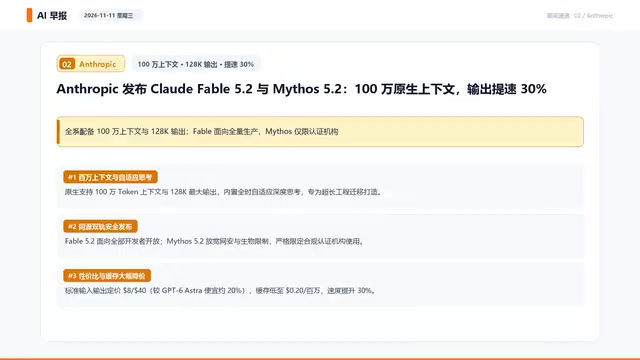
Anthropic has released Claude Fable 5.2 and Claude Mythos 5.2, which are essentially the same underlying model differing only in safeguard level—a "same model, two versions" strategy that is uncommon among mainstream vendors. Fable 5.2 scores 49.1% on FrontierCode 2.0, is priced at $8/$40 per million input/output tokens, and offers a 1M token context window; Mythos 5.2 targets scenarios requiring stricter safety boundaries. The article argues that making safety a product differentiation dimension responds to regulatory pressure and enterprise procurement needs, allowing customers to choose compliance levels per scenario without changing the underlying model. However, Mythos 5.2's specific safety differences, pricing, and benchmark performance are not public, and whether guardrails harm output quality remains a key unknown.
One Release, Two Names: Anthropic's New Approach
Anthropic has released two models: Claude Fable 5.2 and Claude Mythos 5.2. Interestingly, they are essentially the same underlying model, differing only in the level of safeguards. This "same model, two versions" release strategy is unusual among mainstream large model vendors.
According to MarkTechPost, Fable 5.2 scores 49.1% on the FrontierCode 2.0 benchmark, is priced at $8 per million input tokens and $40 per million output tokens, and offers a 1 million token context window. Mythos 5.2 targets scenarios that require stricter safety boundaries.
The Product Logic Behind the Naming
The names "Fable" and "Mythos" are themselves metaphorical. Based on public information, Anthropic does not position them as models at different capability tiers; instead, it makes safety strategy the main axis of product differentiation.
The benefit of this approach is straightforward: enterprise customers can choose different compliance and safety levels based on their business scenarios without changing the underlying model. For companies that handle sensitive data, serve the public, or operate in regulated industries, Mythos 5.2 offers more conservative default behavior; Fable 5.2 is better suited to development teams that prioritize the model's raw capabilities and are willing to take on more safety responsibility themselves.
Comparison with Industry Practice
Mainstream vendors typically differentiate product lines by model size (e.g., Pro/Flash/Lite) or capability tier (e.g., different parameter scales). By making "safety" a standalone product dimension, Anthropic reflects how regulatory pressure and enterprise procurement needs are reshaping the business form of large models. One model with two sets of safety guardrails is essentially answering a question: should safety strategy be uniform across the board from the vendor, or should customers choose per scenario?
What safeguards specifically consist of
In the context of large model products, safeguards usually refer collectively to a set of layered mechanisms: alignment fine-tuning and refusal behavior shaping during training, content classifiers and risk thresholds during inference, filtering and moderation layers at the output end, and compliance policy configurations for specific domains (such as finance and healthcare). Different levels of safeguards may manifest as more conservative refusal boundaries, stricter restrictions on dual-use information, additional output review steps, or more granular audit logs. These mechanisms often trade some answer completeness or increased inference latency for lower risk exposure, so the experiential difference between the "same model, two versions" essentially depends on the trigger frequency and interception granularity of these guardrails.
Key Parameters Explained
Pricing: Fable 5.2 is priced at $8 per million input tokens and $40 per million output tokens. The output price is 5 times the input price, a ratio roughly consistent with the pricing structure of current mainstream large models, reflecting that long-form text generation remains the major cost driver.
Context window: A 1 million token context capacity means it can process ultra-long documents, large codebases, or long multi-turn conversation histories in one go. This specification is in the top tier among current flagship models.
Benchmark score: A score of 49.1% on FrontierCode 2.0 indicates that the model is competitive on code-related tasks. It should be noted that a single benchmark score cannot fully reflect the model's actual performance; specific results still need to be verified against real business scenarios.
Benchmarks and FrontierCode 2.0
FrontierCode 2.0 is an evaluation benchmark for code generation and program understanding, typically including multilingual programming problems, real repository-level tasks, and unit test verification, used to measure a model's capabilities in function completion, bug fixing, cross-file reasoning, and similar areas. A score of 49.1% needs to be understood in the context of the benchmark's difficulty distribution: if the benchmark's overall pass rate is low (e.g., most models fall in the 30%–50% range), then 49.1% is competitive; however, a single benchmark score is affected by prompt design, sampling strategy, and evaluation set contamination, and cannot be directly equated with production environment performance. The industry usually also references complementary benchmarks such as HumanEval and SWE-bench, and combines them with real business regression tests to comprehensively judge model capability.
Context windows and what a million tokens actually means
The context window refers to the total number of tokens a model can receive and attend to in a single inference, covering system prompts, conversation history, retrieved documents, and content to be generated. 1 million tokens roughly corresponds to hundreds of thousands of Chinese characters or tens of thousands of lines of code, enabling the model to digest a large codebase, a lengthy contract, or long meeting records in one pass without relying on external chunking and retrieval stitching. But note that effective context is not equal to nominal context: as input grows, the model's recall of mid-sequence information may decline (the "lost in the middle" phenomenon of long contexts), and inference cost and latency rise linearly or even superlinearly with token count. Therefore, a million-level window is better suited as a capability reserve for reducing engineering complexity rather than as an unconditional full-volume dump.
What the Dual Safety Strategy Means
From a product design perspective, the parallel existence of Fable 5.2 and Mythos 5.2 may bring several chain effects.
First, the decision chain for enterprise procurement will change. Security teams and compliance departments will get involved earlier in model selection, rather than leaving the decision solely to technical teams. Second, two safety versions of the same model mean customers can use Fable 5.2 during development and testing to obtain fuller model behavior, and switch to Mythos 5.2 in production to meet compliance requirements. This flexibility is especially attractive to regulated industries such as finance, healthcare, and education.
However, public information has not yet disclosed the specific differences in Mythos 5.2's safety strategy—for example, whether it has stricter refusal thresholds, more conservative content filtering, or an additional output review layer. The absence of this detail makes it difficult for outsiders to assess the experiential gap between the two versions in actual use.
Open Questions Worth Watching
Whether Mythos 5.2's pricing is consistent with Fable 5.2 is currently unclear. If safety hardening brings additional inference overhead, prices may differ. In addition, whether the two versions score the same on FrontierCode 2.0 is unknown; the report only gives Fable 5.2's 49.1%, and Mythos 5.2's benchmark performance remains unknown.
For developers, the more practical question is: will differences in safety strategy affect the model's output quality on tasks such as programming and reasoning? If Mythos 5.2 frequently refuses or reduces answer completeness due to stricter guardrails, then the claim of a "same model" would be diluted in actual experience.
Whether Anthropic's move will be accepted by the market depends on whether enterprise customers are truly willing to pay for "switchable safety levels." In a competitive landscape where model capabilities are increasingly homogenized, making safety a product layer at least offers a new way of thinking.
Related articles

How Do Cursor, Devin, TRAE, and Copilot Compare on Price? Calculate Your Credits Before You Compare Monthly Fees
Side-by-side comparison of individual and team pricing for Cursor, Devin Desktop, TRAE, and Copilot, breaking down credit rules, third-party model inclusion, overage billing, and practical methods for measuring usage before paying, setting spending caps, and choosing the right tool.
Copilot Retires Three Models: Pro Users Left With Only One Alternative
GitHub Copilot retires Claude Opus 4.8, Claude Opus 5, and GPT-5.6 Tera on Nov 16 across Chat, code completion, and Agent mode. Pro users have only GPT-6 Luna left; Legacy annual plans miss Opus 5.5; admins must enable replacements manually.
Gemini 4 Carbon Arrives: The LLM Race Enters the Era of Million-Token Context and Trillion-Parameter Open Source
Google launches Gemini 4 Carbon and multi-agent tool Swarm; Anthropic debuts million-context Fable 5.2 and Mythos 5.2; OpenAI releases security-focused GPT-6 Cyber; Mistral and Kimi open-source trillion-parameter models — the LLM race accelerates across the board.