Claude Fable 5.2 Lands on Devin, FrontierCode 2.0 Score Jumps Sharply
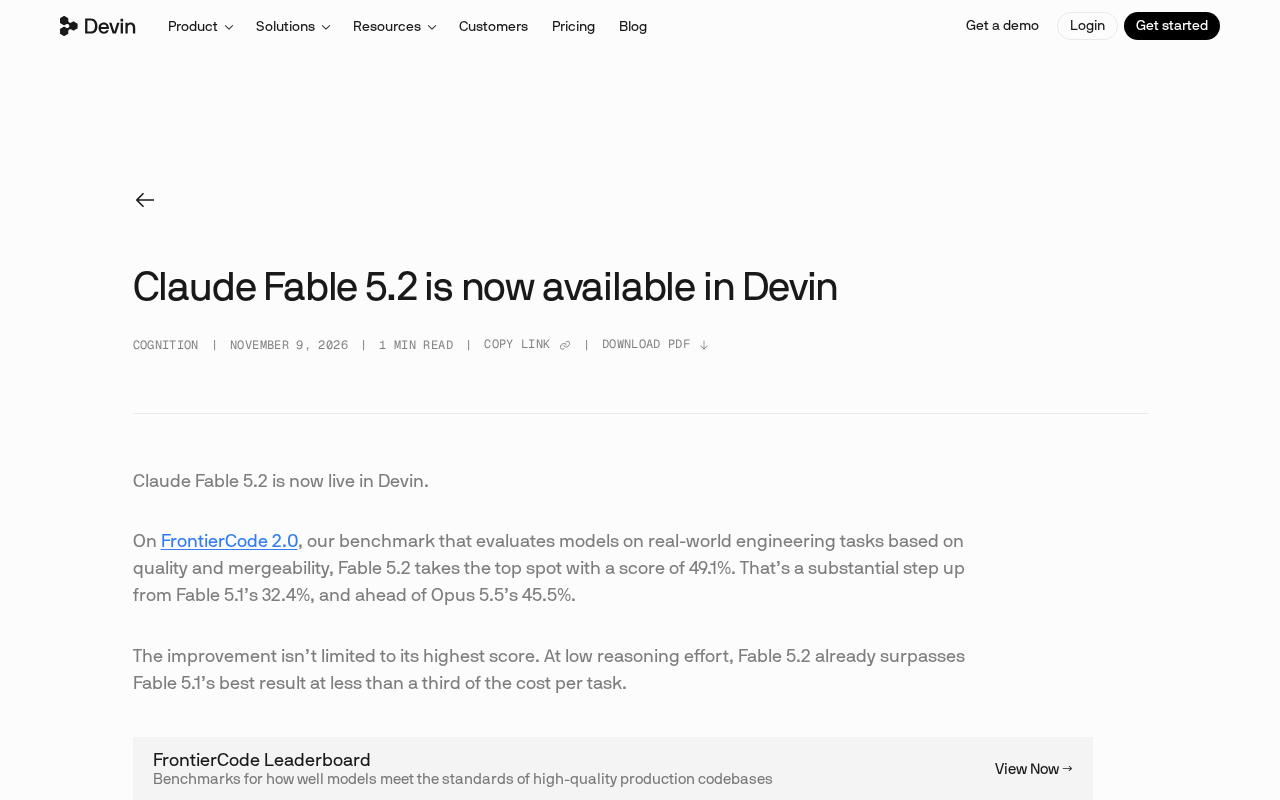
Claude Fable 5.2 lands on Devin, with its FrontierCode 2.0 score jumping from 32.4% to 49.1%.
Claude Fable 5.2 has officially landed on Devin and topped the FrontierCode 2.0 code benchmark with 49.1%, up more than 16 percentage points from version 5.1's 32.4%. A jump of this size is rare and usually signals substantive improvements in training data, reasoning strategies, or code-specific optimization rather than simple fine-tuning. As an autonomous AI software engineer, Devin's multi-step planning depends heavily on the underlying model's reasoning, and its rapid integration reflects a strategy of keeping the toolchain at the frontier. The article also cautions that benchmark gains do not mean all tasks improve linearly, recommending small-scale comparative tests on high-reasoning scenarios such as multi-file refactoring and complex debugging, while keeping fallback options for behavioral differences in code style and requirement interpretation.
Introduction
The AI coding assistant space has seen another key update. Claude Fable 5.2 has now landed on the Devin platform and taken the top spot on the FrontierCode 2.0 benchmark, with its score rising from 32.4% in the previous generation to 49.1%. This jump is quite rare among model iterations in the same category, and it directly changes the performance ranking of the models available on Devin.
FrontierCode 2.0: What the Score Really Means
FrontierCode 2.0 is a benchmark for measuring code generation and comprehension ability, and its score directly reflects how a model performs on real programming tasks. Fable 5.2's 49.1% represents an improvement of more than 16 percentage points over version 5.1's 32.4%. A jump of this size usually means substantive improvements in training data, reasoning strategies, or code-specific optimization, rather than an incremental fine-tuning update.
For developers, benchmark scores are not the end goal, but they provide an anchor for horizontal comparison. A score of 49.1% puts Fable 5.2 in a leading position among the models callable on Devin, making it especially suitable for scenarios that require complex code reasoning and multi-step task decomposition.
What Is a Code Benchmark Test
Code generation benchmarks usually consist of a set of programming tasks with reference answers or executable test cases. The model must produce runnable code under given function signatures, comments, or natural language descriptions, and a test framework then automatically determines whether it passes. Unlike general language understanding benchmarks, code benchmarks emphasize executability and correctness, and scores are often presented as a "task pass rate," so the percentage number directly corresponds to the proportion of tasks the model can solve independently. Version iterations of benchmarks like FrontierCode usually adjust the difficulty distribution of tasks, cover more languages and frameworks, and add real engineering scenarios such as multiple files and cross-function dependencies. Therefore, scores across versions cannot be simply compared horizontally; only comparisons among models within the same version are valid.
What Devin Platform Integration Means
Devin positions itself as an autonomous AI software engineer, and its capability ceiling depends heavily on the underlying model's code comprehension and execution planning abilities. The integration of Fable 5.2 means Devin now has a stronger reasoning foundation for handling long-chain programming tasks.
From a platform strategy perspective, Devin's choice to integrate quickly after the model update shows that it wants to keep its toolchain at the frontier. For users, this means they can directly call one of the Claude models with the best current code benchmark performance without switching platforms.
How an Autonomous AI Software Engineer Works
The core difference between autonomous coding agents like Devin and ordinary code completion tools lies in the task loop: it must read the repository itself, locate relevant files, make a modification plan, execute edits, run tests, and repeatedly revise based on errors. This process places far higher demands on the underlying model's context length, long-chain reasoning stability, and tool-calling accuracy than single-turn code generation. Therefore, a generational change in the underlying model often means more than "writing better code"; it affects whether the agent can maintain plan consistency across multi-step tasks and reduce deviations from the goal midway. This is also why platform providers tend to integrate strong models quickly after release—the experience ceiling of agent products is basically determined by the reasoning ability of the underlying model.
How Developers Should View This Upgrade
A benchmark improvement does not mean every task gets linearly better. What developers need to focus on is whether Fable 5.2 brings perceptible improvements in the languages and frameworks commonly used in their own projects. It is advisable to run small-scale comparative tests on key tasks, especially scenarios that demand deep reasoning, such as multi-file refactoring and complex logic debugging.
In addition, switching models may also bring behavioral differences, such as code style, comment density, or how ambiguous requirements are interpreted. Teams should keep a fallback option when migrating workflows and avoid a one-time full switch.
How to Run Small-Scale Comparative Tests
To evaluate whether a model generational change is worth migrating to, you can build a lightweight internal evaluation set: select several completed tasks from the project's history, such as fixed defects or implemented features, keep the original requirement descriptions as input, then have the old and new models each produce patches, and finally use the project's own test suite to determine the pass rate. In addition to correctness, you should also record metrics such as first-pass rate, average number of revision rounds, and whether the generated code conforms to the team's style guidelines. The sample size does not need to be large; twenty or thirty representative tasks can reveal clear difference trends. It is also advisable to keep the old model as a fallback path and set up manual review steps for automated processes on critical paths.
Conclusion
The sharp jump of Claude Fable 5.2 on FrontierCode 2.0, along with its rapid launch on the Devin platform, shows that AI coding tools are entering a stage of intensive model capability iteration. For developers, continuously monitoring benchmark changes and maintaining a flexible model selection strategy is more important than binding themselves to a single tool.
One-line Summary
Claude Fable 5.2 lands on Devin, with its FrontierCode 2.0 score jumping from 32.4% to 49.1%.
Paragraph Summary
Claude Fable 5.2 has officially landed on the Devin platform and taken the top spot on the FrontierCode 2.0 code benchmark with a score of 49.1%, an improvement of more than 16 percentage points over the previous 5.1 version's 32.4%. This magnitude is relatively rare among model iterations in the same category and usually indicates substantive improvements in training data, reasoning strategies, or code-specific optimization rather than simple fine-tuning. As an autonomous AI software engineer, Devin's multi-step task planning ability depends heavily on the underlying model's code comprehension and reasoning level, and quickly integrating the new model reflects the platform's strategy of keeping its toolchain at the frontier. The article also reminds developers that benchmark improvements do not mean all tasks get linearly better. It recommends running small-scale comparative tests in their own commonly used languages and frameworks, focusing on high-reasoning scenarios such as multi-file refactoring and complex logic debugging, and keeping fallback options to address behavioral differences in code style and requirement interpretation.
Related articles

How Do Cursor, Devin, TRAE, and Copilot Compare on Price? Calculate Your Credits Before You Compare Monthly Fees
Side-by-side comparison of individual and team pricing for Cursor, Devin Desktop, TRAE, and Copilot, breaking down credit rules, third-party model inclusion, overage billing, and practical methods for measuring usage before paying, setting spending caps, and choosing the right tool.

Copilot Retires Three Models: Pro Users Left With Only One Alternative
GitHub Copilot retires Claude Opus 4.8, Claude Opus 5, and GPT-5.6 Tera on Nov 16 across Chat, code completion, and Agent mode. Pro users have only GPT-6 Luna left; Legacy annual plans miss Opus 5.5; admins must enable replacements manually.

Gemini 4 Carbon Arrives: The LLM Race Enters the Era of Million-Token Context and Trillion-Parameter Open Source
Google launches Gemini 4 Carbon and multi-agent tool Swarm; Anthropic debuts million-context Fable 5.2 and Mythos 5.2; OpenAI releases security-focused GPT-6 Cyber; Mistral and Kimi open-source trillion-parameter models — the LLM race accelerates across the board.