Claude Fable 5.2 Released: Beats Opus 5.5 on Benchmarks at Half the Cost

Anthropic's Fable 5.2 and Methos 5.2 beat Opus 5.5 on benchmarks at lower cost—but access lasts only one week.
On November 10, Anthropic released Claude Fable 5.2 and Methos 5.2 for the hardest tasks. Fable 5.2 tops the Artificial Analysis Intelligence Index with a Max reasoning score of 65, delivers up to 30% faster output, matches Opus 5.5's Max at High effort for half the cost per task, and cuts API prices about 20%. Cases include 1,000 agents formalizing Fermat's Last Theorem in Lean in 30 hours, Methos 5.2 accurately predicting 28 of 34 capsid structures, and stronger robot control. Anthropic still recommends Opus 5.5 for daily work; Pro and Team standard access lasts one week, with strict reset-card deadlines.
Anthropic dropped a major update on November 10: the official release of Claude Fable 5.2 and Methos 5.2. The company positions them as "built for the hardest tasks," with upgrades across coding, reasoning, and visual understanding—and on multiple benchmarks they surpass the previous flagship, Opus 5.5.
Benchmarks and Cost: Fable 5.2's Sweeping Advantage
According to a breakdown by Bilibili creator "November 10 AI News," Fable 5.2 outperforms Opus 5.5 on nearly every evaluated capability. On the Artificial Analysis Intelligence Index, Fable 5.2 takes the top three spots, with its Max reasoning effort score of 65 ranking first. Output speed is up to 30% faster than Fable 5.1 and Methos 5.1.
More important is the price-performance ratio. In early Frontier Code 2.0 testing, Fable 5.2 at High reasoning effort scores roughly on par with Opus 5.5 at Max reasoning effort—while costing only half as much per task. The source lists API pricing at $8 per million input tokens and $40 per million output tokens, versus $10 and $50 for the previous-generation 5.1—a reduction of about 20%.
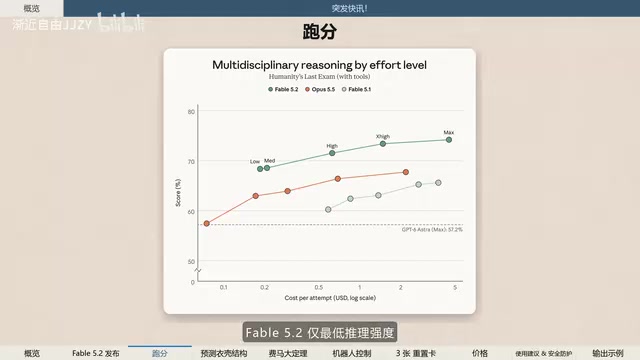
On the Humanity's Last Exam reasoning test, Fable 5.2 surpasses Opus 5.5's maximum reasoning effort using only its lowest reasoning effort. That means users don't need to max out their reasoning budget to get stronger results.
Reasoning Effort is an adjustable parameter widely used by current reasoning models to control the budget the model spends on "internal thinking" before generating an answer. Common tiers include Minimal, Low, Medium, High, and Max; higher tiers mean the model consumes more reasoning tokens, typically yielding higher accuracy but also higher latency and cost. Its engineering significance lies in decoupling "capability" from "expense": the same model can respond quickly at a low tier for simple tasks and max out the tier on hard tasks to gain precision. So comparing two models based on scores at a single tier isn't fair—you need to compare performance at "equal cost" or "equal latency." The fact that Fable 5.2 at High matches Opus 5.5 at Max shows it delivers higher efficiency per unit of reasoning budget.
Beyond Benchmarks: From Mathematical Proofs to Protein Structure Prediction
Fable 5.2's value isn't just reflected in leaderboard numbers—the source provides several more persuasive real-world cases.
A thousand-agent swarm formalizes Fermat's Last Theorem. A team of 1,000 Fable 5.2 agents completed a full Lean formalization of Fermat's Last Theorem in 30 hours. Under the same configuration, Opus 5.5 completed only 26% in 18 hours and made almost no further progress by the 30-hour mark. This kind of long-horizon, multi-agent collaboration scenario precisely magnifies Fable 5.2's advantage in sustained reasoning.
Methos 5.2 predicts protein capsid structures. Gene therapies can deliver via a protein shell called a capsid. Methos 5.2 found a new way to predict complete capsid structures: in Anthropic's tests, it attempted to model 34 capsids, and 28 of its structure predictions were accurate. Biologists can use this to design capsids faster and at lower cost.
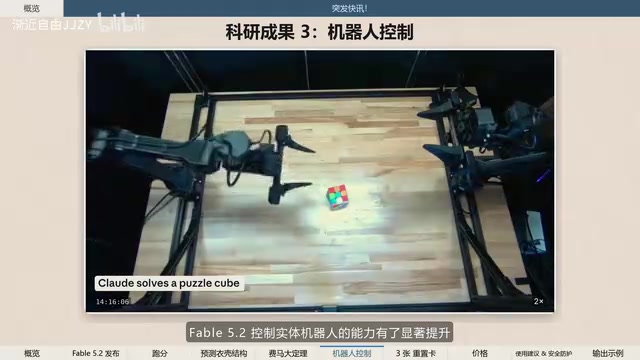
Significantly improved robot control. Fable 5.2 shows clear progress in controlling physical robots, even handling tasks it was never specifically trained on. On the RoboDojo benchmark for simulated dual-arm robots, it outperforms other models as well as most AI systems purpose-built for robot control.
Lean formalization refers to using the interactive theorem prover Lean and its math library Mathlib to rewrite mathematical propositions and proofs expressed in natural language into formal code that a computer can verify step by step. Formalized proofs are checked line by line by the kernel; if they pass, there are no logical gaps, which is why this is regarded as one of the highest standards of mathematical rigor. Formalizing Fermat's Last Theorem is an enormous undertaking, involving modular forms, elliptic curves, Galois representations, and a great deal of modern number theory, and it has long been a goal of the formalization community. Such tasks are characterized by a huge number of steps, zero tolerance for single-step errors, and the need to maintain context consistency over long periods—precisely a test of a model's long-horizon reasoning and self-correction. Multiple agents working in parallel can decompose subgoals, but coordinating interfaces and dependencies is itself a challenge.
A capsid is the protein shell that encloses a virus's genetic material, self-assembled from multiple identical or different protein subunits according to a certain symmetry—commonly icosahedral. In gene therapy, engineered viral capsids (such as AAV capsids) are used as delivery vehicles to carry therapeutic genes into target cells, so capsid structure and surface features directly determine delivery efficiency, tissue targeting, and immunogenicity. Experimentally determining capsid structure usually relies on cryo-electron microscopy, which is costly and time-consuming; predicting the 3D structure of a complete assembly from amino acid sequence alone is far harder than predicting a single protein chain, because it must also handle subunit assembly relationships and flexible regions. Accurate prediction could greatly accelerate screening and engineering in vector design.
Access and Reset Cards: Mind the Time Windows
Behind the launch perks are clear time limits. Fable 5.2 access for Pro and Team standard plans lasts only one week, until November 17; only Max, Ultra, and Team premium plans permanently retain a 50% weekly usage allowance.
To celebrate the launch, Anthropic is giving out up to three reset cards, but only to users who subscribed to Claude before 1:00 AM Beijing time on November 10. Pro and Team standard plans get one; Max, Ultra, or Team premium plans receive a number determined dynamically by subscription length, up to three. Reset cards expire on March 8 next year.

All Claude paid plan users can use Fable 5.2, and the API is already available on the Claude Platform and major cloud platforms.
Which to Use? How Fable 5.2 and Opus 5.5 Differ in Positioning
The source's recommendation is clear: the new model is better suited to harder, open-ended technical work—complex coding, frontier reasoning, and research assistance. For most everyday coding and knowledge work, it still recommends Opus 5.5, since it's already the strongest everyday general-purpose model.
Fable and Methos are built on the same underlying model, but Fable has strict safety guardrails to prevent misuse. Organizations working in cybersecurity or biomedical research and committed to beneficial applications can apply for Methos access through the Life Sciences Verification and Cybersecurity Verification programs.

One hands-on experience worth noting: the creator used Fable 5.2 together with several Opus 5.5 sub-agents and finished the task in about 30 minutes. This mixed approach—a strong reasoning main model plus general-purpose sub-agents—may be more cost-effective than maxing out reasoning effort on a single model.
Overall, Fable 5.2's release continues the "more capable, lower unit price" trajectory, but the one-week access window and the reset-card claim deadline mean users who want to try it need to act quickly.
Main model + sub-agents layered orchestration is a common architecture in today's agent systems: a model with the strongest capability takes charge of planning and decision-making, decomposing the task, then dispatches relatively independent, clearly scoped subtasks to cheaper or more specialized models, and finally collects and integrates the results. The benefit is concentrating expensive, high-intensity reasoning at key nodes, avoiding billing every token at the highest rate, while parallel sub-agents can also shorten overall time. The cost is coordination overhead—context passing, result verification, and error propagation—and how well tasks are split significantly affects the final outcome. The 30-minute completion in the article shows that, with the right division of labor, a mixed setup can be more economical than maxing out reasoning effort on a single model.
One-line Summary
Anthropic releases Fable 5.2 and Methos 5.2, beating Opus 5.5 on benchmarks at lower cost—but access lasts only one week.
Paragraph Summary
On November 10, Anthropic released Claude Fable 5.2 and Methos 5.2, positioned for tackling the hardest tasks. Fable 5.2 takes the top three spots on the Artificial Analysis Intelligence Index, with a Max reasoning effort score of 65 ranking first and output speed up to 30% faster; in Frontier Code 2.0, High effort matches Opus 5.5's Max at half the cost per task, with API prices down about 20%. Real-world cases include 1,000 agents formalizing Fermat's Last Theorem in Lean in 30 hours, Methos 5.2 accurately predicting 28 of 34 capsid structures, and robot control surpassing most specialized systems. The official guidance is to keep using Opus 5.5 for everyday tasks, with Fable 5.2 aimed at hard, open-ended work; Pro and Team standard plans get access for only one week, and reset cards have strict claim and expiry deadlines.
Related articles

How Do Cursor, Devin, TRAE, and Copilot Compare on Price? Calculate Your Credits Before You Compare Monthly Fees
Side-by-side comparison of individual and team pricing for Cursor, Devin Desktop, TRAE, and Copilot, breaking down credit rules, third-party model inclusion, overage billing, and practical methods for measuring usage before paying, setting spending caps, and choosing the right tool.

Copilot Retires Three Models: Pro Users Left With Only One Alternative
GitHub Copilot retires Claude Opus 4.8, Claude Opus 5, and GPT-5.6 Tera on Nov 16 across Chat, code completion, and Agent mode. Pro users have only GPT-6 Luna left; Legacy annual plans miss Opus 5.5; admins must enable replacements manually.

Gemini 4 Carbon Arrives: The LLM Race Enters the Era of Million-Token Context and Trillion-Parameter Open Source
Google launches Gemini 4 Carbon and multi-agent tool Swarm; Anthropic debuts million-context Fable 5.2 and Mythos 5.2; OpenAI releases security-focused GPT-6 Cyber; Mistral and Kimi open-source trillion-parameter models — the LLM race accelerates across the board.