Claude Fable 5.2 Released: Tops Coding Benchmarks, 20% Price Cut, Formalizes Fermat's Last Theorem in 30 Hours

Anthropic releases dual-version Fable/Methas 5.2: tops coding, 20% price cut, claims Fermat formalization.
Anthropic unexpectedly released flagship models Claude Fable 5.2 and Methas 5.2, calling them the most powerful models to date. They are two release endpoints of the same base model: Fable adds safety guardrails for cybersecurity and life sciences, while Methas opens full capabilities to approved security researchers. Frontier Code scored 49.1% and agentic Frontier SWE 69.9%, both first and surpassing Opus 5.5. Pricing dropped 20% to $8/$40 per million tokens, output speed rose 30%, plus a 2.5x fast mode. It claims a 30-hour formalization of Fermat's Last Theorem and solutions to two open black hole physics problems, but from a single official source pending independent reproduction. Official advice: use Opus 5.5 for daily tasks, switch to Fable/Methas for hard ones.
Anthropic suddenly announced its flagship dual release, Claude Fable 5.2 and Methas 5.2, in the early hours of the morning, calling them "the most powerful models to date." There was no teaser, no pre-launch livestream — yet the release landed three heavy punches at once: performance, pricing, and research results.
One Model, Two Guardrail Configurations
Fable 5.2 and Methas 5.2 are not two independently trained models, but two release endpoints of the same base model. According to a Bilibili news brief, the Fable version adds guardrails for cybersecurity and life sciences scenarios, restricting access to high-risk capabilities; Methas opens full capabilities to security researchers via application.
This "one model, two outlets" approach is uncommon in the industry. It means Anthropic is adopting a tiered strategy for capability release: ordinary users get a constrained version, while professional security researchers can access full capabilities. The guardrails themselves do not change the model weights — what changes is the reachable behavioral boundary.
Technical positioning of guardrails: Model guardrails are constraint mechanisms deployed on either side of model input/output or within the inference process, commonly implemented as classifier filters, system prompt restrictions, refusal policies, and capability switches. They do not modify model weights, so "same base, different outlets" is technically entirely feasible — the same set of parameters can present as two products with different capability boundaries through different policy layers and access controls. This tiered release satisfies regulatory and safety commitments while releasing full capabilities to vetted researchers; it is a common compromise frontier labs use between "capability openness" and "risk control."
Sweeping the Coding Benchmarks
The performance numbers are quite direct. Frontier Code coding benchmark scored 49.1%, and agentic coding Frontier SWE reached 69.9% — both first place across the board, and nearly全面 surpassing the previous Opus 5.5.
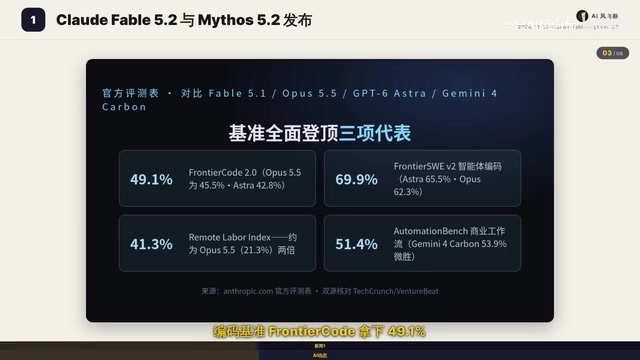
Agentic coding measures not single-turn completion, but the model's ability to autonomously plan, invoke tools, and correct errors in multi-step tasks. The 69.9% on Frontier SWE indicates a clear improvement in Fable 5.2's stability across real engineering task chains. For developers relying on AI coding assistants, such metrics are more informative than traditional code completion benchmarks.
The difference between Frontier Code and Frontier SWE: Frontier Code is a code generation benchmark for single files or short contexts, mainly measuring the model's ability to produce correct completions given function signatures and comments — close to traditional HumanEval / MBPP-style evaluations. Frontier SWE simulates a real software engineering workflow — giving the model a GitHub issue and requiring it to locate the problem across the entire codebase, modify multiple files, run tests, and iteratively fix, with test pass rate as the criterion. The latter's difficulty comes from long-context understanding, tool invocation, and multi-turn self-correction, so a score of 69.9% reflects the model's real-world value in "agentic" workflows far better than 49.1%.
Better Performance, Lower Price
The pricing strategy is the most counterintuitive part of this release. At $8 per million input tokens and $40 per million output tokens, it is 20% lower than the previous generation; output speed is 30% faster than the previous generation, plus a fast mode with up to 2.5x acceleration.
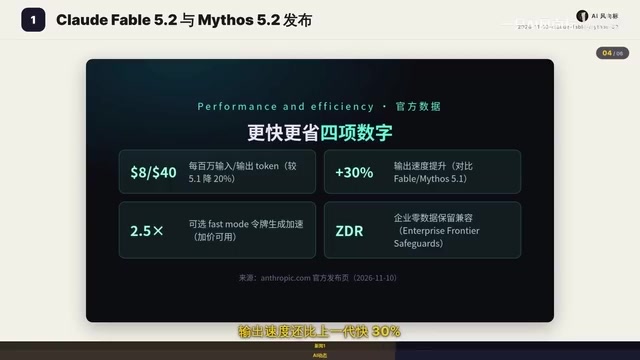
Stronger capability, lower price, faster speed — these three happening simultaneously usually means substantive optimization of inference efficiency rather than mere subsidies to buy market share. For cost-sensitive teams, this directly changes the decision of "which model to run production tasks on."
What token pricing means: LLM APIs typically price input tokens (prompts and context) and output tokens (model-generated content) separately, with million tokens as the industry-standard unit. Low input price and high output price is a common structure, because autoregressive generation requires a full forward pass for each token, while input can be processed efficiently via parallel prefill. The $8/$40 input-output ratio is about 1:5, mid-range among current flagship models. The so-called "fast mode 2.5x acceleration" generally refers to more aggressive batching or speculative decoding on the inference side, at the cost of higher per-token cost — suitable for latency-sensitive rather than cost-sensitive interactive scenarios.
Formalizing Fermat's Last Theorem in 30 Hours
The research results are the most talked-about part of this release. According to the news brief, during pre-release testing the model completed a formal proof of Fermat's Last Theorem within 30 hours, and also solved two open problems in black hole physics.
Formal proofs require every step of reasoning to be mechanically verifiable by a proof assistant, which is a different matter entirely from "writing a proof that looks correct" — the difficulty is not comparable. However, it should be noted that these results currently come from a single official source and await independent reproduction and peer review.
What a formal proof is: A formal proof translates mathematical propositions and reasoning steps into a formal language (such as Lean, Coq, Isabelle) that a machine can check line by line, with a proof assistant verifying step by step whether each inference conforms to axioms and proven theorems. Unlike natural-language proofs, it does not allow jumps like "obviously" or "by the same reasoning" — any missing step causes verification to fail. The formalization of Fermat's Last Theorem is recognized by the mathematical community as a massive undertaking; human teams have spent years advancing related work in Lean. If a model could complete it in 30 hours, it would mean simultaneous long-horizon planning, lemma library retrieval, and strict syntax generation capabilities — but this is still different from "understanding the ideas of the proof," and independent reproduction is needed to confirm authenticity.
Official Advice: Use Opus for Daily Tasks, Switch Up for the Hard Stuff
Anthropic's usage advice: continue using Opus 5.5 for daily tasks, and switch up to Fable or Methas when you hit the hard stuff.

This advice itself explains the product positioning — Fable 5.2 is not a full replacement for Opus 5.5, but a "heavy-lifting tier" with a higher capability ceiling. Opus 5.5 is more cost-effective and lower-latency on routine tasks, while Fable handles complex reasoning, long-chain engineering, and research-grade problems. Tiered invocation is more economical than blind upgrading.
Pro plan users can now use Fable. For developers, the question worth focusing on is not "whether to switch models," but how to tier task difficulty so the right model handles the right work.
One-line Summary
Anthropic releases dual versions of the same model, Fable/Methas 5.2, topping coding benchmarks, cutting prices 20%, and claiming a formalization of Fermat's Last Theorem.
Paragraph Summary
Anthropic released flagship models Claude Fable 5.2 and Methas 5.2 without warning, calling them the most powerful models to date. They are actually two release endpoints of the same base model: Fable adds safety guardrails for cybersecurity and life sciences scenarios, while Methas opens full capabilities to approved security researchers. On performance, Frontier Code scored 49.1% and agentic coding Frontier SWE reached 69.9%, both first place and surpassing Opus 5.5. Pricing counterintuitively dropped 20% to $8 input / $40 output per million tokens, output speed rose 30%, plus a 2.5x-accelerated fast mode. On research, it claims a 30-hour formalization of Fermat's Last Theorem and solutions to two open problems in black hole physics, but only from a single official source, pending independent reproduction. Official advice: keep using Opus 5.5 for daily tasks, switch to Fable/Methas for high-difficulty tasks.
Related articles

How Do Cursor, Devin, TRAE, and Copilot Compare on Price? Calculate Your Credits Before You Compare Monthly Fees
Side-by-side comparison of individual and team pricing for Cursor, Devin Desktop, TRAE, and Copilot, breaking down credit rules, third-party model inclusion, overage billing, and practical methods for measuring usage before paying, setting spending caps, and choosing the right tool.

Copilot Retires Three Models: Pro Users Left With Only One Alternative
GitHub Copilot retires Claude Opus 4.8, Claude Opus 5, and GPT-5.6 Tera on Nov 16 across Chat, code completion, and Agent mode. Pro users have only GPT-6 Luna left; Legacy annual plans miss Opus 5.5; admins must enable replacements manually.

Gemini 4 Carbon Arrives: The LLM Race Enters the Era of Million-Token Context and Trillion-Parameter Open Source
Google launches Gemini 4 Carbon and multi-agent tool Swarm; Anthropic debuts million-context Fable 5.2 and Mythos 5.2; OpenAI releases security-focused GPT-6 Cyber; Mistral and Kimi open-source trillion-parameter models — the LLM race accelerates across the board.