Claude Fable 5.2 Upgrade Breakdown: Price Cut and Mandatory Prefix Checks
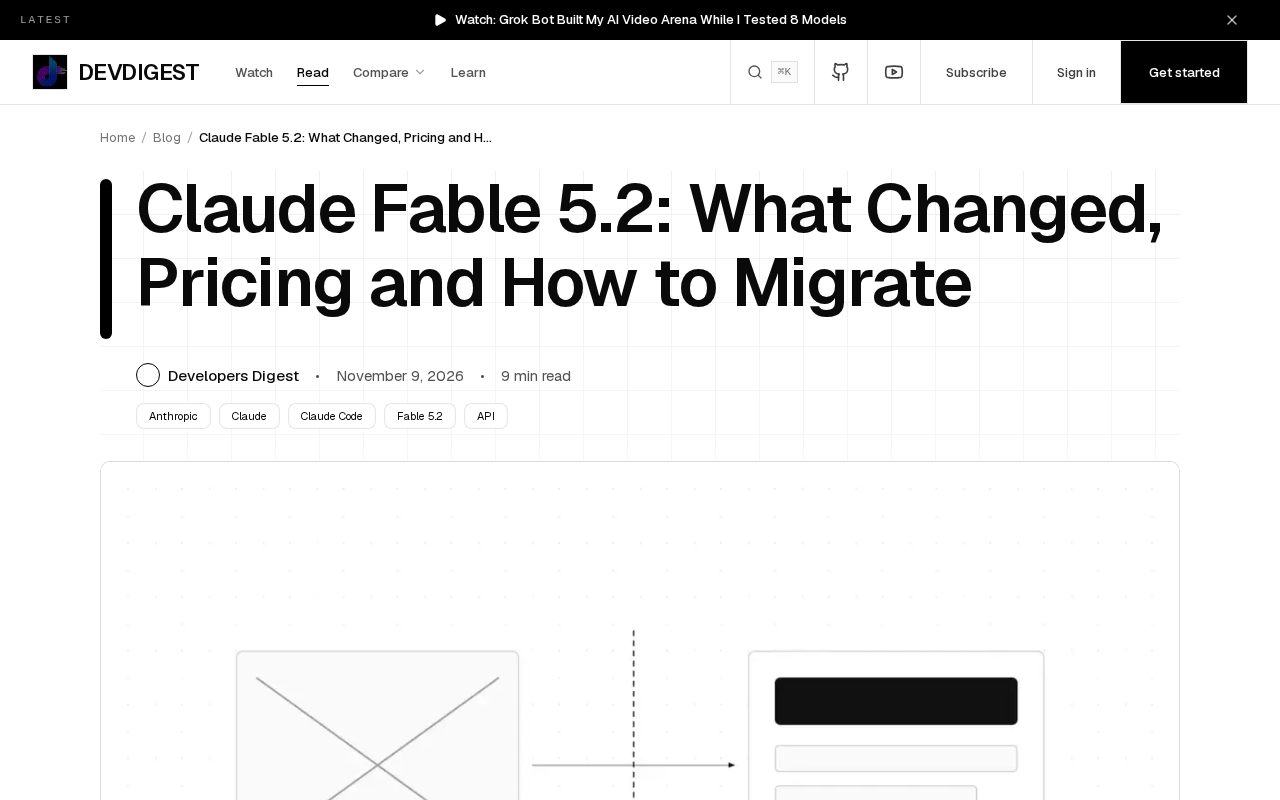
Claude Fable 5.2 cuts prices to $8/$40 but enforces prefix checks and brings four breaking changes.
The most notable change after Claude Fable 5.2's release is the price reduction from $10/$50 to $8/$40 per million tokens, enabling more developers and enterprises to use its capabilities at lower cost. But the price cut comes with a hard requirement: all accounts must perform prefix checks, and requests must carry a valid prefix or they may be rejected. The article also outlines four breaking changes—mandatory prefix checks, pricing structure adjustments, API parameter changes, and error code updates—and offers migration advice: validate in a test environment, update client code, then monitor after launch and prepare a rollback plan. Overall, the new version strengthens security and compliance while reducing costs.
Introduction
The release of Claude Fable 5.2 brings a series of changes, the most notable of which are the price adjustment and mandatory prefix checks. According to official information, the new version's pricing drops from $10/$50 per million tokens to $8/$40, but the trade-off is that all accounts must comply with prefix check rules. This article takes a deep dive into these changes and provides a migration guide.
Price Adjustment: Lower Cost, Broader Reach
Claude Fable 5.2 lowers input and output pricing to $8 and $40 per million tokens respectively, a significant reduction from the previous $10 and $50. This adjustment enables more developers and enterprises to leverage Claude's powerful capabilities at a lower cost. However, the price cut comes with a condition—all accounts must now perform prefix checks.
Mandatory Prefix Checks: A Security and Compliance Upgrade
Prefix checking is one of the core changes in version 5.2. This mechanism requires checking the prefix of the prompt in every request to ensure compliance with usage policies. According to the official statement, this measure is designed to prevent abuse and enhance security. For developers, this means integrating the corresponding check logic into their code, otherwise requests may be rejected.
In the context of LLM APIs, a "prefix check" typically refers to a server-side mechanism that validates the starting fragment of the prompt carried in a request. Such mechanisms may be used to confirm the request's origin, detect whether the system prompt has been tampered with, or determine whether the caller complies with the platform's usage policies. Because large models are highly sensitive to prompt prefixes, attackers may craft carefully constructed prefixes to trick the model into bypassing safety restrictions, so prefix checks are also often regarded as a prompt injection defense. For developers, this means every API call must explicitly carry the required prefix information, and client SDKs and request wrapper layers need to be upgraded in sync, otherwise validation failures will be triggered.
Four Breaking Changes and Migration Guide
Version 5.2 introduces four breaking changes that require special attention during migration:
1. Mandatory Prefix Checks
All API calls must include a valid prefix, otherwise an error will be returned. When migrating, make sure to add the prefix field in the request headers or request body.
2. Pricing Structure Adjustment
The new pricing model may change costs for some usage scenarios. It is recommended to re-evaluate usage and adjust budgets.
3. API Parameter Changes
Some API parameters have been deprecated or renamed. Please refer to the official documentation for details.
4. Error Code Updates
Error codes have been standardized, and error handling logic must be updated during migration.
A "breaking change" refers to a non-backward-compatible API or behavioral adjustment: old code may directly error out or produce different results after upgrading rather than degrading gracefully. Common forms include adding required fields, renaming or deprecating parameters, changing response structures, and adjusting error code semantics. The key to determining whether a change is a breaking change is whether it requires the caller to modify code to maintain existing functionality. In engineering practice, such risks are typically managed through semantic versioning (major version increments), changelogs, and deprecation cycles, and contract tests are used to cover critical call paths before upgrading to reduce production incidents.
How to Migrate Smoothly
To minimize the impact of migration, the following steps are recommended:
- Validate in a test environment: First deploy version 5.2 in a test environment to ensure all functionality works properly.
- Update client code: Modify code according to the breaking changes, especially prefix checks and parameter adjustments.
- Monitor and roll back: After launch, closely monitor error rates and prepare a rollback plan.
A "rollback plan" is a key part of risk control during migration. Its core is to ensure that if anomalies occur after the new version goes live, it can be restored to the previous stable state within an acceptable time. Implementation methods include retaining the old version deployment, using canary releases or traffic splitting for gradual rollout, separating configuration from code for quick switching, and preparing data compatibility handling before release. Combined with alert thresholds set on monitoring metrics such as error rate, latency, and call failure rate, teams can detect and execute rollbacks before problems spread, avoiding impact on all users.
Conclusion
Claude Fable 5.2 lowers prices while enhancing security and compliance through mandatory prefix checks. Although there are four breaking changes, developers can smoothly transition to the new version with a reasonable migration plan.
One-line Summary
Claude Fable 5.2 cuts prices to $8/$40 but enforces prefix checks and brings four breaking changes.
Paragraph Summary
After the release of Claude Fable 5.2, the most notable change is the price reduction from $10/$50 to $8/$40 per million tokens, enabling more developers and enterprises to use its capabilities at lower cost. But the price cut comes with a hard requirement: all accounts must perform prefix checks, and requests must carry a valid prefix or they may be rejected. The article also outlines four breaking changes, including mandatory prefix checks, pricing structure adjustments, API parameter changes, and error code updates, and provides migration recommendations: first validate in a test environment, then update client code, and finally monitor after launch and prepare a rollback plan. Overall, the new version strengthens security and compliance while reducing costs.
Related articles

How Do Cursor, Devin, TRAE, and Copilot Compare on Price? Calculate Your Credits Before You Compare Monthly Fees
Side-by-side comparison of individual and team pricing for Cursor, Devin Desktop, TRAE, and Copilot, breaking down credit rules, third-party model inclusion, overage billing, and practical methods for measuring usage before paying, setting spending caps, and choosing the right tool.
Copilot Retires Three Models: Pro Users Left With Only One Alternative
GitHub Copilot retires Claude Opus 4.8, Claude Opus 5, and GPT-5.6 Tera on Nov 16 across Chat, code completion, and Agent mode. Pro users have only GPT-6 Luna left; Legacy annual plans miss Opus 5.5; admins must enable replacements manually.

Gemini 4 Carbon Arrives: The LLM Race Enters the Era of Million-Token Context and Trillion-Parameter Open Source
Google launches Gemini 4 Carbon and multi-agent tool Swarm; Anthropic debuts million-context Fable 5.2 and Mythos 5.2; OpenAI releases security-focused GPT-6 Cyber; Mistral and Kimi open-source trillion-parameter models — the LLM race accelerates across the board.