Claude Haiku 5.5 Released: Small Models Shift Toward Balancing Performance, Speed, and Cost

Claude Haiku 5.5 launches with 90% price cuts, Effort tuning, and major benchmark gains over its predecessor.
Anthropic has released Claude Haiku 5.5, completing the three-model Claude 5.5 lineup. Targeting high-frequency, cost-sensitive workloads like summarization and customer support, it cuts pricing by up to 90% versus the previous generation. Coding benchmark scores jumped from 735 to 1,620, and Terminal Bench 4.0 leaped from 0% to 39.2%. Haiku 5.5 also introduces Effort-based reasoning adjustment and a 1M token context window, directly competing with GPT-6 Luna as small model rivalry expands beyond price into performance, speed, and reasoning controllability.
Anthropic recently released Claude Haiku 5.5, completing the final piece of its Claude 5.5 lineup. Unlike previous small models that competed purely on price, the core narrative this time has shifted toward efficiency — balancing performance, speed, and inference cost. This reflects a key shift happening across the lightweight model landscape.
Positioning: High-Frequency, Large-Scale, and Cost-Sensitive Tasks
Haiku 5.5 has a clear product focus: fast, repetitive workloads like summarization, compression, database queries, and classification, as well as latency-sensitive scenarios such as real-time customer support and browser automation. Within the Claude 5.5 family, it plays a lightweight, specialized role — complementing the flagship Opus 5.5 and the general-purpose Sonnet 5.5.
Notably, Haiku 5.5 can also serve as a code execution layer for Opus 5.5 and Sonnet 5.5. This means it's not just a standalone small model — it can be embedded into larger multi-model workflows to handle high-frequency, low-level tasks. This layered design reflects Anthropic's product philosophy: match the model to the task, match the compute to the cost.
Pricing: Up to 90% Cheaper Than the Previous Generation
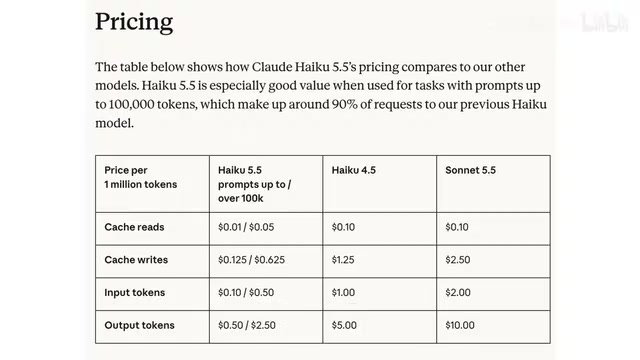
Pricing is the most immediately visible change in this release. For requests with input lengths under 100K tokens, the per-million-token cost is $0.10 for input and $0.50 for output — roughly 90% cheaper than Haiku 4.5 and on par with GPT-6 Luna.
For inputs exceeding 100K tokens, prices rise to $0.50 and $2.50 per million tokens respectively — still about 50% lower than the previous generation. This tiered pricing structure is especially attractive for high-frequency, large-volume use cases, significantly lowering the cost barrier for businesses processing massive volumes of short requests. The price drop essentially turns small model usage into a scalable infrastructure capability.
Performance: Meaningful Gains Across Key Benchmarks
Beyond pricing, Haiku 5.5 delivers tangible improvements in coding, computer use, and knowledge work. According to Anthropic's published data, it scores 1,620 on relevant coding benchmarks — well above Haiku 4.5's score of 735. Terminal Bench 4.0 jumped from 0% in the previous generation to 39.2%, a qualitative leap from near-unusable to genuinely capable.
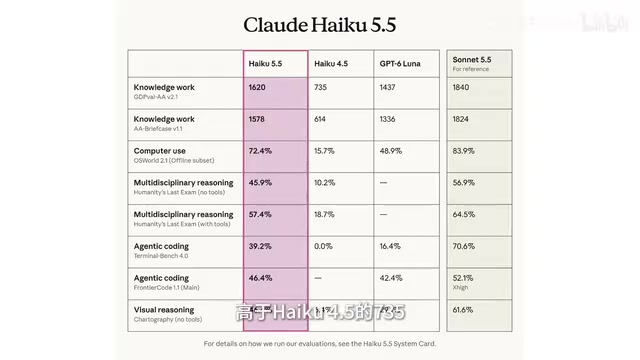
On metrics like GDPVal and Agentic Coding, Anthropic claims Haiku 5.5 outperforms GPT-6 Luna. However, the company also acknowledges that real-world results still depend on task type, reasoning settings, and how the model is invoked — benchmark scores and actual business performance often diverge, and users should calibrate their expectations accordingly.
Terminal Bench is a benchmark specifically designed to evaluate an AI model's ability to complete real operational tasks in a command-line terminal environment, covering scenarios like file management, scripting, system command execution, and multi-step tool invocations. Going from near-zero on the previous Haiku to 39.2% on Haiku 5.5 means the model has moved from "unreliable in terminal environments" to "capable of real automated execution" — a transition with direct practical value for agentic workflows like DevOps assistance and code debugging pipelines. GDPVal evaluates a model's generalization ability across data processing and programming tasks; the simultaneous improvement on both benchmarks suggests that Haiku 5.5's gains in tool use and code execution are systemic, not just point optimizations.
New Features: Effort Adjustment and 1M Token Context
Haiku 5.5 is the first model in the Haiku line to support Effort (reasoning effort) adjustment. Users can tune this setting to flexibly trade off between response speed, compute consumption, and task quality — dial it down for speed, dial it up for accuracy. This adjustable reasoning mechanism allows a single model to serve diverse business needs.

The new model also supports a 1 million token context window, dramatically expanding the information it can process in a single pass. This capability is highly practical for scenarios requiring long-document processing or large-scale data analysis.
The Effort (reasoning effort) adjustment mechanism is essentially dynamic control over the depth of a model's reasoning chain. Traditional language models consume a fixed amount of compute per request, while models that support Effort adjustment can decide "how long to think" based on task complexity — low Effort mode produces quick answers, ideal for clear-cut tasks like classification and summarization; high Effort mode triggers deeper internal reasoning steps, suited for tasks requiring logical inference or multi-step planning. This mechanism is conceptually similar to OpenAI's "thinking tokens" in the o-series — both expose the reasoning process itself as a controllable variable for developers, enabling differentiated speed-accuracy tradeoffs across scenarios. For cost-sensitive, high-frequency use cases, low Effort mode can further reduce per-request compute overhead, making Haiku 5.5's economic advantages even more pronounced.
The Competitive Landscape vs. GPT-6 Luna
On the competitive front, Haiku 5.5 and GPT-6 Luna are closely matched in positioning — both targeting high-frequency, cost-sensitive tasks and both supporting reasoning effort adjustment. Luna offers a 1.05M token context window and six levels of Reasoning Effort from 9 to Max.
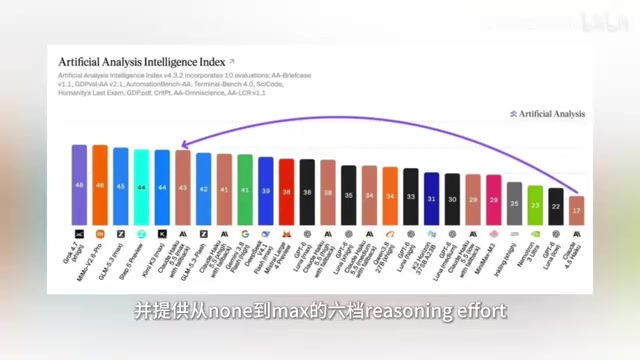
This signals that competition among small models has evolved from a one-dimensional price war into a multidimensional contest spanning performance, speed, context length, and reasoning controllability. Whoever finds the optimal balance across these dimensions will be best positioned to win large-scale real-world adoption.
The Full Picture: Task-Based Division, Cost-Based Matching
With Haiku 5.5's release, all three models in the Claude 5.5 family are now available, maintaining a clear division of roles — flagship, general-purpose, and lightweight: Opus 5.5 lowers the cost of demanding tasks, Sonnet 5.5 reduces token consumption per task, and Haiku 5.5 lowers the barrier for high-frequency calls.
Overall, the 5.5 series upgrade isn't just a capability iteration — it's a systematic reinforcement of the "match the model to the task, match the compute to the cost" product strategy. Whether Haiku 5.5 can convert its balance of speed, performance, and price into broad real-world adoption remains to be validated by the market and actual business use cases.
Related articles

Uber Deploys ChatGPT Work Company-Wide: AI in the Workplace Enters the Scaled Implementation Phase
Uber deploys ChatGPT Work to 30,000+ employees, extending it from engineering to all roles. We analyze its expert-engineer pairing, end-to-end automation, and questions of AI control and power concentration—insights for scaling AI in the workplace.

Shift at Midnight Hands-On: When "ID Verification" Becomes Alien Hunting
Shift at Midnight blends ID verification with horror survival in a four-player co-op game. We break down its inspection mechanics and chaotic humor.

Zelensky Recounts the Outbreak of War: I Need Ammunition, Not a Ride
Zelensky recalls the first day of war in a YouTube interview: farewell to family, rejecting Biden's evacuation offer with "I need ammunition, not a ride," and how Bucha shaped his stance on compromise and peace talks.