Claude Launches Dashboards and Motion: Real-Time Analytics Boards and Animations from Conversation

Claude adds Dashboards and Motion beta features to generate live analytics boards and editable code animations from natural language.
Anthropic has launched two Artifacts-based beta features for Claude: Dashboards lets users connect to BigQuery, Snowflake, and other major data warehouses using plain language to generate auto-refreshing boards with visible SQL queries; Motion converts reports and charts into code-driven animations that can be edited word-by-word and exported as MP4. Dashboards is available to all paid users, while Motion is limited to Team and Enterprise plans — a clear signal that Anthropic is pushing Claude from a conversational tool toward a producer of deliverable work outputs, moving directly into territory traditionally held by BI platforms and motion design tools.
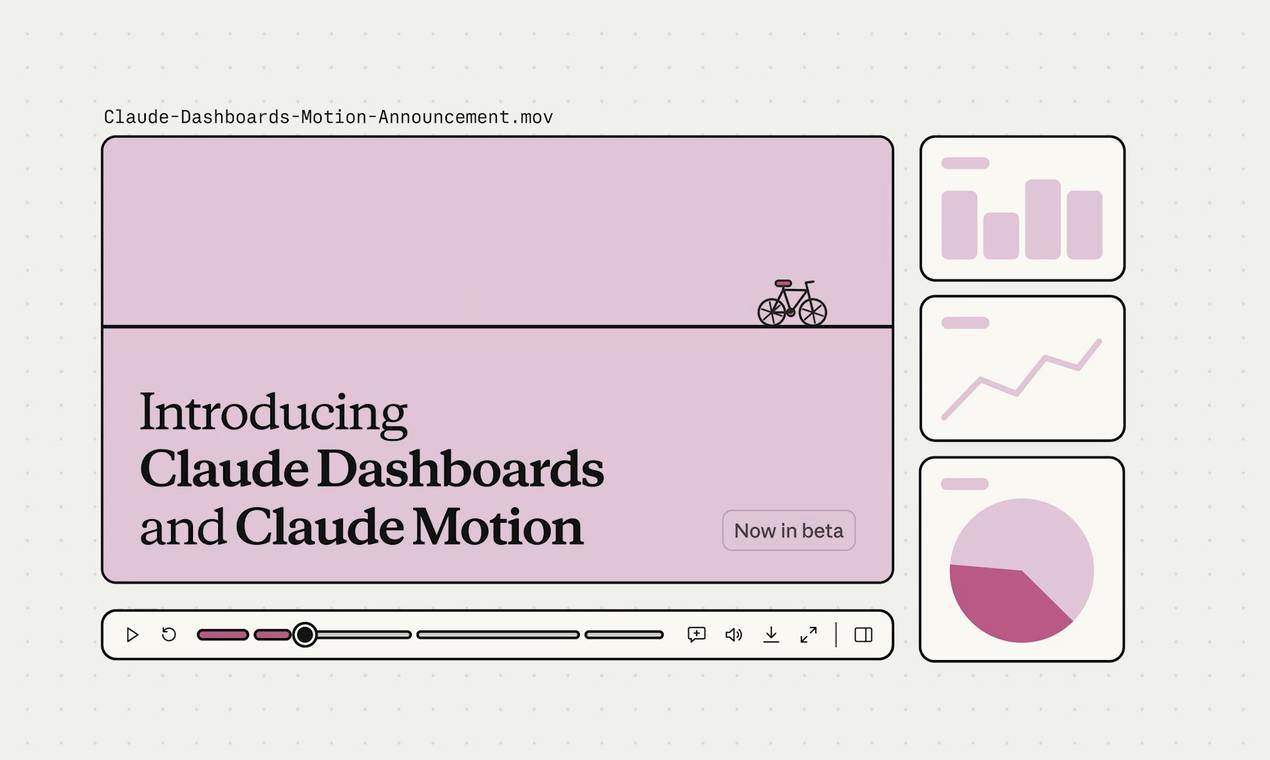
Anthropic has introduced two new beta features for Claude, both delivered as Artifacts — Claude Dashboards and Claude Motion. Dashboards turns a natural language question into a live, auto-refreshing analytics board, while Motion converts reports, charts, and narration scripts into code-driven animations that can be edited line by line. After launching on Product Hunt, both features quickly climbed to #3 for the day, earning 113 upvotes.
Dashboards: Connect Your Data Warehouse With Plain Language
The core value of Claude Dashboards lies in its direct integration with major data sources — BigQuery, Databricks, Snowflake, Redshift, ClickHouse, and Salesforce. Users don't need to write SQL; just describe the metrics you want in plain language, and Claude generates a live dashboard.
Two design decisions stand out compared to traditional BI tools. First, real-time refresh: dashboards aren't one-off static snapshots — they update automatically as the underlying data changes, making them suitable for ongoing team monitoring rather than ad hoc reporting. Second, every number is backed by a visible query — a critical feature for data trustworthiness. The biggest risk with natural language-generated dashboards is that users can't verify whether the numbers are correct. Exposing the underlying query allows users to audit, correct, or reuse the logic, reducing the decision-making risk posed by AI hallucinations.
This design directly addresses a long-standing pain point in enterprise data analytics: business users want to see data but don't know SQL, while data teams are overwhelmed with ad hoc data requests. If natural language-generated dashboards prove reliable enough, this communication overhead could be dramatically reduced.
The supported data sources cover the core components of today's enterprise data stack: BigQuery is Google Cloud's columnar data warehouse, optimized for large-scale SQL analytics; Snowflake is known for elastic scaling and data sharing, and is one of the fastest-growing cloud data warehouses in recent years; Databricks is built on Apache Spark, bridging data engineering and machine learning workflows; Redshift is the data warehousing backbone of the AWS ecosystem; ClickHouse excels at high-throughput real-time queries and is commonly used for log analysis and user behavior tracking; Salesforce represents CRM-side business data. Supporting all six simultaneously signals that Claude Dashboards aims to cover the full chain from operational data to business metrics, rather than targeting any single technology stack.
Motion: Turn Reports Into Editable, Code-Driven Animations
Claude Motion addresses a different type of need — explanation and communication. It converts reports, charts, and instructional walkthroughs into short animations, with the animation itself written as code. This creates a key difference: every word, every number, and every timing beat in the animation can be directly edited, and the result can be exported as an MP4.
Traditionally, creating animated explainer videos requires specialized motion design tools and skills — changing a single number often means re-rendering an entire segment. By making animations code-based, Motion makes edits extremely low-cost, ideal for product demos, earnings presentations, or internal training materials that need frequent data updates. For content creators and product teams, it's a fast path from a text report to a dynamic visual presentation.
That said, a code-driven approach also means complex visual effects may be constrained by Claude's current generation capabilities — real-world performance will need to be validated in practice.
The concept of code-driven animation is not new. Tools like Remotion (React-based) and Manim (the Python animation library used by 3Blue1Brown) have taken similar approaches. The core advantage of this paradigm is "content as code" — text, numbers, and timelines all exist as variables, so updating a data point doesn't require re-rendering the entire scene. Claude Motion's distinction is that it delegates the code generation process itself to the large language model, so users don't need to know animation programming. This abstraction dramatically lowers the barrier to entry, but it also means the depth of control users have over the output depends on whether Claude can accurately interpret intent and generate clean, easily modifiable code.
Pricing and Positioning: Targeted at Paid and Enterprise Users
The two features have clearly differentiated access tiers: Dashboards is available to all paid plan users, while Motion is limited to Team and Enterprise plans. This tiering reflects Anthropic's strategic intent — data dashboards address a general productivity need with broad appeal, while animated presentations are more oriented toward team collaboration and external communication, positioning them as enterprise-grade capabilities.
In terms of product trajectory, Anthropic is steadily expanding Claude's Artifacts ecosystem — from early code snippets and interactive components, progressively extending into data analysis and multimedia generation. The direction is clear: making Claude not just answer questions, but directly produce usable work outputs (dashboards, animations, applications) that persist beyond the conversation as deliverable artifacts.
Claude Artifacts is a core interaction paradigm Anthropic introduced in mid-2024, referring to structured outputs generated by Claude that exist independently of the chat bubble — including code snippets, runnable web apps, SVG graphics, and more. Unlike regular text responses, Artifacts are displayed in a dedicated panel, with support for direct preview and download. The goal is to elevate conversation outputs from "reference information" to "directly usable deliverables." Dashboards and Motion extend this system — the former produces a board bound to live data, the latter a exportable animation file. Both continue the product logic of "conversation as production."
What This Means for the Industry
These two features push Claude into direct competition with specialized tools — Dashboards goes up against BI platforms, Motion enters the motion design space. While still in beta and unlikely to fully replace mature tools in terms of feature depth, they represent a clear trend: general-purpose large language models are using the combination of natural language and editable artifacts to chip away at the entry-level demand traditionally served by vertical software.
For enterprises, the real test lies in reliability and controllability. Exposing underlying queries in dashboards and presenting animations as code are both moves toward "auditable and modifiable" outputs — a sign that Anthropic recognizes how demanding enterprise environments are when it comes to accuracy. Whether these features can earn the trust of data and content teams will determine whether they remain an impressive demo or actually become part of everyday workflows.
Related articles

Apple HomeView Hands-On Review: Is the $300 Smart Home Hub Worth It?
Apple HomeView hands-on: a $300 smart home hub with facial recognition for quick account switching, but no App Store or voice recognition. Is the wall-mounted version worth it? Should you buy the first generation?

Meta Muse Wonder Launch: What It Means for Meta's Return to the Frontier AI Race
Meta releases Muse Wonder and WonderFull, benchmarks reach the frontier, community feedback is polarized. An in-depth look at Meta's return to the frontier AI race, its personal agent strategy, and Zuckerberg's different path.

Apple Home Smart Home Lineup Leaked: LG and Schneider Team Up, UWB Door Lock on Board
Apple Home ecosystem gains new LG and Schneider devices: UWB smart lock with proximity unlock, 2.5K dual-camera doorbell, privacy indoor camera, and AirPods-like seamless pairing.