Claude Motion Hands-On: Why It Gives You an HTML File Instead of a Video

Claude Motion is not a video generator but code-driven animation that exports MP4, with a narrow use case most people cannot access.
Anthropic moved Claude Motion and Claude Dashboards into beta while taking Docs, Slides, and Design out of beta across all plans. Claude Motion is not a video generation model; it has Claude write code to drive text, charts, and graphics, then export MP4, so it allows partial edits but lacks keyframes and looks more like a moving slide deck. It is only available in Team and Enterprise beta, so individual users cannot access it, and much of the online praise actually comes from Claude Design's animation feature. Compared with Veo and Sora, it trades control for speed and fits a narrow lane like internal explainers and board presentations. The standalone Claude Design site will shut down on December 14 and be folded into the main product, which is the bigger change people overlooked.
Someone asked ChatGPT and the free version of Claude for the same thing: a 30-second Reddit motion graphics video. ChatGPT dropped a .mp4 file with music already baked in, while Claude handed back an .html file. After the user asked for a conversion, it only worked a few minutes later.
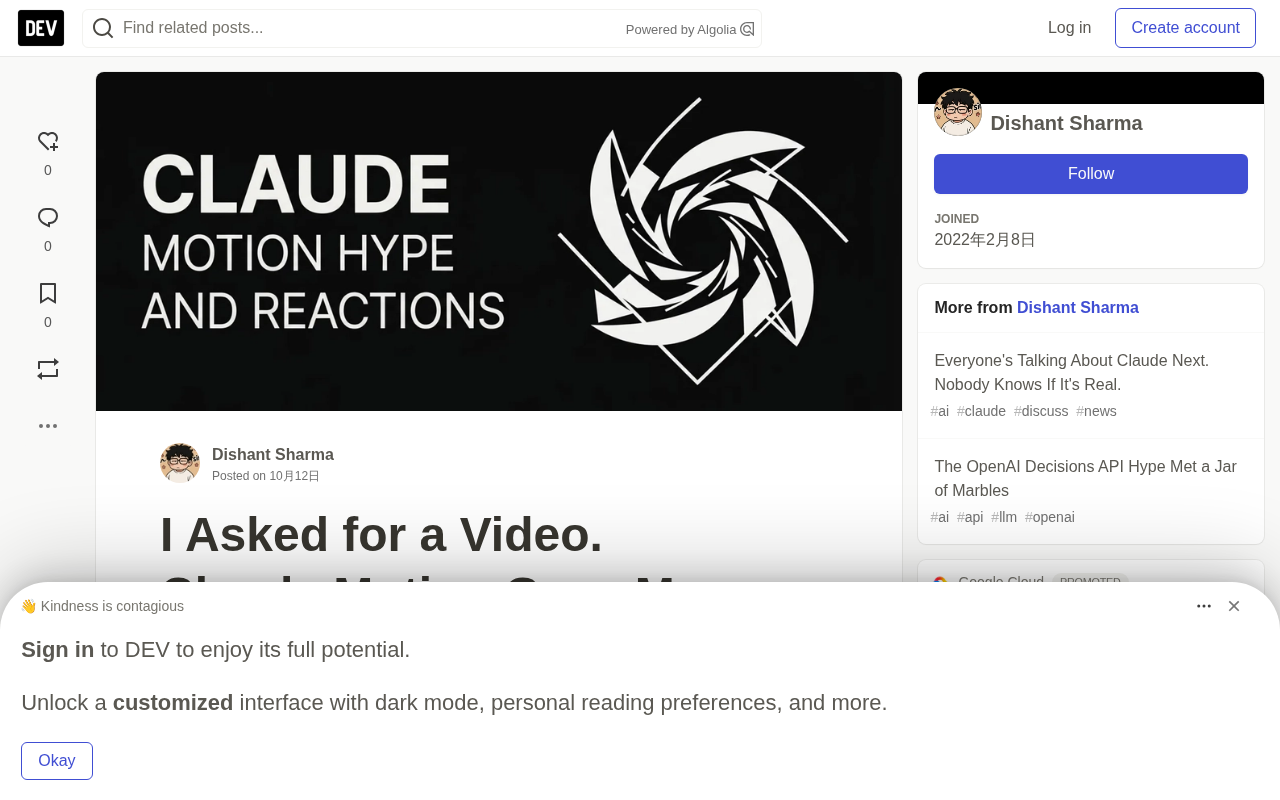
That detail explains the essence of Claude Motion better than any of Anthropic's launch videos. Anthropic has moved Claude Dashboards and Claude Motion into beta, while taking Docs, Slides, and Design fully out of beta across all plans, including free. The official description is simple: turn a quarterly report into a 30-second editable, downloadable short video. But it is not a video generator. It outputs code, then exports to MP4.
What Claude Motion Actually Is
There is only one core fact: Claude Motion is not a video generation model. It has Claude write code that drives the motion of text, charts, graphics, and images, then plays it back as a short video. There are no generated frames, no AI characters, no assets conjured from nothing.
This is a deliberate choice. The animations are built on Motion templates, which are essentially code. So you can change a word, a number, or a timestamp and everything else stays intact. A clip generated with Sora cannot do that—change one thing and you have to redo the whole thing.
That is smart, but it also explains why the result looks like a slide deck in motion rather than a film. It was never meant to be a film.
Keyframe is a core concept in motion design used to define animation states. It refers to a property value explicitly recorded at a specific point on the timeline, such as position, opacity, scale, or rotation angle. Animation software automatically interpolates between adjacent keyframes to create smooth transitions. Keyframes are called "where the magic happens" because they let designers precisely control pacing, ease-in and ease-out, exaggeration, and detail—exactly what gives animation emotion and narrative tension. Without keyframes, animation is just mechanical linear change, looking like a moving slide deck rather than something with a sense of life. Claude Motion's template-based approach gives up frame-by-frame control in exchange for the editability of "change a number without breaking the structure," which directly determines that its audience is internal presentations rather than professional animation.
Who Can Actually Use It
On my first attempt, I could not find the entry point at all. Claude Motion is a beta feature for Team and Enterprise, and it requires an admin to enable it manually. It is off by default on Enterprise.
So most of the internet is forming opinions about a product they cannot open. The people who can use it are sitting on paid team plans, while the people hyping it are often on individual plans with no access at all.
The confusion goes deeper. A highly upvoted post on r/ClaudeAI was titled "Just used Claude Motion for the first time and I'm genuinely blown away," and it ended with the author correcting themselves: "Sorry, it was actually Claude Design's animation feature." That video did extract real statistics on 30 years of New Zealand house prices without the user manually looking up the data. Cool, but it was not testing the product it claimed to be.
What Professionals Think
Most tutorials only cover the hype version. The honest version is the r/MotionDesign post "What kind of motion work will survive the AI era?"
A working motion designer looked at Claude's output and called it beginner-level, with no keyframes. And keyframes are exactly where the magic happens. His conclusion was that cheap talking-head explainer work is basically done.
Keyframes are where the magic happens.
The comments agreed. Flat corporate default styles and stock vector assembly are the first things to get eaten. One line summed it up well:
You will never convince a client whose budget only covers beer to appreciate wine.
On the other side, Hacker News was almost absent. The launch post had only a few points and almost no discussion. Reddit argued; HN shrugged.
The Trade-offs You Actually Make
The reality is that you trade control for speed. Put Claude Motion next to video models like Veo and Sora, and the difference is very clear:
| Claude Motion | Video models (Veo, Sora) | |
|---|---|---|
| Output | Code, exported as mp4 | Pixels |
| Change one number | Everything else stays | Redo the whole thing |
| People and live action | Absent by design | Present, sometimes uncanny |
| Cost | Plan usage, more expensive the longer it gets | Per-generation |
Motion consumes plan usage, and longer, more complex animations use more than a normal message. The so-called "30-second explainer video" is not free, and on most plans it is out of reach entirely.
I like the direction. Editable code beats non-editable video. But opening it to only two plan tiers and naming it alongside another feature that already does animation has produced a launch where nobody is sure what they are reacting to.
Video generation models (such as Sora and Veo) and code-driven animation are fundamentally different in mechanism. The former is based on diffusion models, predicting and generating continuous frames pixel by pixel, and it excels at rendering complex lighting, human motion, and realistic texture. But the output is essentially a "dead" pixel sequence—any change means regenerating the entire video, and it is hard to guarantee consistency of characters or scenes. The latter (Claude Motion) uses code to define element properties and temporal relationships, outputting a reusable, partially editable set of instructions. The two are not substitutes: video models suit shots that need realism and complex narrative, while code animation suits data visualization, chart presentations, and internal content that follows brand guidelines. Understanding this distinction makes it clear why Claude Motion deliberately chooses "not to generate frames"—what it wants is not to look like a film, but to look like an editable presentation.
The Detail Almost Nobody Covered
What surprised me was that the standalone Claude Design website will shut down on December 14. Anthropic is folding Design into the main Claude product and closing the old URL.
People have already produced more than 45 million documents, presentations, and designs in Claude. A lot of the love online about "motion" actually comes from Design, not Motion. People make polished animated videos in a day with no motion graphics training, passing prompts around like recipes.
So while the confusingly named new feature waits in team-plan beta, the thing people actually like is quietly moving. For creators, the shutdown of the old site is the bigger news.
Claude Design is an independent design tool previously launched by Anthropic that lets users generate documents, presentations, brand assets, and basic animations through natural language prompts, with the standalone website handling the entire creation and saving workflow. Folding Design into the main Claude product means workspaces, historical files, and feature entry points will all migrate, and the old URL will stop working after December 14. For users who have accumulated a large body of work, this is not a simple rename but a forced migration of assets and habits. At the same time, Design's animation capabilities overlap functionally with Motion, but the two differ in plan thresholds, output formats, and positioning. This crossover in naming and features is the root of the outside confusion. Anthropic's choice to push the Design migration and the Motion beta in the same window objectively scattered the focus of discussion and amplified the cognitive confusion about "who is using what."
When Names Collide
These days every product name collides with something. Search "Claude Motion" on Reddit and you get this feature, plus an r/GTA post asking who the motion capture actor for Claude in GTA 3 is, plus a post called "Claude Motion Sickness" where a team feels physically nauseous after long coding sessions.
That motion sickness post is real and has nothing to do with animation. Long hours, dual monitors, and feeling carsick by the end of the day. Their setup has not changed in six years. Nobody can explain it.
And the GTA post is my favorite. Claude grunts when he falls in GTA 3, and people genuinely want to know who voiced him. The internet is a beautiful place.
Every product name now collides in three ways: the feature, the profession, and something unrelated that people happen to feel. "Motion" hit all of them within a week.
Straight Talk
Most people do not need Claude Motion. If you are on an individual plan, you cannot open it. If you need real motion design, it cannot give you keyframes. If you need people or live action, it deliberately refuses.
What it does not do:
- It does not generate live-action footage or characters
- It does not offer bendable keyframes
- Exports have no audio; you handle audio yourself
It is for teams that need internal explainers, board presentations, onboarding flows, and all-hands videos. That is its entire lane. It is a good lane, but a narrow one.
And what people are actually excited about is Claude Design's animation feature, which is available now under a different name. Anthropic shipped two overlapping things at the same time and then let the internet sort out who was who. I may be wrong, but the launch process already said everything: the highest-engagement "Motion" content is actually about something else.
If you are a motion designer, do not panic yet. Cheap work is at risk; opinionated work is not. If you are a team lead who hates making slides, this might genuinely save you. Both things are true at once.
I keep coming back to that html file. A person asks for a video and gets a file that will not play anywhere. He asks again, the file converts, and it works.
That is a portrait of Claude Motion: almost a video, one step away from your expectations, and actually fine once you understand the trick.
The hype will keep coming. Every week there is a new demo that looks like it ended a profession. But the people actually pushing slides, charts, and numbers are not dead—they are just on a different plan tier.
One day, when you export your first explainer video, you will not think about the file format anymore. On that day, the name will finally make sense. Until then, I will be here, still converting html files.
One-line Summary
Claude Motion is not a video generator but a code-driven animation tool that exports MP4, with a narrow use case most people cannot access.
Paragraph Summary
Anthropic has moved Claude Motion and Claude Dashboards into beta while taking Docs, Slides, and Design out of beta across all plans. Claude Motion is not a video generation model; it has Claude write code that drives text, charts, and graphics, then exports MP4, so it allows partial edits but lacks keyframes and looks more like a moving slide deck. It is only available in Team and Enterprise beta, so individual users cannot access it, and much of the praise online actually comes from Claude Design's animation feature. Compared with Veo and Sora, it trades control for speed and fits a narrow lane like internal explainers and board presentations. The standalone Claude Design site will shut down on December 14 and be folded into the main product, which is the bigger change people overlooked.
Related articles
LLaMA-Factory in Practice: A Complete No-Code Guide to Fine-Tuning Large Models
An introduction to LLaMA-Factory, the open-source fine-tuning tool: its 60.1K-star background, supported models and algorithms, local vs. cloud deployment, and CUDA setup steps.

Zeng Ming's Deep Retrospective: Why OpenAI May Not Be the Ultimate Winner — and Why the Corporate System Will Disappear
Zeng Ming's deep retrospective on the AI endgame: model companies are just infrastructure, OpenAI and Anthropic won't be the final winners; the next battle is the Agent entry point standard; the corporate system will disappear as AI restructures collaboration, and only mission-driven companies can survive the cycle.

OpenHands v1.28.0: OpenCode and PI Added as Built-in Agents, API Keys Requestable In-Conversation
OpenHands ships 5 releases in 21 days: v1.27.0 adds OpenCode and PI as built-in agents, v1.28.0 enables in-chat key requests. ACP integration, credential reuse, model list changes, and upgrade advice.