Claude Mythos 5.1 and Fable 5.1 Error Incident Analysis
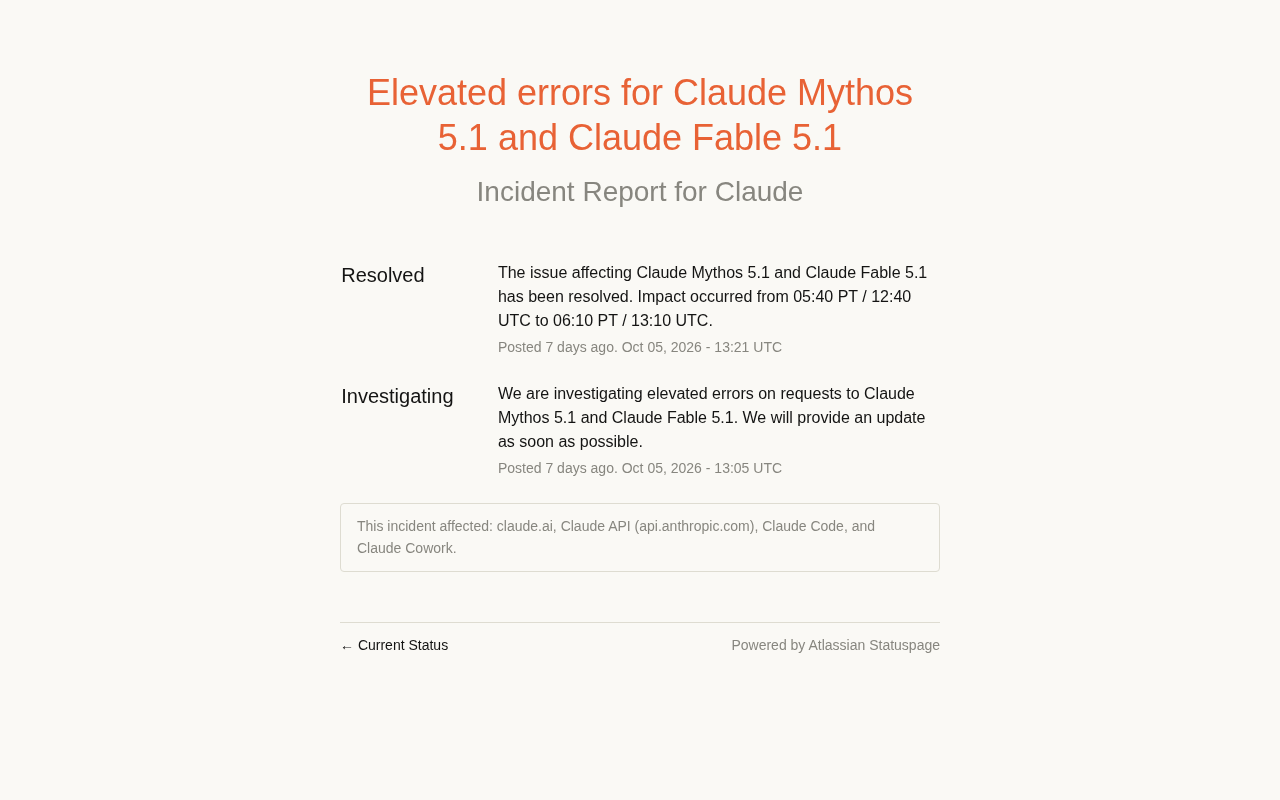
Claude's two models saw a 30-minute error rate spike, quickly resolved by the official team.
Claude Mythos 5.1 and Claude Fable 5.1 experienced elevated request error rates from 05:40 to 06:10 PT, lasting about 30 minutes. The official status page posted Investigating and Resolved updates in sequence, with a complete and transparent response. The article analyzes AI service stability challenges from an operations perspective, including GPU cluster scheduling, batching optimization, and model loading, and recommends developers establish monitoring, retry backoff, fallback model switching, and error budget management for third-party AI services.
Incident Recap: A 30-Minute Service Fluctuation
According to the official status page, Claude Mythos 5.1 and Claude Fable 5.1 both experienced elevated request error rates within a short window. The timeline is clear: anomalies began at 05:40 PT (12:40 UTC), and the team immediately launched an investigation. About 25 minutes later, at 06:10 PT (13:10 UTC), the issue was confirmed resolved. From initial impact to full recovery, the entire window lasted exactly 30 minutes.
The official status page published two updates: first an "Investigating" status confirming high error rates for both models, followed by "Resolved" announcing the issue was fixed. This rapid response and transparent communication is commendable in AI service operations.
Converting between Pacific Time (PT) and Coordinated Universal Time (UTC) is key to understanding timelines on cloud service status pages. Pacific Time uses UTC-8 (standard time, PST) or UTC-7 (daylight time, PDT). In this case, 05:40 PT corresponds to 12:40 UTC, indicating daylight saving time (PDT). Major cloud providers' status pages typically display UTC first because it's a globally unified reference that helps operations teams across time zones align on incident windows; local time helps affected users intuitively assess the business impact during their working hours. When subscribing to status page RSS feeds or configuring alerts, developers should pay attention to timezone labels on timestamps to avoid misreading UTC as local time and under- or over-estimating the outage window.
"Investigating" and "Resolved" are industry-standard incident lifecycle states. Other common states include Identified (root cause found), Monitoring (fix applied and being observed), and Postmortem (post-incident analysis published). Public status page updates typically only disclose the scope of impact and current remediation stage, not the specific root cause, to prevent misleading conclusions before the investigation is complete.
Impact Scope and User Perception
This incident affected two specific models: Claude Mythos 5.1 and Claude Fable 5.1. Notably, the status page did not mention a platform-wide or API-wide outage, suggesting the issue was likely confined to specific model versions or related inference infrastructure.
For developers using these two models, a 30-minute error window is enough to cause:
- Failed API calls in production, triggering retry logic or fallback strategies
- Interrupted automated workflows requiring manual intervention to recover
- Degraded user experience, especially in end-user-facing products
However, from another perspective, a 30-minute recovery is relatively short for cloud service incidents. Most major cloud providers have an average recovery time of over 1 hour for P1-level incidents.
P1 incidents and Mean Time To Recovery (MTTR) are common metrics for measuring service reliability. P1 (Priority 1) typically refers to severe incidents that impact core functionality, affect a large number of users, or cause business interruption; definitions vary slightly across vendors, but most set P1 recovery targets at the hour level. MTTR (Mean Time To Recovery) is the average time from incident occurrence to service restoration, and is one of the key SLIs in SRE. The reason 30 minutes is considered "relatively short" is that it's below many cloud providers' public commitments or historical medians for P1 incidents. However, MTTR only reflects recovery speed, not incident frequency; evaluating a service's stability also requires considering availability percentage, Mean Time Between Failures (MTBF), and error budget burn rate.
Operations Perspective: AI Service Stability Challenges
Stability issues in large language model services are fundamentally different from traditional web service failures. Model inference involves GPU cluster scheduling, batch optimization, model loading and unloading, and more — an anomaly in any of these can manifest as elevated request error rates.
Such incidents typically have several common triggers: first, traffic spikes causing insufficient capacity, as certain model versions may see request peaks during specific periods; second, occasional infrastructure failures such as GPU node anomalies or network jitter; third, regression issues introduced by model updates or configuration changes.
The official status page did not disclose the specific root cause, which is consistent with industry practice — detailed post-incident analysis reports are typically published within days after resolution.
The uniqueness of LLM inference infrastructure lies in its resource binding, which differs from traditional stateless web services. A model inference request requires loading weights onto GPUs, executing forward computation, and returning results, involving VRAM usage, batching scheduling, and KV cache management. When multiple model versions share the same inference cluster, a traffic surge or model loading anomaly for one version can squeeze resources from others, causing elevated error rates for specific models while other platform services appear normal. Batch optimization improves GPU utilization by combining multiple requests into the same batch, but improper batch sizes and timeout settings can amplify tail latency. Model loading and unloading involves moving weights from storage to VRAM; during cold starts or version switches, imperfect scheduling strategies can create brief request failure windows. Together, these factors explain why AI service error rate incidents often exhibit characteristics of being "localized, sudden, and quickly resolved."
Recommendations for Developers
From this incident, developers relying on the Claude API can distill several practical recommendations:
Establish monitoring and alerting mechanisms. Subscribe to the official status page's RSS updates, or actively probe through API health check endpoints, to get notified the moment an incident occurs.
Design resilient calling strategies. Implement retry backoff mechanisms and fallback model switching logic at the application layer. When Mythos 5.1 is unavailable, automatically degrading to other available models can minimize impact on end users.
Pay attention to error budgets. For products with high SLA requirements, consider incorporating third-party AI service availability into overall error budget management, and design multi-vendor redundancy plans accordingly.
Error Budget is a quantitative management tool in SRE based on SLOs (Service Level Objectives). If a service commits to 99.9% monthly availability, the allowed unavailability is about 43 minutes; those 43 minutes constitute that month's error budget. Incorporating third-party AI services into error budget management means clarifying in advance: when vendor outages consume a certain amount of budget, the system should trigger degradation, switching, or manual intervention. Multi-vendor redundancy means using two or more model vendors at the architecture level, distributing requests through a routing layer based on health status or cost strategies. Note that multi-vendor setups introduce differences in output format, latency characteristics, and pricing, requiring normalization at the abstraction layer — otherwise the complexity of redundancy may outweigh its benefits.
Summary
This error incident with Claude Mythos 5.1 and Fable 5.1, while short-lived, reminds us that even top-tier AI service providers cannot completely avoid service fluctuations. For developers, rather than pursuing the perfect assumption of zero incidents, it's better to make resilience design a default option in system architecture. The official team completed the entire process from detection to resolution within 30 minutes — a commendable response efficiency — but the specific root cause still awaits a follow-up post-incident analysis report.
Related articles

Apple HomeView Hands-On Review: Is the $300 Smart Home Hub Worth It?
Apple HomeView hands-on: a $300 smart home hub with facial recognition for quick account switching, but no App Store or voice recognition. Is the wall-mounted version worth it? Should you buy the first generation?

Meta Muse Wonder Launch: What It Means for Meta's Return to the Frontier AI Race
Meta releases Muse Wonder and WonderFull, benchmarks reach the frontier, community feedback is polarized. An in-depth look at Meta's return to the frontier AI race, its personal agent strategy, and Zuckerberg's different path.

Apple Home Smart Home Lineup Leaked: LG and Schneider Team Up, UWB Door Lock on Board
Apple Home ecosystem gains new LG and Schneider devices: UWB smart lock with proximity unlock, 2.5K dual-camera doorbell, privacy indoor camera, and AirPods-like seamless pairing.