Claude Mythos 5.1 and Fable 5.1 Experience Intermittent Error Spikes
Anthropic's two models closed out an intermittent error spike in about 86 minutes, without disclosing the root cause, highlighting the necessity of client-side fault tolerance.
Anthropic's status page recorded an intermittent error spike incident affecting Claude Mythos 5.1 and Claude Fable 5.1, lasting about 86 minutes from being marked Investigating at 09:48 UTC to Resolved at 11:14 UTC, with no root cause disclosed. Both models reporting errors at once usually points to platform-side causes such as shared infrastructure fluctuations, upstream dependency jitter, or side effects of configuration changes, rather than a single model's logic problem. The article notes that intermittent errors appear as spikes, are difficult to reproduce steadily, and are harder to troubleshoot than sustained failures, requiring historical metrics and sampled logs to reconstruct the scene. For developers, it recommends building exponential backoff plus jitter retry strategies into the calling layer, subscribing to status page alerts, distinguishing model errors from platform errors, and preparing multi-model or multi-provider fallback paths for critical links.
Anthropic's status page recorded an incident affecting Claude Mythos 5.1 and Claude Fable 5.1, with both models showing elevated intermittent error rates around the same time. From detection to fix deployment, the whole process took less than two hours.
Incident Timeline Reconstruction
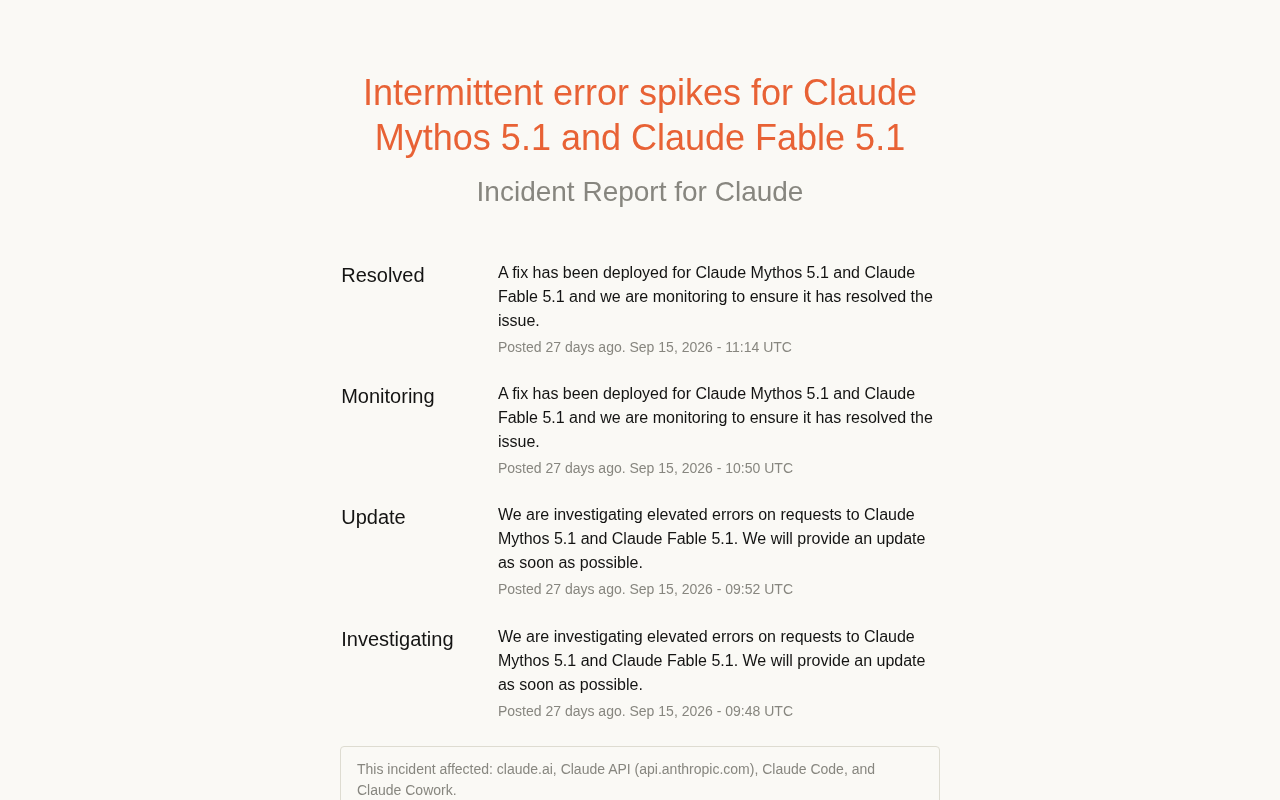
According to the information disclosed on the status page, the incident went through a complete flow from Investigating to Resolved:
- 09:48 UTC: Anthropic first flagged it as Investigating, confirming it was looking into elevated errors on Claude Mythos 5.1 and Claude Fable 5.1 requests.
- 09:52 UTC: Status updated to Update, with content essentially the same as Investigating, indicating the root cause had not yet been identified.
- 10:50 UTC: Status moved to Monitoring, the fix had been deployed, and the team was watching the results.
- 11:14 UTC: Status marked as Resolved, confirming the issue was fixed.
From first disclosure to declared resolution, roughly 86 minutes elapsed. For an error spike incident affecting two production model services, this response pace is fairly tight.
The standardized flow of status pages: Major cloud providers and API service providers generally adopt a set of conventional status levels, commonly including Investigating (reports received, verifying and locating), Identified (root cause confirmed), Monitoring (fix deployed, watching whether metrics stabilize), and Resolved (confirmed back to normal). The value of this flow is that it externalizes internal investigation progress into predictable signals, letting external callers decide whether to switch to fallback plans. It's worth noting that being marked Monitoring does not mean the problem has completely disappeared, but rather that remediation actions have landed and entered a validation window; if metrics worsen again during the observation period, the status may roll back to Investigating. Therefore, when developers see Monitoring, they should still keep retry and fallback logic active until Resolved appears.
What It Means When Two Models Are Affected at Once
What's notable is that it wasn't a single model having issues, but Claude Mythos 5.1 and Claude Fable 5.1 reporting elevated errors at the same time. This usually points to several possibilities:
A problem at the shared infrastructure layer. When multiple models go abnormal simultaneously, it's often not that a single model's weights or inference logic failed on its own, but more likely that shared routing, scheduling, authentication, or rate-limiting components experienced fluctuations.
Jitter in upstream dependencies. If both models depend on the same inference cluster or the same batch of compute resources, then instantaneous pressure on the resource side would also show up in both models' error rates at the same time.
Side effects of a release or configuration change. A configuration push targeting multiple models could also affect multiple service endpoints simultaneously.
Anthropic did not disclose the root cause on the status page, only stating that "a fix has been deployed." From an engineering practice perspective, being able to move from Investigating to Monitoring in under an hour suggests the team's path for locating such issues is already fairly mature—either they have robust monitoring and alerting that can quickly narrow the scope, or they have a rollback-capable change mechanism.
Intermittent Errors Are Harder to Handle Than Sustained Failures
The phrase "Intermittent error spikes" in the title deserves separate unpacking. Intermittent means the errors do not reproduce steadily, but appear in peaks.
Troubleshooting this kind of issue is significantly harder than sustained failures. Sustained failures have clear reproduction paths, and logs directly show a large volume of consistent errors; intermittent spikes, however, often appear on monitoring charts as short-lived spikes, and by the time engineers step in they may have already subsided, requiring historical metrics and sampled logs to reconstruct the scene.
For developers building applications on the Claude API, the practical impact of such incidents also varies by usage pattern:
- Interactive applications with synchronous calls: Users may directly perceive occasional failures, requiring retry logic as a safety net.
- Batch offline tasks: Peaks are more easily absorbed through queue retries, but the retry pace needs to be controlled to avoid intensifying upstream pressure during the error window.
- Latency-sensitive scenarios: Even if requests ultimately succeed, latency jitter caused by retries can affect the experience.
The measurement issue with error rate metrics: Monitoring systems typically aggregate request success rates over fixed time windows (such as per minute), and intermittent spikes get averaged out under coarse-grained windows, appearing as only a slight elevation; only by switching to finer windows or percentile metrics (such as p99 error rate, consecutive error counts) can the spike shape be captured. In addition, errors may be concentrated in a specific region, a specific API version, or a specific request size, creating the illusion of "normal overall, abnormal locally." This is also why troubleshooting such issues often requires looking at aggregate metrics, dimension-drilled grouped metrics, and sampled logs with request IDs at the same time, corroborating all three to reconstruct the true conditions under which errors occur.
Practical Takeaways for Developers
This incident itself has already closed out, but it provides a sample for observing the stability of production-grade LLM services. A few actionable practices:
Build retries and backoff into the calling layer. Facing intermittent error spikes, an exponential backoff plus jitter retry strategy is more effective than fixed-interval retries, avoiding a large number of clients retrying at the same moment.
Subscribe to the status page and set up alerts. The status page timeline is the basis for retrospective tracing, but during an incident, being able to know as soon as possible directly affects how efficiently it is handled. Connecting the status source to your own alerting channel is more reliable than manual polling.
Distinguish between "model errors" and "platform errors." When multiple models report errors at the same time, suspect the platform side first rather than prompt or parameter issues, which can save detours.
Prepare fallback paths for critical links. If the business has high availability requirements, consider routing across multiple models or multiple providers to spread the risk of single-point dependency.
Key implementation points for exponential backoff and jitter: Exponential backoff means increasing the wait time by a multiple on each retry (such as 1s, 2s, 4s, 8s), avoiding repeated impacts while the server has not yet recovered; Jitter means adding a random amount to the calculated wait time, preventing a large number of clients from retrying at the same moment due to adopting the same backoff curve and forming a new traffic pulse. Common approaches include "full jitter" (random value between 0 and the current backoff cap) and "equal jitter" (fluctuating proportionally around the calculated value). At the same time, a maximum retry count and total timeout budget should be set, and retries should be idempotent to avoid duplicate side effects from non-idempotent requests during retries.
Summary
This intermittent error spike for Claude Mythos 5.1 and Fable 5.1 lasted about an hour and a half from Investigating to Resolved, with no root cause disclosed. The incident itself was not severe, but it serves as a reminder: even top-tier vendors' model services can experience short-term error fluctuations, and client-side fault tolerance design is not optional—it's essential.
One-line Summary
Anthropic closed out an intermittent error spike affecting two models in about 86 minutes, without disclosing the root cause, highlighting the necessity of client-side fault tolerance.
Paragraph Summary
Anthropic's status page recorded an intermittent error spike incident affecting Claude Mythos 5.1 and Claude Fable 5.1, lasting about 86 minutes from being marked Investigating at 09:48 UTC to Resolved at 11:14 UTC, with no root cause disclosed. Both models reporting errors at once usually points to platform-side causes such as shared infrastructure fluctuations, upstream dependency jitter, or side effects of configuration changes, rather than a single model's logic problem. The article notes that intermittent errors appear as spikes, are difficult to reproduce steadily, and are harder to troubleshoot than sustained failures, requiring historical metrics and sampled logs to reconstruct the scene. For developers, it recommends building exponential backoff plus jitter retry strategies into the calling layer, subscribing to status page alerts, distinguishing model errors from platform errors, and preparing multi-model or multi-provider fallback paths for critical links.
Related articles

Apple HomeView Hands-On Review: Is the $300 Smart Home Hub Worth It?
Apple HomeView hands-on: a $300 smart home hub with facial recognition for quick account switching, but no App Store or voice recognition. Is the wall-mounted version worth it? Should you buy the first generation?

Meta Muse Wonder Launch: What It Means for Meta's Return to the Frontier AI Race
Meta releases Muse Wonder and WonderFull, benchmarks reach the frontier, community feedback is polarized. An in-depth look at Meta's return to the frontier AI race, its personal agent strategy, and Zuckerberg's different path.

Apple Home Smart Home Lineup Leaked: LG and Schneider Team Up, UWB Door Lock on Board
Apple Home ecosystem gains new LG and Schneider devices: UWB smart lock with proximity unlock, 2.5K dual-camera doorbell, privacy indoor camera, and AirPods-like seamless pairing.