Claude Opus 5.5 Error Surge: A Full Record of a 23-Minute Service Disruption

Claude Opus 5.5 errors surged; Anthropic fixed it in 23 minutes, exposing stability and transparency gaps in LLM services.
Anthropic's status page recorded a Claude Opus 5.5 service anomaly: marked Investigating at 12:24 UTC, root cause identified at 12:37, resolved at 12:43—about 23 minutes total. Official disclosures covered only state transitions, not error types, impact ratios, or root cause attribution. The article notes that LLM APIs often sit on the critical path and lack smooth fallback, so brief failures can be amplified into user-visible outages; model availability is becoming a hard enterprise selection criterion, and status page transparency directly affects developer trust. It concludes with practical tips on timeout retries, multi-model fallback, status-page-linked alerts, and graceful degradation.
Claude Opus 5.5 Error Surge: A Full Record of a 23-Minute Service Disruption
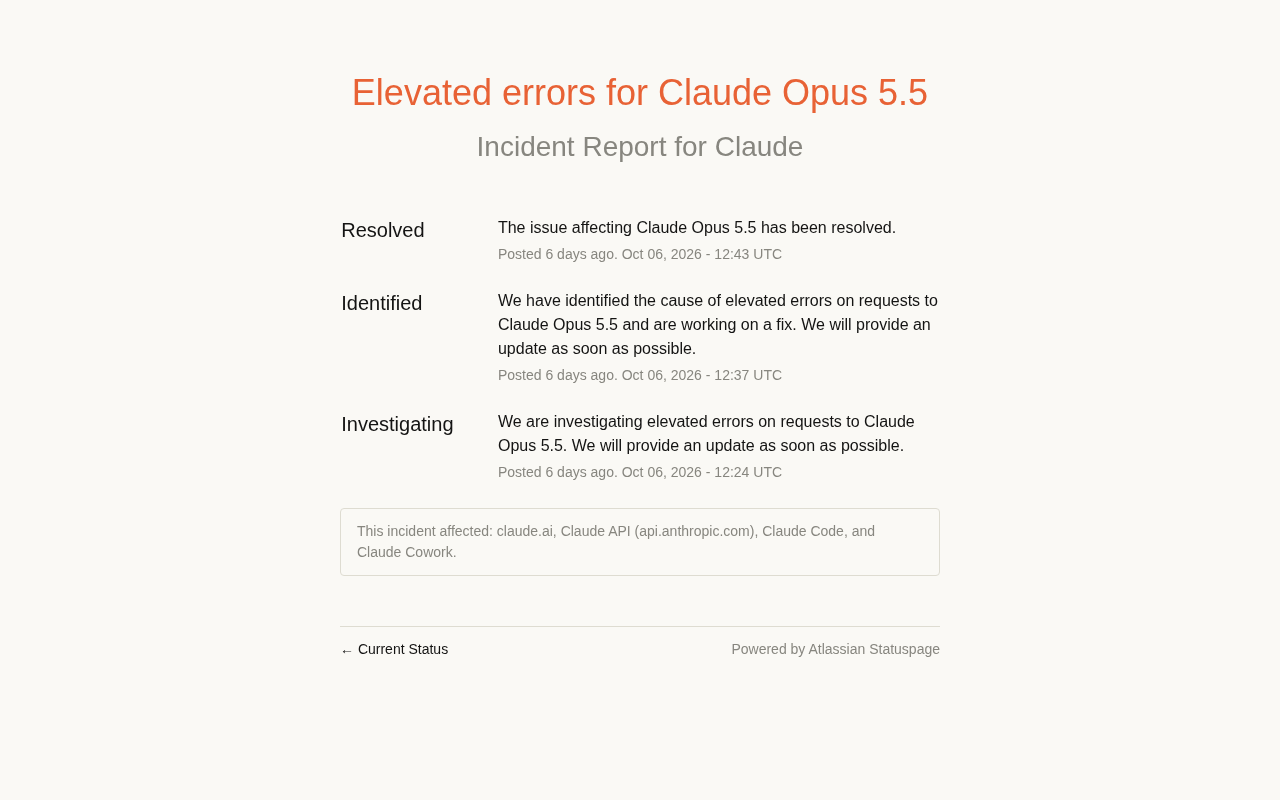
Anthropic's official status page recorded a service anomaly affecting Claude Opus 5.5. From the first "Investigating" flag to the "Resolved" announcement, the entire process lasted about 23 minutes. For developers building products on top of this model, that window is long enough for a batch of production requests to fail simultaneously—and it once again pushes the stability of large model services into the spotlight.
Event Timeline: 23 Minutes from Discovery to Fix
According to three updates on the status page, the event unfolded at a fairly tight pace. At 12:24 UTC, Anthropic first marked the status as Investigating, confirming a "surge in errors" on Claude Opus 5.5 requests and promising updates soon. Just 13 minutes later, at 12:37 UTC, the team moved the status to Identified, indicating the root cause had been found and a fix was underway. Six minutes after that, at 12:43 UTC, the official announcement declared Resolved, closing out the incident.
You may not have noticed, but Anthropic never disclosed the specific proportion of affected requests, the error type (whether timeout, rate limiting, or internal error), or where the root cause lay—model inference side, API gateway, or underlying infrastructure. For ordinary users, this is just a line on a status page; for engineering teams, the missing information is precisely what determines whether they need to add fallback logic.
Anthropic's status page uses the industry-standard three-phase incident state machine: Investigating means an anomaly has been confirmed but the root cause is unknown; Identified means the root cause has been found, a fix determined, and remediation underway; Resolved means abnormal metrics have returned to normal and the incident is closed. This vocabulary comes from default templates provided by status page vendors like Statuspage and is widely adopted by mainstream cloud providers. The speed of state transitions is itself a signal: taking only 13 minutes from investigation to identification suggests the problem was most likely not a hard-to-reproduce bug requiring lengthy reproduction, but rather something quickly diagnosable like a configuration change, capacity bottleneck, or dependency component glitch.
Why a Brief Disruption Deserves Serious Attention
Twenty-three minutes might count as a minor blip for traditional web services, but in the context of large model APIs, its impact gets amplified. Most AI applications place model calls on the critical path: a single request delay or failure can directly cause conversation interruption, Agent task deadlock, or even trigger a chain reaction of upstream timeouts.
More crucially, model services usually lack smooth transition mechanisms like "fall back to the old version." Switching models means output style, format stability, and tool-calling behavior may all change, so many teams would rather fail briefly than temporarily switch to another model. As a result, a surge in server-side errors often translates directly into a batch of user-visible failures on the client side. This also explains why the developer community is so sensitive to the granularity of status page updates—the vaguer the information, the harder it is to make decisions.
Exponential backoff retry refers to a client gradually lengthening retry waiting times at exponential intervals like 1s, 2s, 4s, 8s after a request failure, and may layer on random jitter to prevent large numbers of clients from retrying simultaneously at the same moment. It matters because error surges in large model APIs are often transient—when the server is overloaded, if all clients retry immediately and without restraint, it creates a "retry storm" that further crushes an already fragile service. Exponential backoff combined with idempotency guarantees both gives the server a recovery window and avoids duplicate billing and duplicate side effects.
Model Stability Is Becoming a Hard Selection Criterion
For a while, competition among large models centered on dimensions like reasoning, coding, and multimodality. But as enterprise applications spread, the weight of availability is rising rapidly. No matter how strong a model is, if it frequently errors during peak hours and the status page is vague, teams will find it hard to put it on the critical path of production environments.
The Claude Opus 5.5 incident itself was not large in scale, and the official response speed was relatively timely. But it reminds us of one thing: for model vendors, the status page is not just a PR tool but an input source for developers making architectural decisions. If information like error rates, scope of impact, and root cause post-mortems could be disclosed more transparently, the accumulation of ecosystem trust would be far more valuable than the words "update soon."
Multi-model fallback in practice is not simply swapping the call address to another provider's API. Different models differ in output format, instruction-following degree, the JSON structure of function calling, context window, and even token billing methods, so direct switching may cause downstream parsing failures. A safer approach is to abstract a model adaptation interface at the application layer, with a unified input/output contract handled by the adaptation layer, and preset prompt fine-tuned versions for backup models. Data compliance must also be considered: if the business involves sensitive data, whether the backup vendor is on the allowlist is often locked down by legal during the selection phase.
Practical Tips for Developers
Facing unpredictable model service fluctuations, engineering-side preparations can include:
- Timeout and retry strategy: Set reasonable timeouts for model calls and enable exponential backoff retries for idempotent requests, so transient errors are not directly exposed to users.
- Multi-model fallback: Reserve switchable backup models on the critical path; even if output style differs, it is better than complete unavailability.
- Monitor status pages and error rates: Link vendor status pages with your own API error rate alerts to shorten discovery time.
- Graceful degradation for users: When the model is unavailable, provide clear prompts or a queueing mechanism rather than letting the interface spin endlessly.
The cost of such preparations is low, yet in similar incidents it can compress the impact from "service outage" to "degraded experience." Stability issues in model services will not disappear; whatever can be absorbed by engineering means should not be left to luck.
Related articles

Cursor AI Programming in Practice: Build a Student Management System from Scratch in 30 Minutes
A Bilibili creator demonstrates Cursor AI programming: generating a student management system in 30 minutes with natural language. Details on Agent mode, Claude selection, prompt techniques, and thresholds.

Top 20 AI Coding Tools Ranking: From Rock-Solid to Lackluster, a Scored Matrix
Bilibili creator releases top 20 AI coding tools ranking, tiered T0–T4 from rock-solid to lackluster, with Claude Code and Codex tied at T0. This article details the scoring dimensions (capability, reliability, robustness, durability, cost, domestic availability) and tool performances to help developers choose the right AI coding assistant.

Vibe Coding Systematic Tutorial: Master AI-Assisted Programming from Zero
A three-month Vibe Coding tutorial from a Bilibili creator covering Codex, ClaudeCode, and Cursor, from core logic to commercial project practice for beginners.