Claude Opus 5.5 Generates an Animated Short in One Shot: The $3.21 Autonomous Creative Experiment

Claude Opus 5.5 autonomously produced an animated short in 80 minutes from a single prompt, with only $3.21 in API costs.
A Reddit user demonstrated how a single prompt could direct Claude Opus 5.5 to autonomously create a hand-drawn collage-style animated short inside Claude Code — handling scripting, image generation, voiceover, and JavaScript animation with no human intervention. The process took about 80 minutes, called 8 different OpenRouter APIs, and incurred just $3.21 in external tool costs. The true cost, however, includes roughly $20 in model inference compute. The experiment's real significance lies not in its low price, but in showcasing a top-tier model's ability to orchestrate multiple tools for open-ended creative tasks — and validating a new paradigm where humans set goals and constraints while AI autonomously executes the full pipeline.
A Reddit user shared a striking experiment: using a single prompt, Claude's Opus 5.5 model autonomously produced a hand-drawn collage-style animated short film — from script and assets to voiceover and animation — with zero human intervention. The entire process took about 1 hour and 20 minutes, with OpenRouter API costs totaling just $3.21.
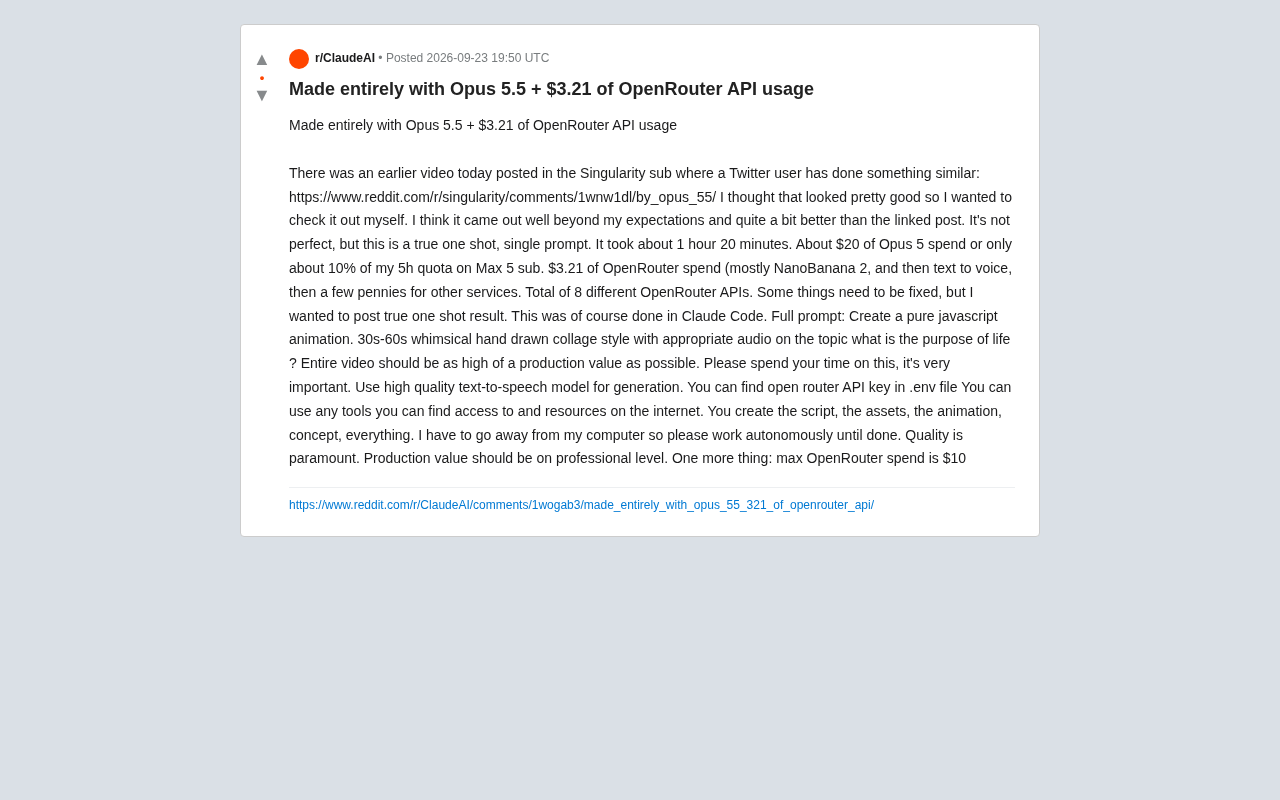
One Prompt, One Complete Short Film
The heart of this experiment is what the author calls a "true one shot." He emphasized that the final output wasn't the result of iterative refinement — it was generated by a single prompt, with the model running autonomously inside Claude Code until completion. He simply stepped away from his computer and let the AI make all its own decisions unsupervised.
Looking at the full prompt that was shared publicly, the task was remarkably open-ended: create a 30–60 second, hand-drawn collage-style animation in pure JavaScript with appropriate audio, on the theme of "what is the meaning of life," aiming for "the highest possible production quality, professional level." The model was given enormous freedom — script, concept, assets, and animation were all left entirely to the AI, which could use any tools and online resources it could find.
One notable constraint in the prompt: the OpenRouter spending cap was set at $10. This is a classic "budget guardrail" — a way to let an autonomous agent explore freely without costs spiraling out of control.
Cost Structure: A Two-Part Bill for Compute and API Calls
The experiment's costs broke down into two distinct parts, which nicely illustrates the current economics of AI-generated content.
One part is the inference cost of Opus 5.5 itself — the author estimated the equivalent of roughly $20 in Opus 5 usage, or about 10% of the 5-hour compute quota included in his Max 5 subscription. This covered the model's planning, code writing, and creative decision-making.
The other part was external services called through OpenRouter, totaling $3.21. The biggest chunk went to NanoBanana 2 (image generation), followed by text-to-speech (TTS), plus some miscellaneous service fees. The author mentioned the workflow called 8 different OpenRouter APIs in total.
In other words, the true cost of this short film isn't the $3.21 implied by the headline — it's a combination of subscription compute plus API calls. The low-cost figure in the title reflects the extremely low marginal cost of "external tool calls," while the model's own inference compute remains the dominant expense.
Understanding the cost structure here requires distinguishing between two different types of fees. Inference costs are billed per token processed; the Opus series is Anthropic's highest-tier model, priced significantly higher per token than lighter-weight versions like Sonnet or Haiku. Anthropic's Max subscription plan provides a fixed monthly compute quota, with overages billed per use. External API call costs operate on a pay-per-use model — image generation is typically billed per image or by resolution, while TTS is billed per character or audio duration. NanoBanana 2 is a model available on OpenRouter that specializes in illustration and collage-style image generation; it's known for low per-image costs and fast output, making it well-suited for agentic tasks that need to generate assets in bulk. This layered architecture — "expensive reasoning model handles planning and decisions, cheap specialized model handles content production" — is the dominant approach to cost optimization in AI-generated content today.
An Agent That Orchestrates Multiple Tools Autonomously
Beyond cost, what this experiment really demonstrates is the ability of today's top models to act as an orchestrator.
The model had to figure out on its own what stages a short animated film requires: write the script and narration first, then decide on a visual style for the assets, call an image API to generate frames, call TTS to produce voiceover, and finally use JavaScript to assemble all those assets into a rhythmically animated piece. The full chain involves creative, engineering, and resource-scheduling capabilities — and all of it was completed autonomously within a single prompt.
The coordinated use of 8 different APIs shows that the model can do more than call a single tool — it can plan a combination of tools for an open-ended task and manage the data flow between them. This is precisely why "Agentic workflows" are generating so much excitement.
An Agentic Workflow places a large language model in an execution environment where it can loop through decisions, call external tools, and self-correct — rather than simply processing a single input and producing a single output. Unlike traditional "Q&A-style" calls, an agent continuously observes the state of its environment, plans its next action, executes tool calls, and adjusts strategy based on the results — forming a closed "perceive–plan–execute" loop. Claude Code is exactly this kind of execution environment, designed for agentic tasks: it lets the model read and write files, run code, access the web, and iterate continuously in a sandbox. OpenRouter acts as a unified API gateway, giving the model a consistent interface to dispatch requests to specialized models from different providers — image generation, speech synthesis, and more — enabling cross-model tool orchestration. The key challenge in this architecture is "tool combination explosion" — as the number of available tools grows, the model needs sufficient planning ability to select a sensible execution path without getting stuck in inefficient loops.
How to Think About Demos Like This
The author himself maintained a measured tone: the final product is "not perfect" and "has some things that need fixing," but he committed to releasing the raw one-shot result without patching it, precisely to show genuine capability. He also noted that his result was "noticeably better" than a similar Twitter demo that had been circulating on the Singularity subreddit — exceeding his own expectations.
This kind of demonstration deserves a measured interpretation. On one hand, having an AI autonomously produce a short film with a "far exceeded expectations" level of production quality in 80 minutes does showcase a real leap in model planning and tool-calling capabilities. On the other hand, "one-shot generation" framing often obscures hidden costs — including subscription compute, carefully designed prompts, and the author's own familiarity with the Claude Code environment and OpenRouter ecosystem.
The real value of this experiment isn't the attention-grabbing "$3.21 for a short film" headline. It's the new creative paradigm it sketches out: humans define the goal and constraints (budget cap, quality requirements, theme), and AI autonomously handles all execution from concept to finished product. This approach is far from mature, but the direction is clearly visible.
Related articles

iPhone Duo Tips: An Essential Getting-Started Guide
iPhone Duo is Apple's all-new iPhone form factor with an obvious learning curve. This guide offers getting-started tips to help pre-order users adapt quickly.

Cursor AI Programming in Practice: Build a Student Management System from Scratch in 30 Minutes
A Bilibili creator demonstrates Cursor AI programming: generating a student management system in 30 minutes with natural language. Details on Agent mode, Claude selection, prompt techniques, and thresholds.

Top 20 AI Coding Tools Ranking: From Rock-Solid to Lackluster, a Scored Matrix
Bilibili creator releases top 20 AI coding tools ranking, tiered T0–T4 from rock-solid to lackluster, with Claude Code and Codex tied at T0. This article details the scoring dimensions (capability, reliability, robustness, durability, cost, domestic availability) and tool performances to help developers choose the right AI coding assistant.