Claude Opus 5.5 Tested: AI Creates Game-Ready Animations in Blender in 30 Minutes

Claude Opus 5.5 generates complete game-ready animation sets for rigged characters in under 30 minutes via Blender.
A creator tested Claude Opus 5.5 with Higgsfield's Blender plugin for game character animation across two tasks: FPS weapon animations (5 actions, 37 min) and a T-Rex (6 actions, 27 min), both working from pre-rigged models. Highlights included a detailed reload sequence and tail-swinging walk cycle; the run loop needed minor tweaking. The animations were then exported as a play blast, uploaded to Higgsfield, and processed through SeaDance 2.5 into a photorealistic jungle sequence with rain and sound effects — pointing to a powerful new pipeline for indie developers facing the chronic scarcity of custom creature animation assets.
Can AI genuinely handle high-skill work like 3D animation? A content creator (in a test video originally from YouTube) put Claude Opus 5.5 through a seriously rigorous challenge using Higgsfield's Blender plugin — not writing scripts or generating static models, but creating complete game animation sets for already-rigged characters. The results suggest AI is advancing in animation faster than many people expect.
The Test: From FPS Weapons to Dinosaurs
This wasn't a simple task. The creator targeted one of game development's most practical needs — character animation. Two sets of pre-rigged models were prepared: a first-person arm rig with an AK-47, and a T-Rex model downloaded from Sketchfab.
For the FPS weapon set, the prompt asked Claude to create a complete, polished suite of first-person animations — idle, walk, run, fire, and reload — organized as separate actions for easy use in a game engine. The key insight here: AI isn't generating models from scratch, it's manipulating existing rigs through keyframe animation, which is much closer to how a real animator actually works.
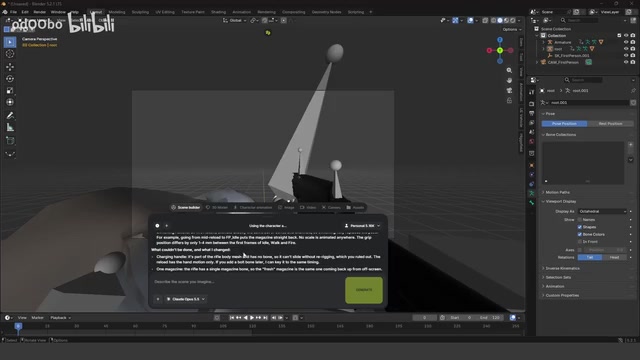
The workflow itself is straightforward — download Blender (free) and Higgsfield's Blender plugin, install it from disk in the add-ons preferences, log in, and a chat window appears. Paste your prompt and hit generate.
Rigging is the foundational step in 3D animation: animators build a hierarchy of bones and joints inside the mesh, then use skinning to map bone movement to vertex deformation on the model's surface. For humanoid characters, this process is relatively standardized — tools like Mixamo can automate it. For non-humanoid creatures like dinosaurs, bone structures vary significantly and auto-rigging tools often fall short, requiring animators to manually define each bone's influence and weight. This is why the test starts with pre-rigged models — AI skips the highest-barrier stages of modeling and rigging and focuses purely on keyframe animation, which is already the most creatively demanding and time-consuming part of an animator's daily work.
FPS Weapon Animations: 5 Actions, 37 Minutes, ~200–300 Credits
Claude Opus 5.5 didn't dive in immediately. It spent roughly eight minutes analyzing the scene, then added a camera, switched to a first-person perspective, and began blocking out animations one by one. It started with the idle pose, confirmed hand placement, then worked through the rest — reaching the reload animation around the 20-minute mark. The full process took 37 minutes and consumed approximately 200 to 300 credits.
The standout result was the reload animation — mag drops out, gets reinserted, bolt gets racked. The completeness of that sequence prompted a "pretty crazy" reaction. The run animation held up well too, and the idle, walk, and fire animations all reached a usable standard. Averaging about seven minutes per animation, that's a remarkable efficiency for a basic locomotion set in game development.
Blocking is the first phase of professional animation workflow: animators place key poses at critical points on the timeline to establish the basic rhythm and direction of movement, without worrying about in-between transitions yet — similar to the concept of "key drawings" in traditional cel animation. In game development, locomotion specifically refers to a character's basic movement animation set — idle, walk, run loops — which serve as the core inputs for a game engine's state machine and directly shape how a player perceives a character's feel. The reload animation earned special praise because it's a "functional animation": the three steps of dropping the mag, inserting a new one, and chambering a round require both hands to coordinate precisely on the timeline in physically accurate sequence, making it one of the more technically challenging actions in FPS game animation.
Creature Animation: Solving a Real Creator Pain Point
The second T-Rex test is where the real value of this experiment lies. The creator pointed out an industry reality: humanoid character animations are everywhere online, but creature animations — especially for custom characters — are extremely hard to find. This is exactly where AI-driven animation can deliver the most impact.
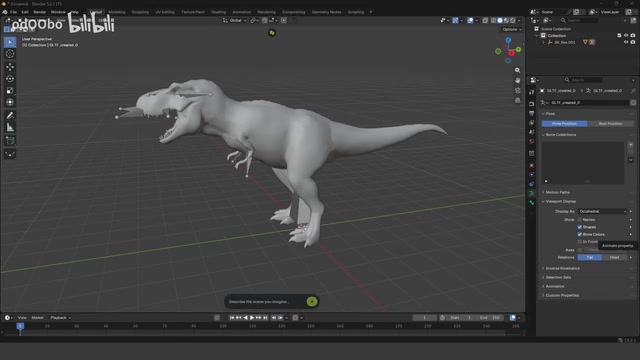
The prompt called for six high-quality, game-ready dinosaur animations: idle, walk, run, bite (attack), roar, and death. Claude's process was clearly observable — around the six-minute mark it zoomed into the dinosaur's head to work on jaw movement; at about ten minutes it started the walk cycle; fifteen minutes in it was on the bite attack; seventeen minutes for the death animation — all six actions completed in 27 minutes, consuming roughly 200 credits.
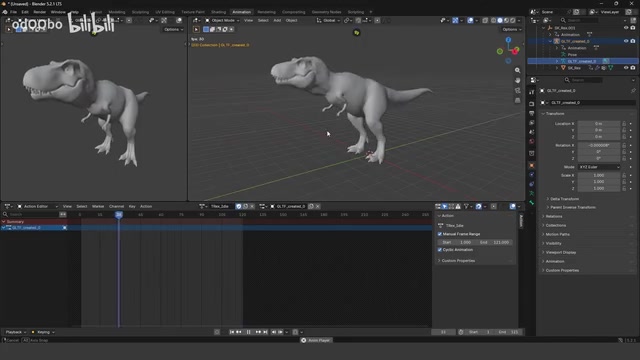
Feedback was mixed in a good way. The death animation — standing to falling — was considered a solid knockdown effect, ready to drop directly into something like ARK: Survival Evolved; the walk animation even had the tail swaying side to side, a detail that drew genuine praise; the bite and roar both hit a usable standard. The weaker entry was the run cycle — the creator felt the pacing needed to be faster, requiring a manual playback speed boost to sell the sense of movement.
From Animation to Final Video: Connecting to a Video Generation Model
The test didn't stop there. The creator asked Claude to use the generated animations to build a cinematic camera sequence — orbiting the T-Rex to showcase each action in turn. That step took about nine minutes and produced a demo reel.

The final step was exporting that blockout as a play blast, uploading it to Higgsfield.ai's video tab, and processing it through the SeaDance 2.5 model. The prompt asked to maintain the exact same camera movement, composition, and layout, adding only a jungle background, realistic lighting, and visual polish. The final output added rain, ambient sound effects, footstep audio, and a mud-splash effect on the death hit. This complete pipeline — from 3D keyframe animation to photorealistic video — showcases a genuinely new creative possibility.
A play blast (preview render) is a lightweight output method in 3D software: it captures the current viewport's real-time display directly, without going through full ray tracing or a render engine, making it extremely fast. It's commonly used for animator check-ins and timing reviews, and the resulting video typically has a distinct "3D wireframe/cartoon" look. SeaDance 2.5 is a video generation model developed by Higgsfield, focused on preserving the motion trajectory and compositional structure of input video while stylizing the imagery to look photorealistic. Its core capability — motion-guided generation — follows a similar logic to ControlNet's spatial control over image generation, shifting AI video creation from "conjuring from nothing" to "style-transferring existing motion content," dramatically reducing how unpredictable the results feel for creators.
What This Workflow Actually Means
For indie developers and small teams, animation has long been a wall blocking creative ambition — outsourcing is expensive, creature animation assets are scarce, and hand-keying is technically demanding. This test demonstrates that AI can now produce a batch of "ready-to-use game animations" within 30 minutes, at a cost of just a few hundred credits.
Some perspective is warranted: the test used pre-rigged models — AI handled the animation phase, not modeling or rigging; some animations like the run cycle still need manual tweaking; and this is a single-source test with limited sample size. But the trajectory is clear. The creator themselves said they're excited to see how far this capability evolves over the next few months. For anyone who's ever hit a wall with animation as a creative bottleneck, this is a direction worth watching closely.
Related articles

LLaMA-Factory in Practice: A Complete No-Code Guide to Fine-Tuning Large Models
An introduction to LLaMA-Factory, the open-source fine-tuning tool: its 60.1K-star background, supported models and algorithms, local vs. cloud deployment, and CUDA setup steps.

Zeng Ming's Deep Retrospective: Why OpenAI May Not Be the Ultimate Winner — and Why the Corporate System Will Disappear
Zeng Ming's deep retrospective on the AI endgame: model companies are just infrastructure, OpenAI and Anthropic won't be the final winners; the next battle is the Agent entry point standard; the corporate system will disappear as AI restructures collaboration, and only mission-driven companies can survive the cycle.

OpenHands v1.28.0: OpenCode and PI Added as Built-in Agents, API Keys Requestable In-Conversation
OpenHands ships 5 releases in 21 days: v1.27.0 adds OpenCode and PI as built-in agents, v1.28.0 enables in-chat key requests. ACP integration, credential reuse, model list changes, and upgrade advice.