Claude Opus 5.5 vs. GPT-6 Sol/Luna Head-to-Head: Who Wins the Value Battle?

Five real-world tests pit Claude Opus 5.5 against GPT-6 Sol and Luna to find the best value-tier AI model.
On September 23rd, Anthropic's Claude Opus 5.5 and OpenAI's GPT-6 Sol and Luna launched within hours of each other, all targeting the value-tier market with promises of faster, cheaper, and smarter performance. Across five tests — coding animation, game generation, website design, sand art video, and Blender modeling — Opus 5.5 excelled at coding and creative detail, GPT-6 Astra proved most reliable for complex multi-step tasks, and GPT-6 Sol consumed half the quota of Astra for identical work. The verdict: use Opus 5.5 for coding, Astra for research, and Luna/Sol for everyday or budget-sensitive use cases.
At around 1 AM Beijing time on September 23rd, the AI model market erupted once again. Anthropic launched Claude Opus 5.5 (referred to as "OPS 5.5" in the original video), and just ninety minutes later, OpenAI unveiled two new models: GPT-6 Sol and GPT-6 Luna. All three share a common label — they are the "value-tier" versions of their respective flagship models, promising to be faster, more capable, and more affordable.
This article summarizes real-world test results across five use cases — coding, game generation, website creation, video production, and 3D modeling — to help you decide which model is best suited for your specific needs.
The Value Tier Arrives: Overseas Models Enter the Price War
Historically, frontier models from Western AI labs have been associated with premium pricing, standing in sharp contrast to the value-oriented offerings coming out of China. But this latest batch of releases marks a clear shift in strategy. GPT-6 Luna's per-token input and output pricing alone could put it below DeepSeekAd — though once you factor in caching advantages, DeepSeek may still hold the edge.
The natural concern with lower prices is lower quality. Yet Anthropic's official capability radar chart shows Opus 5.5 leading by a wide margin in coding — even surpassing Sonnet 5.1 (referred to as "Fable 5.1" in the video) — with only GPT-6 Astra beating it on agentic workflows and research tasks.
Third-party benchmarks, however, reveal another side of the story: Opus 5.5's token efficiency is considerably lower than the GPT-6 series. The takeaway is that Opus 5.5 is smarter and more specialized, while Luna and Sol are cheaper and more efficient. This tradeoff between intelligence and cost is the central tension running through this entire comparison.
A note on key terms: A token is the basic unit of processing and billing in large language models — roughly 1–2 Chinese characters or 4 English characters. "Token efficiency" refers to how many tokens a model consumes to complete a task of equivalent quality; higher efficiency means lower cost and faster output for the same result. "Caching advantage" refers to how some models (like DeepSeek) cache repeated context, billing subsequent calls at a lower cached price — particularly beneficial for developers working with long contexts or frequently repeated system prompts. Understanding these two concepts is essential to why sticker price alone doesn't tell the full story.
Case 1: Teapot Riding a Bicycle Animation — Opus 5.5 Wins
The first test used the classic "teapot riding a bicycle" degradation benchmark. The prompt simply asked for an SVG low-detail (LD) animation of a teapot riding a bicycle, with no additional constraints. Five models were run simultaneously: GPT-6 Astra, Sol, Luna, Claude Opus 5, and Opus 5.5.
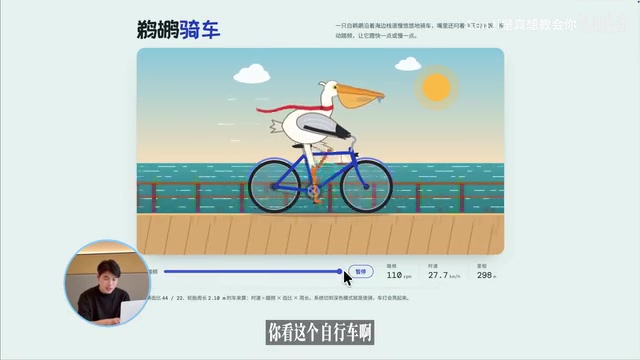
The subjective verdict favored Opus 5.5 — it not only reproduced the cycling motion but also included an adjustable cadence panel, simple rotation indicators on both wheels, and real-time readouts for cadence, speed, and distance. This level of interactive detail is a prime example of Opus 5.5's "specialist" character.
Case 2: Minecraft-Style Game Generation — Lowering the Bar for Indie Dev
The second case raised the difficulty considerably: implement a first-person Minecraft-style mini-game in a single HTML file using Three.js, with procedurally generated textures, playable by double-clicking the file in a browser.
Opus 5.5 delivered an impressive spatial modeling result — distant terrain gradually sharpens as you move, WASD controls player movement, the spacebar enables interaction, and the scene includes background music and basic sound effects. Sheep, cows, and pigs roam the world, while water reflections, satisfying hit sounds, and a basic crafting system all added up to a convincing experience.
The conclusion drawn here: the barrier to indie game development is about to drop dramatically. The ability to generate a playable prototype from a single prompt represents a meaningful efficiency revolution for small studios and solo developers.
A note on the tech: Three.js is a WebGL-based JavaScript 3D graphics library that renders complex 3D scenes directly in the browser with no plugins required. Compressing a complete game into a single HTML file means the model must simultaneously handle scene rendering, physics and collision, procedural texture generation (drawing pixel-art-style textures algorithmically rather than from pre-made assets), audio synthesis, and more — all integrated into directly runnable code. The procedural texture generation detail is especially noteworthy: traditional game development requires artists to create each texture individually, while AI generates them via mathematical functions, dramatically compressing the time from concept to playable prototype.
Case 3: Modern-Style Website Creation — Each Has Its Strengths
The third case asked each model to independently design a modern, creative website featuring dynamic interactions, 3D models, smooth transitions, and rich color palettes, with the tech stack left to the model's discretion.
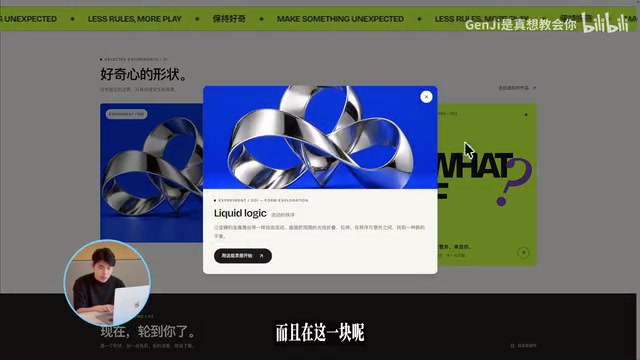
Each model produced something distinctly its own. GPT-6's first output — "Flow Lab" — featured a freely draggable, rotatable 3D centerpiece with crystal selection and color injection. GPT-6 Astra delivered a highly polished result, adding secondary 3D components, metallic sheen, dynamic rhythm, and even built-in inspiration-saving functionality.
Opus 5.5 produced a modular mechanical keyboard showcase — each keystroke triggers a "lucky draw," and the keyboard can be disassembled into six layers: keycaps, switches, plate, foam, PCB, and case. Real-time lighting and shadow relationships shift as the mouse moves. The originality and overall execution were judged to surpass the previous two outputs.
Case 4: Sand Art History Animation — GPT-6 Astra Understands the Brief Best
The fourth case tested video production capabilities: generate a one-minute sand art animation telling the history of China's Spring and Autumn and Warring States periods, complete with background music and sound effects.
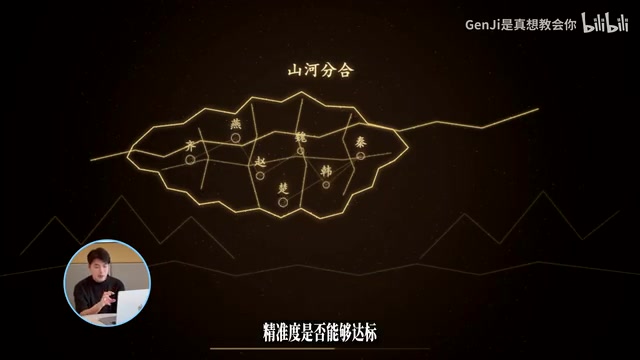
The models interpreted "sand art" in noticeably different ways. GPT-6 Sol produced a complete sand-art aesthetic but with rough execution — a single swipe across the canvas lacking the deliberate brush strokes of real sand art. GPT-6 Luna leaned heavily on mathematical functions and geometric shapes, which felt better suited to math-themed content than historical narrative.
GPT-6 Astra earned the most praise — it advanced the story through a series of still sand-art frames, moving from the Hundred Schools of Thought and the Seven Warring States to Shang Yang's reforms and Qin's unification of China, cleverly representing the "seven powers vying for supremacy" with seven flags. Opus 5.5 added a flashy intro and heavy use of transition animations, making the narrative flow smoother, but its drawing process still felt distant from traditional sand art.
Case 5: Blender House Modeling — Delivered in Phases
The final showpiece asked for a modern residential home to be modeled in Blender from scratch, delivered in three phases: first, present a 2D floor plan for review; then build an editable Blender model from the approved plan (separating architecture, furniture, lighting, and landscaping into distinct layers); finally, render multiple interior and exterior perspectives and verify the logical placement of doors, windows, and rooms.
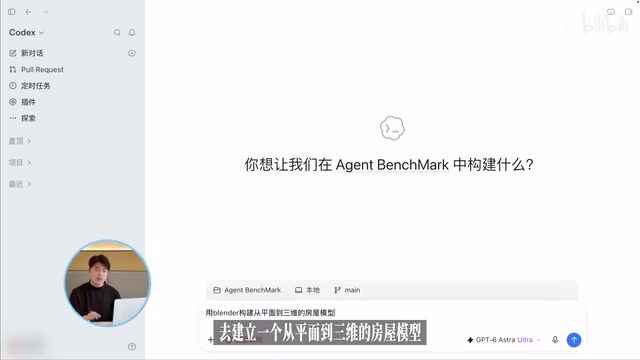
GPT-6 Astra was used for this demonstration. The deliverables fully covered every checkpoint across all three phases, showcasing the model's planning and execution capabilities in a complex, multi-stage task.
A note on the tech: Blender is a free, open-source 3D modeling and animation suite widely used in professional film and game production. AI typically controls Blender by generating Python scripts — Blender has a built-in Python interpreter, and scripts can call its API to create geometry, set materials, configure lighting, and position cameras. The "phased delivery with self-review" approach is a classic task decomposition strategy: attempting to generate complex projects all at once tends to produce errors, while incremental delivery with checkpoints effectively reduces the cost of rework. This also reflects the increasingly mature "plan–execute–feedback" loop that top-tier models are developing.
Token Usage Comparison: Sol's Value Proposition Is Real
The biggest surprise from the testing came from GPT-6 Sol's credit consumption. After running all five cases over five hours, Sol used only around 50% of the available quota — while Astra completing the same tasks consumed nearly 90%. This near-twofold gap provides direct, empirical support for the value-tier positioning of Sol and Luna.
Choosing the Right Model: Match Tool to Task
Based on all five tests, here is a one-sentence guide for each scenario:
- Coding and execution tasks: Go with Claude Opus 5.5 — strongest coding performance and highest specialization
- Research and complex multi-step tasks: Stick with top-tier models like Sonnet/Astra
- Everyday use or budget-sensitive scenarios: Use Luna or Sol — and make sure to set the reasoning level to maximum
This value-tier battle has no absolute winner. It reads more like a careful division of labor between capability and cost. For most users, understanding each model's "personality" matters more than chasing whatever launched most recently. Given how quickly these models were released, this five-case rapid test only scratches the surface — more features and comparisons are well worth continued attention.
Related articles

GitHub Daily · October 23: Agent Runtimes and Skill Libraries Surge on the Same Day
NVIDIA open-sources OpenShell, a Rust security runtime for autonomous agents; Claude-Red turns security methodology into SKILL.md skills; VoxCPM2 drops the tokenizer.

Build an AI Super Employee System at Zero Cost: A Full Breakdown of Automated Agent Workflows
A deep breakdown of the AI super employee system demoed on Bilibili: agent orchestration, digital human voiceovers, map and enterprise lead generation, 24/7 customer service, and legal modules. We analyze the business logic and compliance risks behind zero-cost signup to help entrepreneurs judge the real ROI of this AI digital employee system.

The Essential Difference Between Chatbots and AI Agents: Crossing from Conversation to Execution
What's the difference between a chatbot and an AI agent? Based on the MCP series on the Learn Tech channel, this article uses examples like booking flights and summarizing notes to explain: a chatbot only gives answers, while an agent actually completes tasks through a think-act-observe loop. It breaks down the four core components—model, tools, memory, and goal—as well as MCP's role as a bridge, and discusses agents' applicable boundaries and permission risks.