Claude Opus Reverse-Engineers a Microphone in 15 Minutes: How AI Is Filling Linux's Hardware Gaps

Claude Opus reverse-engineered a microphone's USB protocol in 15 minutes, delivering full Linux control as an open-source project.
A Linux user whose Maono DGM20 microphone lacked Linux software support asked Claude Opus to reverse-engineer its USB protocol — a process that took about 15 minutes and produced a complete open-source project with a system service, Web UI, installer, and LAN remote access. The case highlights AI coding assistants' real potential for hardware adaptation, while also noting key limits: USB audio protocols are relatively simple to reverse-engineer, AI-generated code needs real-world validation, and legal boundaries around reverse engineering vary by jurisdiction.
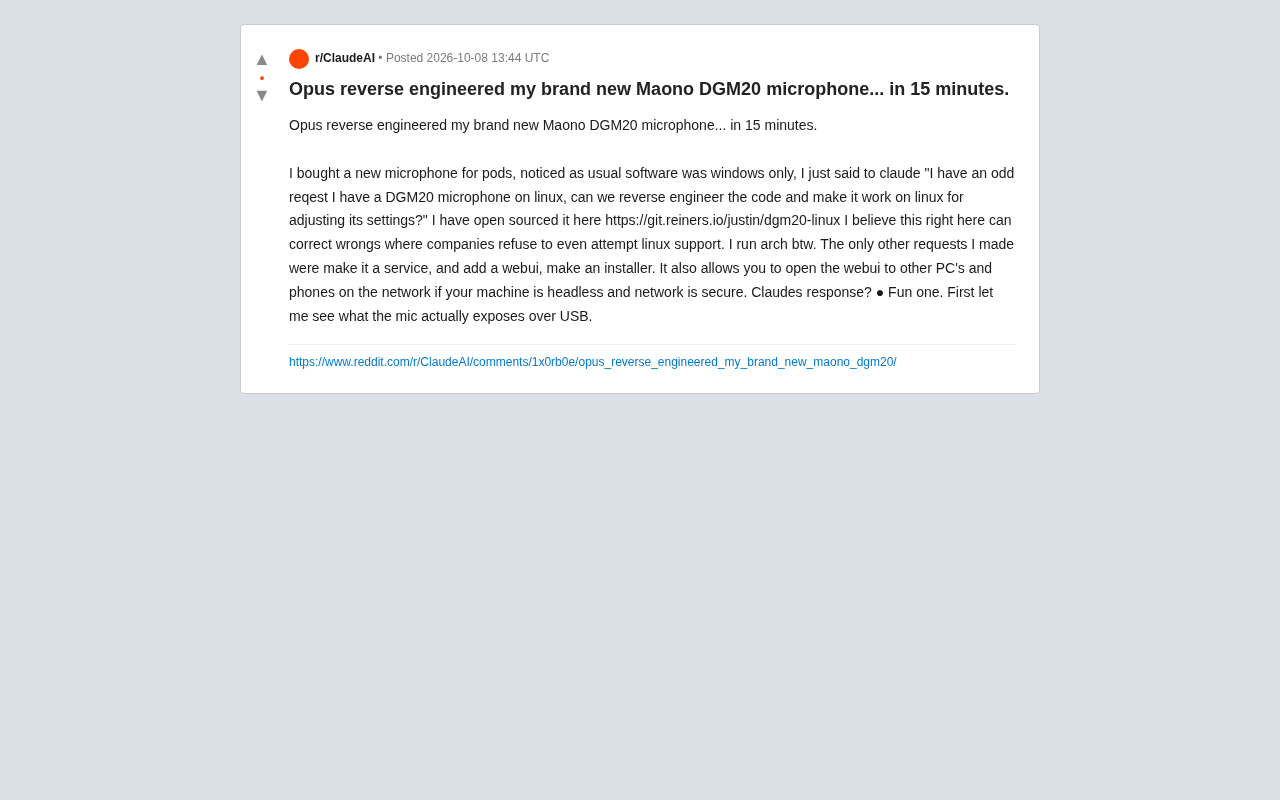
A Reddit user recently shared an impressive hands-on experiment: after buying a Maono DGM20 microphone and discovering that the manufacturer's companion software only supports Windows, he turned directly to Claude Opus — asking it to reverse-engineer the microphone's communication protocol so he could adjust its settings on Linux. The entire process took roughly 15 minutes, and the finished project has been open-sourced at git.reiners.io.
On the surface, this looks like a minor DIY hack. But it reflects something more significant: the real-world potential of AI coding assistants in tackling hardware compatibility and long-tail device support.
A "Weird Request" That Led to Reverse Engineering
The user's approach was refreshingly straightforward. His exact words: "I have a weird request — I have a DGM20 mic on Linux, can we reverse engineer the code so I can adjust settings on Linux?"
Claude's response had an unmistakably engineering-minded quality: "Interesting. Let me see what the microphone exposes over USB first." — which is precisely the standard starting point for hardware reverse engineering: examine the descriptors, HID reports, and control endpoints the device exposes over USB, then infer how the manufacturer's software communicates with it.
For most USB peripherals, all the Windows software is really doing is sending control transfers or HID reports in a specific format to adjust parameters like gain, monitoring mix, and noise reduction. Capture and parse the structure of those commands, and you can replicate the same functionality on any platform. Claude handled the core work of protocol analysis and code generation throughout this process.
From a CLI Script to a Complete Service
What's notable is that the project didn't stop at a "good enough" proof-of-concept script. The user added several follow-up requirements, all of which came together smoothly:
- Wrapping the functionality as a system service for autostart and background operation
- Adding a Web UI to replace the pure command-line interface
- Creating an installer to lower the barrier for other users
The Web UI even supports access from other PCs or phones on the local network. For scenarios where the microphone is connected to a headless machine — say, a compact, display-less box used for podcast recording — this means you can adjust microphone settings remotely from your phone's browser, provided the network environment is secure.
Starting from a single protocol-cracking need and expanding into a fully service-oriented, visualized, deployable, and remotely accessible mini software project — with AI connecting the entire chain in a short time — is a textbook example of how large language models are delivering real engineering value today.
A Response to the "No Linux Support" Problem
The user offered a pointed observation: "I believe this in itself can correct the mistake companies make when they don't even bother trying to provide Linux support." (The signature "I run arch btw" became a fitting community in-joke.)
Hardware manufacturers not providing companion software for Linux is a long-standing frustration for Linux users. The reasons are familiar: small user base, high maintenance costs, poor return on investment. Historically, community solutions relied on a small number of skilled reverse engineers willing to spend hours capturing packets, analyzing protocols, and writing code — a very high bar.
AI coding assistants are now meaningfully lowering that bar. Work that once required professional reverse engineering expertise can now be approached by ordinary users who can clearly describe their needs and help the AI gather device information. The implication: community support for long-tail hardware devices could shift from "only a handful of people can do this" to "a lot more people can do this."
A Few Boundaries Worth Keeping in Mind
The enthusiasm is warranted, but the limitations of this type of case are also worth noting:
Sample specificity. USB audio device protocols are relatively well-structured, and many parameter adjustments already follow the standardized USB Audio Class spec — making them among the easier targets in the hardware reverse engineering space. This doesn't generalize to all devices, especially those using proprietary encrypted protocols or complex firmware interactions. Not everything can be "solved in 15 minutes."
Reliability and security. Whether AI-generated reverse-engineering code is stable and handles all edge cases properly typically requires real-world, long-term use to validate. Exposing a Web UI to the local network also carries potential security risks — the user's caveat about network safety is an important prerequisite, not a footnote.
Legal and licensing boundaries. The legality of reverse-engineering device communication protocols varies across jurisdictions. Personal interoperability use tends to be treated with more leniency, but commercial redistribution warrants careful consideration.
USB Audio Class (UAC) is a standard device class specification defined by USB-IF, with UAC 1.0 and UAC 2.0 as the two main versions. It defines common interfaces for audio stream transfer, sample rate negotiation, volume control, and more. Devices that conform to the UAC spec work plug-and-play on Linux, macOS, and Windows without dedicated drivers — Linux's snd-usb-audio kernel module provides native support. However, many manufacturers layer a proprietary HID channel on top of UAC to control DSP effects, noise reduction, equalizers, and other "premium features" — and that layer is the actual reverse engineering target. The Maono DGM20 fits this pattern exactly: basic recording works on Linux without any fuss, but advanced parameter controls like EQ and monitoring mix rely on a proprietary protocol, which is why the manufacturer only ships companion software for Windows. This architectural characteristic explains why the reverse engineering went smoothly: the protocol structure is not complex and carries no encryption.
Conclusion: AI Is Reshaping the Boundaries of What's Possible
The real value of this Reddit case isn't the microphone itself. It's what it demonstrates: when AI can understand requirements, analyze hardware, and write and package usable software, individual users facing "no vendor support" are no longer limited to waiting passively or giving up.
The open-source release also means this work compounds — other DGM20 users on Linux can benefit directly. As AI coding capabilities continue to grow, user-driven hardware adaptation projects like this will become increasingly common, serving as a meaningful complement to the gaps left by official vendor support.
Background: How This All Works
When a USB device connects to a host, it announces its identity and capabilities through descriptors. HID (Human Interface Device) is a USB device class designed for human-interface peripherals; microphone parameter adjustments are often implemented via HID reports — meaning the device and host exchange byte sequences in a predetermined format, where each byte or bit corresponds to a specific parameter (such as gain or mute state). The first step in reverse engineering is using tools like lsusb, usbhid-dump, or Wireshark with USBPcap to capture raw communications between the manufacturer's software and the device, then inferring the semantics of each command against the HID spec. From there, Python libraries like hidapi or pyusb can replay those same byte sequences on Linux, bypassing the Windows-only software to control the device directly.
Related articles

5 Practical Ways Real Estate Agents Can Use AI to Boost Efficiency (2026 Edition)
How can real estate agents use AI to boost efficiency? Based on a YouTube walkthrough, this breaks down five methods — ChatGPT for listing descriptions, Canva for marketing materials, forms for open house leads, Zapier for automated follow-up, and seller meeting prep — and flags risk boundaries like fair housing laws, photo authenticity, and price verification.

Grok Bot vs ChatGPT Agent: Which AI Agent Is More Powerful?
How does Grok Bot differ from ChatGPT Agent? This comparison examines how they work: Grok Bot has a cloud computer and runs persistently inside tools to execute multi-step tasks automatically; ChatGPT Agent operates web pages in a browser and is more mature at general tasks. Includes selection advice.

Walmart Agent Gateway: AI Shops for You Automatically—Why Is Amazon Going the Opposite Way?
Walmart's Agent Gateway lets ChatGPT, Gemini and other AI assistants access its product catalog to search, compare and add to cart, with spending limits and per-purchase approval. Amazon blocks external AI agents—two retail giants, opposite paths. Currently US-only, India may follow.