Claude Pro Quota Mysteriously Depleted: User Grievance Dilemmas and the AI Subscription Transparency Crisis

Claude Pro user finds quota depleted without usage; Anthropic support unable to investigate or explain.
A Claude Pro subscriber discovered their usage quota was exhausted despite not using the service for two days. Anthropic's support team could not investigate, access activity logs, or explain the anomaly, and denied a refund. This case highlights structural issues in AI subscription services including opaque metering systems, limited customer support capabilities, potential account security risks, and the critical need for usage transparency across the industry.
A Puzzling Case of Vanishing Quota
Recently, a Claude Pro paid subscriber posted on Reddit about a strange experience: after two consecutive days of not using Claude at all—neither opening the web interface nor using any official app or browser extension—he opened Claude only to find his usage quota completely exhausted. And this wasn't a one-time occurrence.
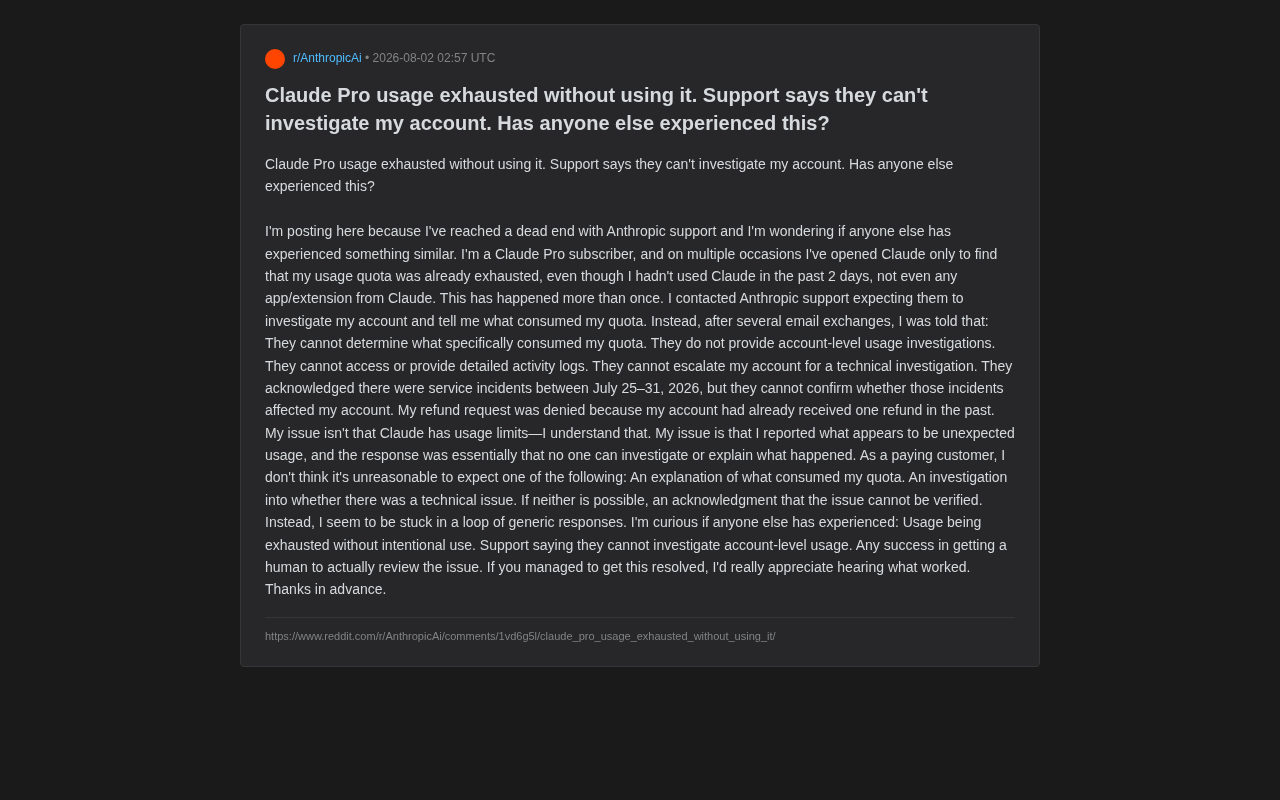
For any paying user, this is a confusing and frustrating experience. A paid subscription should deliver a more reliable and transparent service experience, but when anomalies occur, users find themselves trapped in a seemingly unbreakable grievance loop.
Claude Pro's Quota Mechanism: What You Need to Know
To understand the severity of this incident, you first need to understand Claude Pro's subscription mechanism. Anthropic's Claude Pro subscription ($20/month) doesn't offer unlimited usage—instead, it employs a dynamic rate limiting system. Unlike fixed-count quotas, Claude Pro's allowance adjusts dynamically based on current system load, the model selected (e.g., Claude 3.5 Sonnet, Claude 3 Opus), and conversation complexity. More capable models (like Opus) consume more quota, and long-context conversations deplete it faster than short ones. Anthropic has never publicly disclosed the precise formula for calculating quota, only stating generally that users who hit the limit need to wait before continuing. This opaque design inherently sets the stage for disputes—when users can't quantify their consumption, anomalies become harder to identify and prove.
Anthropic's Support Team Response Sparks Controversy
The user subsequently contacted Anthropic's customer support team, expecting an official investigation into his account and an explanation of what consumed his quota. However, after multiple rounds of email exchanges, the response he received was disappointing. According to the post, Anthropic's support team stated:
- They could not determine what specifically consumed the user's quota;
- They do not provide account-level usage investigations;
- They cannot access or provide detailed activity logs;
- They cannot escalate the account for technical investigation;
- They acknowledged that service incidents did occur during the relevant time period, but could not confirm whether these incidents affected the user's account;
- The refund request was denied on the grounds that the account had already received one prior refund.
You might not have noticed, but the user specifically emphasized that his complaint wasn't about Claude having usage limits in the first place—he fully understands that paid products have quota restrictions. What he was truly frustrated about was this: when he reported what appeared to be anomalous usage consumption, the response was essentially "no one can investigate or explain what happened."
The User's Reasonable Demands vs. The Platform's Capability Boundaries
The user raised three progressively tiered demands, each of which deserves consideration:
Demand One: Explain Where the Quota Went
As a paying customer, he wanted an explanation—what exactly consumed his quota. This is the most basic right to information. Any metered service should theoretically be able to provide consumption details to its users.
Demand Two: Investigate Whether a Technical Issue Exists
If an immediate explanation isn't possible, then at minimum an investigation should be conducted to confirm whether a technical fault occurred. This demand is especially reasonable given that Anthropic itself acknowledged service incidents during the period in question.
Demand Three: At Least Acknowledge the Issue Can't Be Verified
If neither of the above is achievable, the user hoped the company would honestly acknowledge that "this issue cannot be verified," rather than trapping him in a loop with generic, templated responses.
These three demands, ranging from high to low, demonstrate the restraint of a rational user. Yet the reality is that he seemingly couldn't even get the bare minimum of an honest acknowledgment.
The Deeper Issues Behind the Incident: Structural Flaws in AI Subscription Services
While this is just one user's experience, it reflects a widespread structural problem in the AI subscription service space: the lack of usage transparency.
The Metering Black Box: Consumption Users Can't See
Unlike traditional cloud computing services (where AWS and GCP provide detailed usage dashboards and billing breakdowns), many consumer-facing AI subscription products don't offer granular usage tracking. Users can't see how much quota each conversation consumed, nor can they review historical usage records. This "black box" design might be harmless during normal use, but once an anomaly occurs, users completely lose the ability to prove their innocence or investigate the truth.
Notably, the billing unit for large language models—the token—is itself a concept that isn't particularly intuitive for average consumers. One token corresponds to roughly 3/4 of an English word or one Chinese character, and the actual consumption of an AI service includes not only the user's input prompt tokens but also the model's generated completion tokens, plus the system tokens needed to maintain conversation context. In Anthropic's API pricing, Claude 3 Opus costs $15 per million input tokens and $75 per million output tokens; while the consumer-facing Pro subscription doesn't charge directly per token, its underlying quota calculation logic is likely tied to token consumption. This means that even a single conversation that inadvertently retained a large context could consume far more quota than the user expected. However, without a visual token metering dashboard, users have zero awareness of this.
By contrast, services like AWS CloudWatch and GCP Cloud Monitoring provide usage tracking precise to the API call level. Users can view hourly or per-minute resource consumption curves, set usage alerts, and even trace back to specific request IDs. This transparency not only aids cost control but also provides a credible evidence base for both parties when disputes arise.
Limitations of the Customer Support System
From the post's description, Anthropic's front-line customer support clearly lacks permission to access underlying account logs and lacks channels to escalate issues to technical teams. While this design improves support efficiency, it also erects a wall that users can hardly climb over. For technically intensive products like AI services, when anomalies involve technical layers, front-line support's "standard scripts" often fail to resolve substantive issues.
This actually reflects the inherent contradictions of the tiered support system common in the tech industry. In standard IT Service Management (ITSM) frameworks, support is typically divided into three tiers: L1 (front-line: handling common issues and basic operations), L2 (second-tier: technically capable support engineers), and L3 (third-tier: core development or architecture teams). Most user issues should be resolved at L1, with only a few complex problems requiring escalation. However, for rapidly growing AI startups like Anthropic, the scale and maturity of their support teams may be far behind the pace of user growth. According to public reports, Anthropic had approximately 1,000-1,500 total employees in 2024, most of whom are research and engineering staff, meaning the dedicated customer support team is likely quite limited in size. Under these circumstances, L1 support may only be authorized to perform limited actions (such as providing standard response templates or performing simple account resets), lacking process channels to escalate issues to L2/L3 teams capable of querying database logs.
Potential Account Security Risks Should Not Be Ignored
There's an even more concerning possibility: if the user genuinely didn't use the account yet quota was consumed, could there be risks of account compromise, API key leakage, or unauthorized access? This goes beyond a mere "billing dispute" and enters the realm of account security. Unfortunately, the official response apparently didn't address this from a security perspective.
In today's cybersecurity landscape, there are more pathways for unauthorized account access than most users imagine. Beyond the most common password leaks (obtained through data breaches or phishing attacks), there are session hijacking (attackers impersonating legitimate users by stealing authentication cookies from browsers), OAuth token abuse (third-party apps previously authorized by the user may continue calling APIs in the background), and malicious browser extension behavior (certain extensions may leverage the user's logged-in session to make requests in the background). For a service like Claude, if a user has ever authorized any third-party application via OAuth, or generated API keys in the developer console for personal projects or third-party integration tools, these could all become sources of quota consumption—even if the user never actively opened the Claude interface. A responsible platform should, at minimum, check the account's active session list, recent login IPs, and device fingerprints when receiving such reports to rule out security incidents.
Industry Comparison of AI Subscription Services: How Are Peers Doing?
Zooming out to examine the broader AI subscription service industry, insufficient transparency isn't unique to Anthropic, but performance varies across companies. OpenAI's ChatGPT Plus (also $20/month) uses message-count-based limits—for example, 80 messages per three hours for GPT-4o, 40 messages per three hours for GPT-4—which, while crude, at least lets users intuitively perceive and track their consumption. Google's Gemini Advanced employs a more generous quota strategy, with fewer user reports of quota exhaustion. On the developer API side, both OpenAI and Google provide detailed usage dashboards where users can view daily and hourly token consumption, request counts, and cost breakdowns.
By comparison, Anthropic's Claude Pro offers consumers neither clear quantified quota metrics (users only know they've "hit the limit" but not what the limit actually is) nor historical usage query functionality. This means users exist in a state of complete information asymmetry: the platform holds all the data while users know nothing. When disputes arise, this asymmetry severely damages user trust, as they can neither prove their innocence nor demand that the platform "show the evidence."
Practical Advice for Claude Pro and AI Subscription Users
While this incident remains unresolved, it offers practical lessons for all paid AI service users:
- Regularly check account security: Change passwords, enable two-factor authentication (2FA), and check for unusual login records or authorized third-party apps. Specifically, look in your Claude account settings for any active sessions you don't recognize—if you find any, terminate them immediately.
- Watch for API key leaks: If you've ever generated API keys and used them with third-party tools (such as AI agent frameworks, automation scripts, or browser plugins), verify the scope and security of these keys, and revoke and regenerate them immediately if necessary. Note that API keys generated under a Pro subscription account, if obtained by others, may have their consumption counted against your subscription quota.
- Preserve evidence: Once you notice an anomaly, take screenshots and document the timeline promptly—this is crucial for subsequent dispute resolution. The best practice is to record the exact time you last used Claude normally and the exact time you discovered the quota was exhausted. The "gap" between these two points is your strongest evidence.
- Leverage community power: As this user did, speaking up on public communities like Reddit can sometimes attract official attention or help find other users with the same experience to build collective momentum. In fact, Anthropic product team members are known to browse subreddits like r/ClaudeAI, and cases where public posts gained attention and were subsequently resolved are not uncommon.
- Check browser extensions and authorized apps: Review whether your browser has any AI-related extensions installed, and whether your Claude account has authorized third-party app access. Some "AI assistant" extensions may call Claude's interface in the background.
Conclusion: Transparency Is the Foundation of Trust
At its core, this incident isn't really about a few dozen dollars in subscription fees or quota itself—it's about trust. When users pay for a service, they're purchasing not just functionality, but a promise of reliability and transparency.
As AI subscription services rapidly proliferate globally, user expectations for usage transparency, account security, and customer support quality are rising accordingly. For leading AI companies like Anthropic, how they build mechanisms that can address users' reasonable concerns—even if it's just providing a basic usage query feature or a technical escalation channel capable of genuine investigation—will directly impact long-term user trust.
From a broader perspective, this is also a challenge the entire AI industry must face as it transitions from "technology-first" to "service-first." When AI companies evolve from pure research institutions into service providers serving millions of consumers, they need to build operational capabilities that match their technical prowess—including robust billing transparency systems, tiered technical support structures, and dispute resolution mechanisms capable of handling anomalies. This isn't just a necessary business investment; it's a demonstration of basic respect for paying users.
After all, in an era of increasingly powerful AI, "we cannot investigate" is simply an unsatisfactory answer for paying customers.
Related articles

GitHub Daily · August 19: The AI Agent "Memory" Revolution and the Open-Source Hardware Wave
GitHub Trending Aug 19: ByteDance's OpenViking tops charts as AI Agent memory layer, open-source phased array radar surges, GenLayer scaffold sees explosive growth.

How to Launch Your First Open Source Project: A Complete Guide for New Authors
First time open-sourcing a project? This guide covers license selection, documentation setup, contribution management, and version planning for new authors.

Free Machine Learning Roadmap: A Systematic Learning Path Based on Official Microsoft Content
A free machine learning roadmap based on Microsoft Learn's official content, covering ML core concepts, Python hands-on practice, Azure ML deployment, and MLOps for systematic learning from zero to production.