Claude Pro vs Max: Is the $200/Month Max Worth It?

Max and Pro have nearly identical features; Max only sells capacity, and whether it's worth it depends on your usage data.
Based on a video breakdown, the article notes that in Claude's subscription ladder the real feature leap happens between Free and Pro—Pro and Max have almost completely overlapping feature lists, and Max's only substantive addition is capacity. Capacity consists of two "jars": a 5-hour session limit and a weekly limit, with chat and Claude Code sharing the same quota. 5X and 20X are multiples of Pro's session quota; going from $100 to $200 doubles the bill but quadruples capacity. Max also bundles Fable 5.1's special billing and monthly API credits, but the credits don't cover interactive Claude Code. The key dividing line is $80: Pro plus usage credits is more economical than Max 5X as long as monthly spending stays below that. The article suggests checking the Usage page to confirm the source of your limits first, then deciding whether to upgrade by use case.
Claude Pro vs Max: Is the $200/Month Max Actually Worth It?
Claude's subscription tiers are often misunderstood. Many people assume the $200/month Max plan unlocks models or features that the $20 Pro plan can't reach—but that isn't the case. Based on a YouTube channel's complete breakdown of Claude's various plans, Max and Pro have almost identical feature lists. The only real difference is capacity.
This article is based on that video's detailed breakdown, combined with user feedback across multiple platforms, to help you decide whether you actually need to pay for "more room."
The Plan Ladder: From Free to Enterprise—Where Do Features Actually Increase?
Anthropic's pricing is like a ladder. The free tier offers memory, connectors, voice, file creation, and 5 project spaces—many features that seem paid are actually already free. Pro ($20/month, about $17/month billed annually) adds four things on top: the Opus 5.5 model, the Claude Code coding agent, Research deep-search mode, and background task handoff. The real feature leap happens between Free and Pro—the Pro-to-Max list barely changes.
Max comes in two tiers: 5X ($100/month) and 20X ($200/month), neither with an annual discount. Above that are seat-based Team (Standard $25/seat/month, Premium $125/seat/month) and Enterprise (from $20/seat/month, annual billing, minimum 20 seats). Education pricing is set per institution.
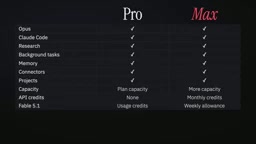
Opus 5.5 is the high-end model in Anthropic's current flagship lineup, positioned to favor reasoning over speed—suited to complex analysis, long-form writing, and multi-step coding tasks. In Claude's subscription system, it unlocks starting at the Pro tier; the free tier can't call it. Claude Code is an agentic coding tool that runs in the terminal or IDE, capable of reading and writing local files, executing commands, and iteratively modifying code. It's metered by token and shares quota with chat. Research mode is a deep-search feature that lets the model autonomously run multiple rounds of web retrieval, cross-verify, and summarize sources. What sets it apart from ordinary web search is that it plans a retrieval path rather than issuing a single query. Background task handoff lets long-running tasks continue after the browser is closed, with results returned later—mainly aimed at time-consuming agentic workflows.
The Truth About Capacity: Two "Jars" Define Your Usage Limits
Max doesn't sell features—it sells "room." That room is defined by two limits: a 5-hour session limit and a weekly limit. The video explains this with a "two jars" analogy—a small jar on the desk refills every 5 hours, and a large jar in the drawer refills at a fixed time each week. Every message (whether chat or Claude Code) draws tokens from both jars simultaneously, and when either jar runs empty, usage stops.
The key point: chat and Claude Code share these two limits. Heavy chat use in the morning squeezes your coding room in the afternoon—even though they feel like two separate products. Long conversations, attachments, model choice, and reasoning intensity all accelerate consumption. Anthropic doesn't disclose how many tokens are in the jars, nor does it promise any message or token counts.
The names 5X and 20X are often misread. They are multiples of Pro's 5-hour session quota: 5X is 5 times, 20X is 20 times. Going from $100 to $200 doubles the bill, but session capacity becomes 4 times (20÷5=4). Team Standard is 1.25 times Pro, and Premium is 6.25 times, with each quota belonging to an individual member rather than a shared large jar.

There's also a recent change worth noting: Claude Code's weekly quota had a temporary 50% boost in summer (May 13 to September 13), and starting September 14 it became 25% above the original level. All told, the current weekly quota is about 17% lower than in summer, while the 5-hour limit is unchanged. If summer felt more generous, that's why.
Token is the basic unit of model metering, roughly equivalent to half a word in English or one to two Chinese characters. Input tokens are what you send to the model (conversation history, attachments, code files), and output tokens are what the model generates. Because each turn of conversation re-reads the full prior context, the cost of long conversations accumulates with each turn—which is the main reason long sessions drain quota faster. Reasoning intensity (thinking budget) is another hidden cost: making the model reason internally for longer before answering produces extra output tokens. Per-token prices vary significantly across models—Opus-class models typically cost several times more per token than Sonnet, so the same "jar" supports less actual work on the pricier models.
Max's Other Two Additions: Fable 5.1 and API Credits
Beyond capacity, Max brings two conditionally valuable extras.
How Fable 5.1 is billed. This is the most expensive model in the lineup. On Pro and Team Standard, using it consumes usage credits (paid extra); on Max and Team Premium, it's deducted from the regular weekly quota, but capped at half the quota. In other words, heavy Fable use can take up at most half the drawer jar, leaving the other half for everything else.
API credits. Starting October 7, Max 5X includes $100 of API credits per month, and Max 20X includes $200. After meeting a 7-day eligibility requirement, you claim them by linking an organization in the Anthropic console; unused credits expire each billing cycle. These credits cover only some scenarios: API calls and the Agent SDK qualify, but interactive Claude Code does not, nor do usage credits inside Claude. If the desk jar runs dry, $200 in API credits won't save you. Team plans have a pooled version—Standard seats add $20 and Premium seats add $100, with a shared pool cap of $500/month.

API (Application Programming Interface) is the channel through which developers call models programmatically, billed by token usage—a separate billing system from web subscriptions. Agent SDK is Anthropic's development toolkit that lets developers build agent applications with tool-calling capabilities in code, which is likewise billed through the API. This explains why Max's bundled API credits can be used for your own apps but can't offset usage in the web interface or interactive Claude Code—the latter two fall under the subscription quota system and are settled separately from API accounts. Understanding this boundary is the only way to judge whether these credits are truly valuable to you: for users who don't write code or build integrations, actual credit utilization may be close to zero.
The Math to Do Before Upgrading: $80 Is the Dividing Line
Usage credits are now called Extra Usage, purchased separately at API rates with an optional monthly spending cap. This leads to a key comparison: Pro plus usage credits is cheaper than Max 5X as long as your monthly credit spending stays under $80. $80 is exactly the price difference between the two tiers.
If you only hit the wall a few times a month, estimate your credit cost at API rates first, then decide whether to upgrade. Under the video's assumed workload (1M input tokens + 100K output tokens, no caching), Opus costs about $6, Sonnet about $3, and Fable about $15. $80 covers roughly 13 runs of that workload on Opus.
Other Entry Points and Real User Experience
The same models are also available through other platforms. Google AI Pro ($19.99/month) includes Sonnet and Opus 5.5 in Anti-Gemini, with similar 5-hour and weekly quotas, but Google decides the jar size. Cursor Premium starts at $30/month, with Claude usage billed separately by token—about $6 for Opus under the assumed workload; its $8 tier doesn't include Claude. GitHub Copilot has three tiers at $10/$39/$100, including $15/$70/$200 in AI credits respectively, metering Claude at the same rates as the Anthropic API—$15 covers roughly five Sonnet runs, two and a half Opus runs, or one Fable run. Going directly through the API has no subscription threshold at all.

As for real user experience, in an October Reddit discussion, some hobbyists using Opus said they had never hit a limit on Pro; others using Google's agentic coding tools said quota drained quickly. These are just individual stories and can't predict where you'll land—the answer is on the Usage page in your settings.
How to Choose: Match Your Use Case
- Occasional chat: The free tier is enough—memory, connectors, voice, and projects are all included.
- Everyday writing and documents: Pro at $20/month, with Opus, Research, and Claude Code all in this tier.
- Max 5X: Only suits one situation—Claude Code limits have interrupted real work more than once, and the Usage page backs that up.
- Max 20X: Only consider it when 5X also frequently falls short.
- Team: When you need shared managed seats and billing. Standard is 1.25 times Pro's session capacity per person.
- Already using Google AI Pro: Test its quota first, then decide whether to buy an Anthropic plan.
In one sentence: Max doesn't sell features, it sells room. Figure out whether the 5-hour window or the weekly limit was what stopped you last time, then decide based on real data from the Usage page—not by paying for a feature list.
One-line Summary
Max and Pro have nearly identical features; Max only sells capacity, and whether it's worth it depends on your usage data.
Paragraph Summary
Based on a video breakdown, the article notes that in Claude's subscription ladder the real feature leap happens between Free and Pro—Pro and Max have almost completely overlapping feature lists, and Max's only substantive addition is capacity. Capacity consists of two "jars": a 5-hour session limit and a weekly limit, with chat and Claude Code sharing the same quota. 5X and 20X are multiples of Pro's session quota; going from $100 to $200 doubles the bill but quadruples capacity. Max also bundles Fable 5.1's special billing and monthly API credits, but the credits don't cover interactive Claude Code. The key dividing line is $80: Pro plus usage credits is more economical than Max 5X as long as monthly spending stays below that. The article suggests checking the Usage page to confirm the source of your limits first, then deciding whether to upgrade by use case.
Related articles

Altman Declares: The Cybersecurity Crisis Is Unsolvable and There Are Too Many Vulnerabilities to Patch
OpenAI CEO Sam Altman publicly admits he can't fix all security vulnerabilities and that the cybersecurity crisis will keep worsening. This article analyzes the industry reality behind this statement: exploding software complexity, the double-edged sword of AI, and the need to shift security paradigms from "zero vulnerabilities" to resilient defense.

Product Hunt Launches Visual Launch Editor, Saying Goodbye to Tedious Form Filling
Product Hunt launches a Visual Launch Editor with in-place editing for name, tagline, gallery, and maker info, auto-saved drafts, and a checklist to guide creators.

Zelensky Speaks: How We Held Kyiv Against 200,000 Russian Troops
Zelensky recalls the early Russia-Ukraine war: 200,000 Russian troops drove on Kyiv while Ukraine's main forces were in the east. He explains how mobilization grew the army from 200,000 to 800,000 and how Kyiv and Chernihiv oblasts were recaptured.