Claude Releases Fable 5.2 and Mythos 5.2: One Model, Two Versions, API Price Cut
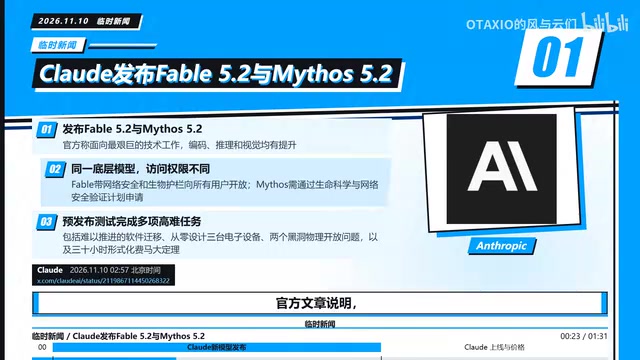
Claude launches same-origin dual versions Fable 5.2 and Mythos 5.2, differentiating safety levels by access permissions and cutting API prices.
Claude released Fable 5.2 and Mythos 5.2, which are actually the same underlying model differing only in access permissions: Fable 5.2 has cybersecurity and biosecurity guardrails and is open to all users, while Mythos 5.2 requires verification. Official pre-release tests included software migrations, designing three working electronic devices, solving two open problems in black hole physics, and a 30-hour formal proof of Fermat's Last Theorem. Standard pricing is $8 per million input and $40 per million output tokens, down from $10 and $50; an optional fast mode offers up to 2.5x speed at $16 and $80, with Mythos's fast mode limited to verified organizations.
Claude's official account announced the launch of two new versions, Claude Fable 5.2 and Claude Mythos 5.2, aimed at the hardest technical work, with improvements in coding, reasoning, and vision. The official post explicitly states that Fable and Mythos are actually the same underlying model, differing only in access permissions.
One Model, Two Access Tiers
Fable 5.2 comes with cybersecurity and biosecurity guardrails and is open to all users; Mythos 5.2 requires applying through the life sciences verification program and the cybersecurity verification program. This "same model, two versions" strategy essentially moves safety and compliance requirements forward to the access control layer rather than carving up model capabilities. For ordinary developers and enterprise users, Fable 5.2 is the default choice; for specialized institutions in life sciences and cybersecurity, Mythos 5.2 provides a verified access channel.
Safety Guardrails refer to the automatic interception and refusal mechanisms deployed at the model's output layer, typically based on classifiers or policy models that judge in real time whether a request involves high-risk domains (such as malicious code generation, pathogen design, or exploit development), and that refuse, downgrade, or attach warnings to requests that hit the policy. Unlike "capability trimming," safety guardrails do not reduce the model's performance on compliant tasks; instead, they apply policy filtering along the input-output chain. Tying guardrails to access permissions means the vendor moves the compliance judgment from the "model training stage" to the "access control stage": ordinary users by default go through the guarded channel, while professional institutions gain a less restricted channel after qualification verification. The cost of this design is that guardrails may produce false refusals, so the verification programs are essentially also providing a compliant path for high-trust users to bypass false refusals.
Hardcore Performance in Pre-release Testing
According to the official announcement, in pre-release testing these two models helped engineers complete software migrations that were previously difficult to advance, design three working electronic devices, solve two open problems in black hole physics, and formally prove Fermat's Last Theorem in 30 hours. These cases span software engineering, hardware design, astrophysics, and mathematical proof, showing that the models have real capability to advance long-horizon, highly complex technical tasks.
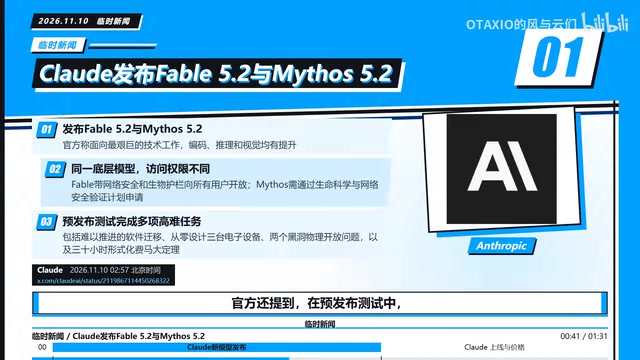
Formal proof refers to writing out a mathematical proposition and its proof completely in a machine-checkable logical language (such as Lean, Coq, or Isabelle), with a proof assistant checking every step of reasoning line by line for validity, thereby eliminating human oversight. Unlike natural-language proofs, the conclusion of a formal proof is "the compiler verified it," which is more trustworthy but extremely costly to write. The formalization of Fermat's Last Theorem is recognized in the mathematics community as an engineering-grade challenge, because it relies on a large amount of modern algebraic number theory and modular form theory and requires formalizing a huge number of prerequisite lemmas first. The "30 hours" figure usually refers to the cumulative time the model spent continuously attempting, completing lemmas, and fixing compilation errors in an interactive proof environment, reflecting the model's endurance on long-horizon tasks with verifiable feedback rather than one-shot generation capability.
API Price Cut, Optional Fast Mode
Fable 5.2 is available from launch day on all paid plans, the Claude platform, and major cloud platforms (including AWS, Google Cloud, and Microsoft Azure). On pricing, it costs $8 per million input tokens and $40 per million output tokens, lower than the previous generation's $10 and $50. The company also offers an optional fast mode that boosts generation speed by up to 2.5x, priced at $16 per million input tokens and $80 per million output tokens. Mythos's fast mode is available only to organizations that pass the verification programs.


Token-based pricing and fast mode are key to understanding the cost structure. LLM APIs charge separately for input tokens (prompts and context) and output tokens (generated content), with output usually more expensive because autoregressive token-by-token generation requires more computation. In this article the output price is 5x the input price, consistent with this industry convention. Fast mode generally trades more aggressive inference configurations, greater parallelism, or dedicated compute pools for lower latency, at the cost of doubling the per-token price. For latency-sensitive applications (such as interactive coding assistants or real-time customer service), a 2.5x speed boost may matter more than the unit price; for batch processing and offline analysis tasks, standard mode is more economical. When choosing, evaluate by "total cost per completed task" rather than "price per token."
Practical Impact on Developers
The price cut directly lowers the cost barrier for high-frequency usage scenarios, while fast mode offers a performance option for latency-sensitive applications. The two-version design of the same underlying model also means developers don't have to choose between "capability" and "compliance"—which version to pick depends on the verification requirements of the use case, not on the model's own strength. For life sciences or cybersecurity teams that need to handle sensitive data, Mythos's verification process adds onboarding steps but also provides a clear path for compliant use.
Signals Worth Noting
By binding safety guardrails to access permissions rather than imposing differentiated limits on model capabilities, Claude's approach offers some reference value for the industry. At the same time, the company's use of cases like the formal proof of Fermat's Last Theorem and open problems in black hole physics to demonstrate model capabilities also reflects that leading model vendors are increasingly inclined to let verifiable, hardcore tasks speak for them in marketing, rather than broad benchmark scores.
One-line Summary
Claude launches same-origin dual versions Fable 5.2 and Mythos 5.2, differentiating safety levels by access permissions and cutting API prices.
Paragraph Summary
Claude officially released Fable 5.2 and Mythos 5.2, which are actually the same underlying model differing only in access permissions: Fable 5.2 comes with cybersecurity and biosecurity guardrails and is open to all users, while Mythos 5.2 requires applying through the life sciences or cybersecurity verification programs. According to the official announcement, in pre-release testing the models completed software migrations, designed three working electronic devices, solved two open problems in black hole physics, and formally proved Fermat's Last Theorem in 30 hours. On pricing, standard mode costs $8 per million input tokens and $40 per million output tokens, lower than the previous generation's $10 and $50; an optional fast mode boosts speed by up to 2.5x at $16 and $80, with Mythos's fast mode available only to verified organizations. Fable 5.2 is available from launch day on all paid plans, the Claude platform, and AWS, Google Cloud, and Microsoft Azure.
Related articles

How Do Cursor, Devin, TRAE, and Copilot Compare on Price? Calculate Your Credits Before You Compare Monthly Fees
Side-by-side comparison of individual and team pricing for Cursor, Devin Desktop, TRAE, and Copilot, breaking down credit rules, third-party model inclusion, overage billing, and practical methods for measuring usage before paying, setting spending caps, and choosing the right tool.

Copilot Retires Three Models: Pro Users Left With Only One Alternative
GitHub Copilot retires Claude Opus 4.8, Claude Opus 5, and GPT-5.6 Tera on Nov 16 across Chat, code completion, and Agent mode. Pro users have only GPT-6 Luna left; Legacy annual plans miss Opus 5.5; admins must enable replacements manually.
Gemini 4 Carbon Arrives: The LLM Race Enters the Era of Million-Token Context and Trillion-Parameter Open Source
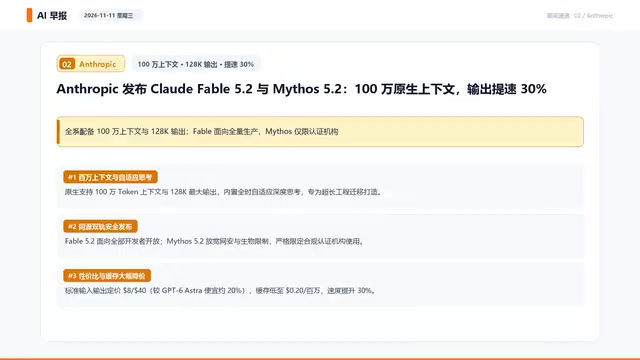
Google launches Gemini 4 Carbon and multi-agent tool Swarm; Anthropic debuts million-context Fable 5.2 and Mythos 5.2; OpenAI releases security-focused GPT-6 Cyber; Mistral and Kimi open-source trillion-parameter models — the LLM race accelerates across the board.