Claude's New Skill Anatomy: Turning Abstract Concepts into Playable Machines

The Anatomy skill turns abstract engineering concepts into operable physical models with interactive mechanical devices.
Anatomy is a free, open-source Claude skill that installs with one npx command and needs no API key; type `/anatomy` plus an idea to use it. Its core idea is not to draw a diagram but to invent a machine whose moving parts embody the concept's logic: a rate limiter becomes a real mechanical device, and a cache key becomes a pin tumbler lock that only turns when every pin matches. The output is a live isometric figure you can rotate, press, and read, letting users verify conditions firsthand. Advice: name the idea rather than describe a picture, and provide real numbers as parameters; generation is intentionally slow, so allow time. The author also advises scanning the code before use.
Abstract concepts are hard to teach and hard to explain clearly — take engineering concepts like cache keys or rate limiters. No matter how much you describe them in words, the listener still only half-understands. A Claude skill called Anatomy offers another approach: turn an idea directly into a mechanical device you can turn, press, and read.
One-command install, zero barrier to entry
Anatomy is part 4 of a skill series, free and open source. According to the video, installation takes just one npx command and requires no API key. The author recommends scanning the code first, as in part 3, before using it — a habit worth keeping. The principle of reviewing open-source tools before use never goes out of style.
Once installed, just type /anatomy in Claude along with the idea you want explained. There's no complex parameter configuration and no extra account system — this "zero-friction" design is what makes it so easy to spread.
npx is a command execution tool bundled with npm in the Node.js ecosystem. Its job is to temporarily download and run an npm package without needing to install it globally first. When you run npx <package-name>, npm checks whether the package already exists locally; if not, it pulls it from the registry into a cache directory and then runs its entry script. This brings two direct benefits: users don't need to worry about install paths or version management, and package publishers can continuously push the latest version so that users always get the current release each time they run it. The cost is that every run may trigger a network request, and it executes code that hasn't been reviewed locally — which is precisely the technical reason the original article emphasizes "scan the code before use."
It's important to distinguish that the npx command itself doesn't equal "no API key." The real reason no API key is needed is that the skill relies on the Claude client's own model-calling capability to run, rather than connecting directly to the model provider inside the script. Understanding this is the only way to judge where the cost and permission boundaries of such tools actually fall.
Translating concepts with mechanical parts
Anatomy's core idea is not to draw a diagram, but to "invent a machine" whose moving parts are themselves part of the concept.
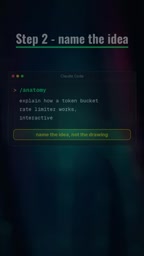
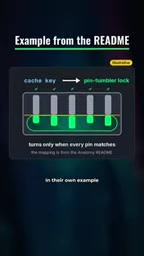
The official example is very intuitive: when you type "how a rate limiter works," Claude constructs a real, existing mechanical device to correspond to that concept. Another example is the cache key — it's transformed into a pin tumbler lock that only turns when every pin matches. This mapping isn't a decorative metaphor; it directly embeds the concept's decision logic into the mechanical structure, greatly reducing the cost of understanding and remembering.
From a teaching perspective, this follows the classic "embodied cognition" route: letting learners build mental models by operating physical objects rather than memorizing definitions. For anyone who needs to explain technical concepts to others — instructors, technical writers, interviewers — this skill provides a ready-made expression tool.
A pin tumbler lock is the most common mechanical lock structure, and its principle happens to correspond to the matching logic of a cache key. Between the plug and the shell there is a row of vertical pin chambers, each containing a lower pin and an upper pin, with the dividing plane between them called the "shear line." After inserting the key, the key's tooth heights push the lower pins to different heights; only when every single upper pin's bottom edge lands exactly on the shear line can the plug rotate. If any one pin's height doesn't match, the plug is stuck fast.
This is isomorphic to how a cache key is judged: a cache key is usually composed of multiple fields (such as user ID, resource type, version number), and only when all fields match one by one is it considered a cache hit and the result returned; any mismatched field means a miss. By mapping the logic of "only release when all fields match" onto the pins, a learner can turn the key once and intuitively feel the strictness of the "AND" condition — far more memorable than reading a snippet of pseudocode like if (key1 === a && key2 === b).
Isometric view and real-time interaction
The final output is a live isometric figure that you can rotate, press, and read information from directly.

Compared with traditional static illustrations, an interactive mechanical model adds a layer of "verification" capability: you can turn the lock yourself and see under what conditions it opens, which is closer to the real process of understanding than looking at a labeled diagram.
An isometric view is a type of axonometric projection: the three coordinate axes are distributed evenly at 120 degrees on the picture, and lengths in all directions are scaled by the same ratio, so there is no perspective effect of near objects appearing large and far objects appearing small. For mechanical devices, the advantage of this projection is that — no matter where a part is in the frame, the size ratio stays consistent, so gear meshing relationships and the relative lengths of linkages can be read faithfully without being misled by perspective distortion.
This is exactly why it's widely used in engineering drawings and isometric-style games (such as simulation and building games). Compared with perspective projection, which emphasizes "the viewer's viewpoint," isometric projection emphasizes "the object's own structure," which aligns closely with Anatomy's goal of conveying "how the machine works." Rotatability further makes up for the shortcoming that axonometric drawings can only fix a single viewing direction, letting users verify from multiple angles whether the mechanism is truly self-consistent.
Usage tips: describe the idea, not the picture
The video offers two practical suggestions. First, when typing, you should name the "idea" itself rather than describe the picture you want — for example, type "how a rate limiter works" rather than "draw a picture of a rate limiter." Second, try to provide real numbers so that the mechanical structure has concrete parameters to work from, rather than vague suggestions.
The author also specifically reminds: this skill "is slow on purpose" and you need to let it run fully. Generating a reasonably structured mechanical model itself involves considerable computation, and rushing for results will instead produce rough output.
Embodied cognition is a theoretical orientation in cognitive science that argues thinking is not pure symbolic computation divorced from the body, but deeply dependent on sensorimotor experience. People understand concepts like "turning," "getting stuck," and "releasing" through actual hand operation, not dictionary definitions.
This explains a common teaching dilemma: abstract concepts are hard to explain because they have no corresponding bodily experience. Translating a rate limiter into a device with a gate, a counterweight, and a lockout triggered by overload is effectively "borrowing" a set of bodily experiences for this purely symbolic concept. When learners turn the handle and observe the gate closing at the threshold, they form action memory and causal intuition, not just verbal memory. This also explains why interactive mechanical models are more effective than static diagrams — static diagrams provide only visual information, whereas operable models engage three channels at once: vision, action, and expected feedback.
A microcosm of the open-source skill ecosystem
Anatomy's emergence shows that Claude skills are moving from "text assistance" toward "visual construction." One-command installation, no API key, free and open source — this combination lowers the barrier to trying it and makes it easier for skill creators to get feedback and spread the word. For anyone who wants to turn abstract knowledge into intuitive experience, this tool is worth putting in the toolbox and trying once; and its reminder to "scan before use" also signals that security awareness still cannot be absent from the open-source ecosystem.
One-line Summary
Anatomy turns abstract engineering concepts into operable physical models using interactive mechanical devices.
Paragraph Summary
Anatomy is a free, open-source Claude skill that installs with a single npx command and requires no API key. Just type /anatomy plus an idea to use it. Its core approach is not to draw a diagram but to invent a machine whose moving parts themselves carry the concept's logic: a rate limiter is built as a real mechanical device, and a cache key is translated into a pin tumbler lock that only turns when all pins match. The final output is a live isometric figure you can rotate, press, and read, letting users verify conditions firsthand. The advice is to name the idea rather than describe a picture, and to provide real numbers as parameter bases; generation is deliberately slow, so allow enough runtime. The author also reminds users to scan the code before use.
Related articles

Zed Editor Releases v1.29.2: Observations on a Routine Version Iteration
Zed editor releases patch v1.29.2, version bump by @JosephTLyons, commit verified via GitHub signature. This article covers the release's basic info, what a patch version means, and practical upgrade advice for users.

Anthropic IPO Questioned: Hacker News Debates Timing of Going Public
A Hacker News post titled "Just say no to Anthropic's IPO" sparks debate on the timing of Anthropic's public listing and AI capitalization, touching on valuation bubbles and mission independence.

Hands-On with the Genie 4 World Model: Directing Worlds in Real Time Like a Puppeteer
Google DeepMind's Genie 4 world model in depth: Special Guest X's hands-on demo of real-time scene direction via prompts, custom interactive apps in Project Genie, and prompts-as-seeds reproducibility.