Claude's New Skill: Letting the Model Assess Conversation Safety Itself

Anthropic has Claude self-assess conversation safety after replying, replacing external classifiers with model judgment.
Anthropic trained a self-assessment capability into Claude: after each reply it performs a preliminary safety assessment of the whole conversation, using the model's own judgment to spot potential abuse instead of external classifiers. Since Claude already has full context, it is more efficient and broader than classifiers covering only discrete harm types, and accuracy rises with model capability without separate iteration. Since June it has flagged abuse other measures missed. But limitations remain: self-consistency bias, undisclosed false positive/negative rates and human review proportions, and unknown cost and latency at scale—credibility ultimately depends on verifiability.
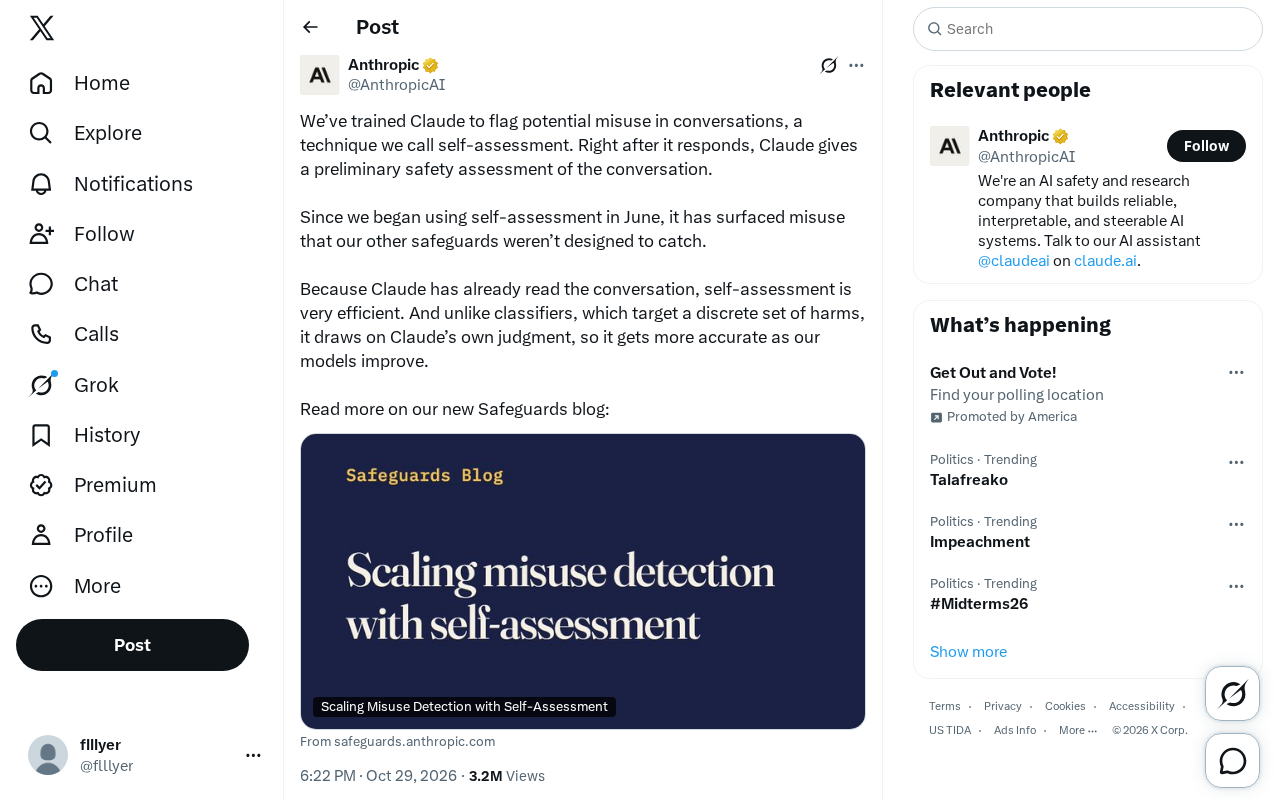
Anthropic has trained a new capability into Claude: after each reply, it performs a preliminary safety assessment of the entire conversation. They call this mechanism self-assessment. Unlike the traditional approach of relying on external classifiers, it directly taps the model's own judgment to identify potential abuse.
How Self-Assessment Works
According to Anthropic's explanation on X, after Claude produces an answer, it immediately performs a preliminary safety judgment on the current conversation. This amounts to embedding a lightweight "self-check" step into the normal interaction flow, rather than sending the content off to a separate safety model for scoring.
The key difference lies in the information foundation. Claude has already read the full context, so self-assessment is highly efficient; in contrast, classifiers trained for specific harm types cover only a discrete set of risks and struggle to generalize to newly emerging forms of abuse.
From Classifiers to Model Judgment
The traditional safety classifier approach is "enumerate harms, model each separately," and the problem is that coverage always lags behind actual abuse. Self-assessment hands the judgment back to the model itself, with the advantage that it can leverage a holistic understanding of semantics and intent.
Anthropic explicitly states that as model capabilities improve, the accuracy of this mechanism will rise accordingly—safety capabilities evolve in tandem with model capabilities, rather than requiring repeated separate iteration like fixed classifiers. This is engineering-attractive: as the model gets stronger, safety judgment benefits automatically.
Safety classifier refers to a class of independently trained small models that take text to be examined as input and output a label or score for "whether it belongs to a certain category of harm," commonly used in content moderation pipelines. Its training depends on manually labeled harm samples, so each classifier typically corresponds to only one or a few risks (such as hate speech, self-harm, or illegal activity), and semantic understanding is hard to share across harm types. This "enumerative" design brings two inherent problems: first, coverage is limited to the known harm list at labeling time, and new forms of abuse require re-labeling and retraining; second, classifiers often see only a single message without conversation history, making it easy to misjudge irony, quotation, or educational discussion in context as genuine harm. The self-assessment approach is precisely to replace such bolt-on classifiers with the main model that has full context, trading semantic understanding for stronger generalization.
Practical Findings After Launch
Since self-assessment was enabled in June, it has flagged abuse that other safety measures were not designed to catch. This wording is worth noting—it does not claim to replace existing protections, but to fill blind spots outside the existing system.
For safety teams, such "accidental discoveries" are themselves proof of value: real abuse often appears where classifier designers did not think to look, and a model self-check with contextual understanding is more likely to notice anomalous patterns.
Limitations and Open Questions
Self-assessment is not a panacea. Having a model evaluate its own conversation carries an inherent risk of self-consistency bias—it may tend to believe its own replies are fine. Anthropic did not disclose details such as false positive rate, false negative rate, or the proportion of human review in this tweet, only pointing to its Safeguards blog for further reading.
Another unresolved issue is cost and latency. Although the tweet emphasizes "efficient," adding an extra model call per turn still means real overhead for large-scale deployment. Whether this mechanism can run stably under real traffic still needs more public data to support.
Self-consistency bias refers to the tendency of a model, when evaluating its own output, to reach conclusions consistent with its existing judgments, thereby systematically underestimating its own errors. This is similar to the "inflated self-evaluation" phenomenon in human review, rooted in the model being more "familiar" with the probability distribution of its own generated content and finding it harder to make negative judgments about it. In safety scenarios, the direct consequence of this bias is an underestimated false negative rate: genuinely dangerous replies may be judged harmless by the model itself. Mitigation usually includes introducing independent review models, sampling human review of self-assessment results, or having the model use different prompts and role settings during evaluation than during generation. The article notes that Anthropic did not disclose false positive and false negative rates, which means the actual impact of self-consistency bias currently cannot be quantified from public information.
Significance for the Industry
Internalizing safety judgment as part of model capability is an important shift in current AI safety engineering. Moving from external rules and classifiers toward adaptive protection that leverages the model's own understanding is especially friendly to fast-iterating model products, if it works.
But its credibility ultimately depends on verifiability. How flagged content is human-reviewed, how it links with existing interception policies, and how misjudgments are corrected—these engineering details determine whether it is a substantive safety enhancement or a pretty demo.
Verifiability in AI safety engineering refers to whether the effectiveness of a protection measure can be independently measured and reproduced externally, usually requiring public false positive rates, false negative rates, test set composition, and human review processes. For mechanisms like self-assessment where "a model judges a model," verifiability is especially critical: because the evaluator and the evaluated share the same source, outsiders cannot judge reliability from the mechanism description alone and must rely on quantitative metrics and third-party red-team testing. Without such data, safety enhancements and marketing demos are hard to distinguish in appearance. In industry practice, verifiability is usually achieved through standardized benchmarks (such as harm classification test sets), public abuse interception statistics, and auditable logs, which is also the core threshold for judging whether self-assessment can move from concept to engineering deployment.
One-line Summary
Anthropic has Claude self-assess conversation safety after replying, replacing external classifiers with model judgment.
Paragraph Summary
Anthropic trained a self-assessment capability into Claude: after each reply, it performs a preliminary safety assessment of the entire conversation, directly using the model's own judgment to identify potential abuse rather than relying on external classifiers. Because Claude has already read the full context, self-assessment is more efficient and broader in coverage than classifiers that cover only discrete harm types, and accuracy rises in tandem with model capability without separate iteration. Since enabled in June, the mechanism has flagged abuse that other safety measures originally failed to catch. But the article also notes its limitations: model self-evaluation of its own conversations carries a risk of self-consistency bias, Anthropic has not disclosed false positive rates, false negative rates, or human review proportions, and the cost and latency of extra model calls remain unknown at large-scale deployment; its credibility ultimately depends on verifiability.
Related articles

API vs. Local LLM Deployment: Cost Analysis and Selection Guide
Compare the costs and use cases of APIs vs. local LLM deployment: APIs require zero hardware and charge per Token but have rate limits; local deployment means buying a GPU upfront, amortized to near-free over time, with data staying on-device. Light users choose APIs; heavy and privacy-sensitive users choose local.

Can the Ark Ship Be Hijacked by Pirates? The Hard-Core Logic of a Space 'Ark Heist'
The ark ship: most expensive object ever, centuries-long voyage — why wouldn't anyone steal it? Mustard's video breaks down hijacking windows, economic logic, the stealth paradox, and defense strategies.

Touchscreen MacBook Pro Hands-On: Innovation or Gimmick?
Hands-on with the touchscreen MacBook Pro: ProLED XDR display supports touch, but professional apps like Photoshop lack adaptation, Dynamic Island and touch optimization are limited, and the screen wobbles noticeably. The blogger considers it a cool but unnecessary feature.