Claude's New Usage Limits Spark Backlash: Pro and Team Plans Falling Short for Real Workloads
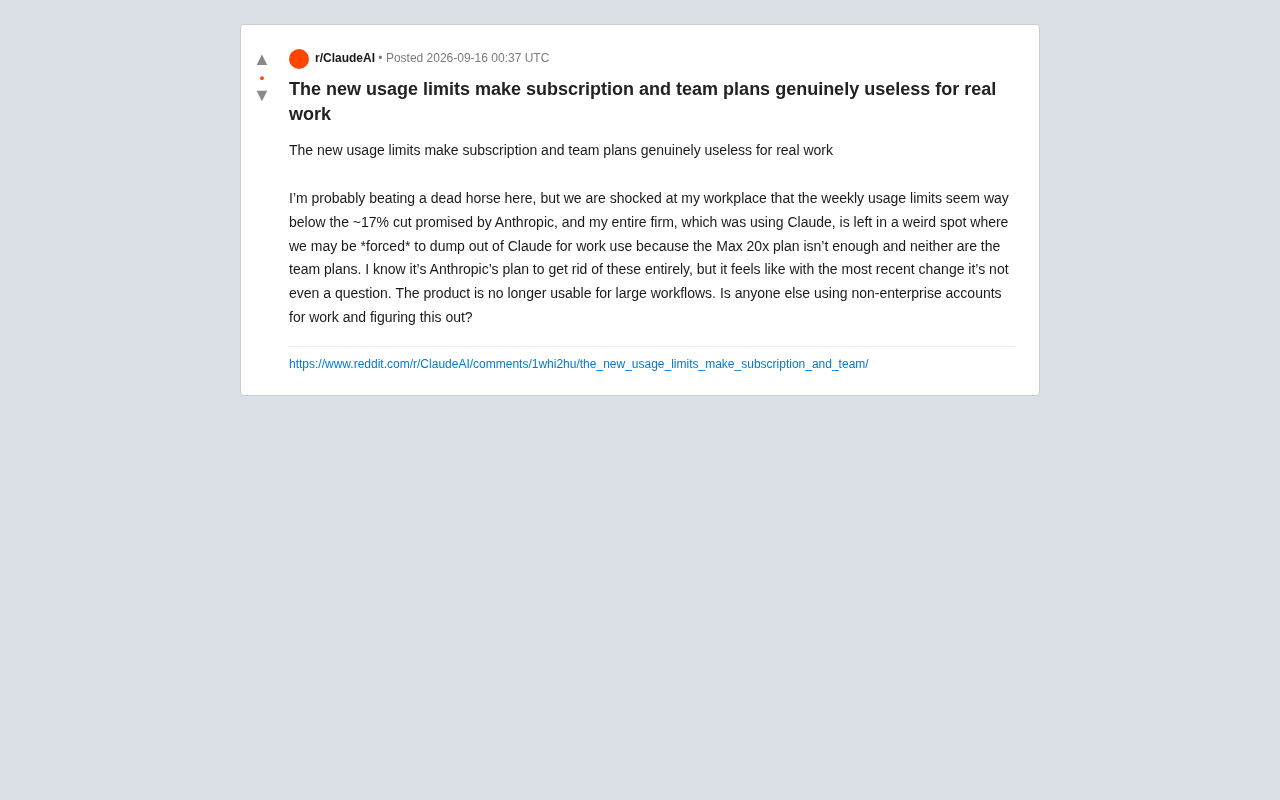
Claude usage limits spark backlash as small teams find Max 20x and Team plans insufficient for real workloads.
A Reddit post has ignited broad discussion after multiple users reported that Anthropic's new Claude usage restrictions far exceed the officially stated ~17% reduction, leaving Max 20x and Team Plan subscribers unable to handle large workloads. The poster speculates Anthropic may be deliberately degrading mid-tier plans to push heavy users toward Enterprise contracts. The controversy shines a light on an overlooked segment — small and mid-sized teams doing commercial work on non-enterprise accounts — who lack both enterprise budgets and the light usage profiles of individual developers. The episode is also a cautionary reminder that tying core business processes to a single vendor's mid-tier plans carries real policy risk.
Usage Limit Tightening Triggers Strong User Pushback
A Reddit user recently posted a blunt complaint: Anthropic's latest usage adjustments to Claude's subscription plans have made "the subscription and team versions nearly useless for real work scenarios." The post quickly resonated with others, reflecting widespread anxiety among small and medium-sized teams over changes to Claude's pricing tiers.
According to the poster, their company had previously relied on Claude for day-to-day workflows, but the new weekly usage caps appear "far lower than the roughly 17% reduction Anthropic promised." The gap between the actual experience and the official messaging became the immediate trigger for this wave of discontent.
From Max 20x to Team Plan: Why Neither Is Enough
The poster highlighted a critical detail: even the highest-priced Max 20x plan couldn't meet their team's large-scale workflow needs — and the Team Plan was equally inadequate. This points to a significant gap in the current non-enterprise tier structure for high-intensity use cases.
Large Workloads Are Hit Hardest
"Large workloads" typically refer to high-frequency usage patterns involving long contexts, multi-turn iterations, and batch processing. These patterns are extremely sensitive to token consumption — once weekly limits are tightened, users hit the ceiling quickly. For companies that have deeply integrated Claude into their production pipelines, these restrictions aren't just a degraded experience; they directly disrupt business continuity.
The poster was blunt: "The product can no longer support large workloads." Behind those words lies the very real pressure of teams being forced to reassess their entire toolstack.
Claude's current tiers for individual and team users are roughly: Free, Pro, Max 5x, Max 20x, and Team Plan, with Enterprise pricing negotiated separately. Max 20x is the ceiling for consumer-grade subscriptions — priced at roughly 20x the Pro plan — and theoretically offers a much higher message quota. The Team Plan focuses on multi-user collaboration with per-seat pricing, but its usage limits don't match Max 20x levels. Anthropic measures consumption in "messages" or the underlying token usage; when large context windows are occupied, the quota consumed per conversation multiplies rapidly — which is precisely why large workloads hit limits so easily.
A Suspected Strategic Intent: Pushing Users Toward Enterprise
Notably, the poster also floated a theory: that Anthropic "always intended to gradually phase out these plans." In other words, the tightening of subscription and team plan usage may not be purely capacity management — it could be a deliberate product segmentation strategy designed to funnel heavy commercial users toward Enterprise contracts.
This kind of approach is hardly unheard of in the SaaS industry. As a product evolves from a personal tool into an enterprise necessity, vendors often adjust the value proposition of lower-tier plans to filter out customers willing to pay more. But for small and mid-sized teams caught in the middle, the cost of "moving up" may be prohibitive, leaving them stuck between a rock and a hard place.
It's worth noting that the above reflects the observations and speculation of a single user. Anthropic has made no public confirmation of any plans to discontinue these tiers, and this article treats such claims with appropriate caution.
In the SaaS and cloud services world, this approach — squeezing the value of mid-tier plans to push heavy users toward premium pricing — is sometimes called "Feature Gating" or a "usage funnel" strategy. The business logic: Enterprise contracts typically come with room to negotiate, custom SLAs, and dedicated support, making them significantly more profitable than standardized subscriptions. OpenAI, Google, and other AI vendors have followed similar playbooks — draw users in with affordable subscriptions, then guide them toward upgrades once dependency is established. For small teams, the barrier to Enterprise isn't just price; it also involves procurement processes, contract cycles, and other administrative friction — making the real cost of "moving up" far higher than the sticker price difference alone.
The Real Dilemma for Small and Mid-Sized Teams
The true value of this discussion lies in what it exposes: a neglected user segment — small and mid-sized teams using non-enterprise accounts for genuine commercial work. They're not light users like individual developers, but they also lack the budget to jump straight to Enterprise.
The closing question in the original post is telling: "Anyone else working on non-enterprise accounts and trying to figure out how to cope?" It's essentially a call for shared experience from users in the same boat. For many small teams dependent on AI tools, every shift in usage policy can ripple through their entire collaborative workflow — and may force them to reconsider their vendor entirely.
What This Means for the AI Subscription Market
From a broader perspective, this controversy reflects a core tension in today's AI subscription market: the clash between high compute costs and user expectations. Vendors need to control costs and optimize pricing structures; users want stable, predictable service capacity. When the two fall out of balance, user trust erodes.
For any organization that has woven LLM services into its core workflows, this also serves as a practical reminder: don't tie critical business operations entirely to a single vendor's mid-to-low-tier plans. Usage policies and pricing tiers can change at any time. Maintaining some degree of migration flexibility and keeping backup options available is the prudent way to manage uncertainty.
Conclusion
A single Reddit post doesn't represent the full range of user experiences, and Anthropic's actual strategy still awaits official clarification. But the anxiety this discussion reflects is real: when AI tools shift from "nice to have" to "mission-critical," any ripple in subscription policy gets amplified into a question of business survival. For Anthropic, finding the right balance between cost control and user retention will be a defining factor in its reputation among commercial customers.
Related articles

Claude Code vs. Codex in Enterprise Projects: How AI Engineering Handles Complex Systems
From Vibe Coding to AI engineering: a breakdown of Claude Code and Codex in real enterprise projects, covering three dev modes, domestic LLM rankings, SuperPower workflows, and Open Router's profit logic.
Hands-On with Open-Source Desktop Client CC-HAHA: Let AI Automatically Control Your Computer
CC-HAHA is an open-source desktop client with computer use support, letting AI control your GUI via virtual mouse. Learn the 3-step setup and model comparisons.

Claude Code Desktop: A Complete Guide to Chinese Localization, Account-Free Use, and DeepSeek Integration
Step-by-step guide to installing Claude Code Desktop, enabling account-free use, adding Chinese UI, connecting DeepSeek via CC Switch, and importing custom Skills.