Claude Solves a Physicist's 23-Year-Old Unfinished Calculation, Heralding a New AI Research Paradigm
Claude, running multi-agent in the background for six weeks, completed a 23-year-old black hole phase transition calculation verified in Lean.
The article describes an Anthropic researcher Hongbin Chen's side-project experiment: letting Claude list open problems in black hole physics and bootstrap methods, yielding 22 candidates, then dispatching independent agents to attack them for about six weeks, ultimately solving two. One is the black hole phase transition calculation proposed in 2003 but never completed, whose conclusion points to a sudden jump rather than a gradual transition, showing that black hole formation is built into quantum theory; the other is the exact upper bound of modular bootstrap in a simplified two-dimensional universe, proved with sphere-packing mathematics. The results were formally verified in Lean and the preprint made public, but they concern model universes and have not yet undergone independent peer review. The article stresses that the real signal is in the method: the same model, Fabel 5.2, had previously completed animation generation and formalization of Fermat's Last Theorem, and the bottleneck is shifting from computation to problem selection.
23 years ago, physicists wrote down a calculation to answer a fundamental question about black holes. The computation was too large, and they never managed to finish it. Six weeks ago, an AI completed it unattended in the background—and solved a second problem along the way.
A video from YouTube revealed an experiment by Anthropic researcher Hongbin Chen as a "side project": letting Claude list open problems in black hole physics and bootstrap methods. Hours later, Claude returned 22 candidates; independent agents were dispatched to each problem and ran for about six weeks. According to the video, two problems were ultimately solved, the results were formally verified in Lean, and a preprint has been made public.
The Rift Between Two Theories
Physics has two extraordinarily successful theories. General relativity describes the very large—planets, stars, galaxies, the curvature of spacetime itself. Quantum mechanics describes the very small—atoms, particles, the jitter underlying everything. Each has passed every experimental test: relativity keeps satellites precisely in orbit, and quantum mechanics gave rise to transistors, lasers, and mobile phone chips.
But put them in the same equation and they collapse. Infinities, contradictions, meaningless results. The missing bridge is called quantum gravity, and black holes are exactly where that bridge must stand—mass compressed into an extremely small space, heavy enough for relativity to rule, small enough for quantum mechanics to rule.
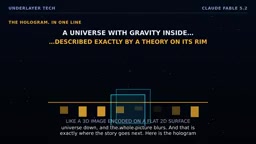
The picture physicists use to think about black holes is the holographic principle: a gravitational interior universe can be fully described by a gravity-free quantum theory on its boundary, like a 3D image encoded on a 2D surface. When the mathematics on the gravity side breaks down, one can switch to computing on the boundary.
The 2003 Calculation: Is the Critical Point a Sudden Jump or a Gradual Transition?
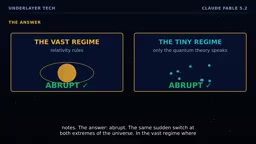
In 1983, Hawking and Page calculated the phase transition from hot gas to black hole in anti-de Sitter space, concluding it was sudden—like water turning to steam at the boiling point in an instant, not a slow transition. But their mathematics was only valid on huge scales where spacetime is smooth and relativity holds.
In 1999, physicists discovered that the same thermal-to-black-hole transition exists in the weakly coupled region on the boundary, but one question remained unresolved: is the switch on the boundary sudden like Hawking-Page, or a smooth gradual transition? The answer would tell us whether black hole formation is built into quantum theory itself or exists only in relativity.
In 2003, a group of physicists proposed a calculation that could settle the question. It relied on a single number appearing in a three-loop computation, entangled across thousands of diagrams, and along the way infinities had to be tamed. This calculation was never completed. A simplified version was finished in 2005, while the real version is an order of magnitude larger. The problem sat on the shelf for 23 years.
Anti-de Sitter space (AdS) is a spacetime solution in general relativity with negative constant curvature, whose boundary lies at infinity and is the standard stage for AdS/CFT duality. In AdS, gravity is "trapped" in a box, so hot gas and black holes can be in thermodynamic equilibrium and compete with each other—precisely the premise that makes the Hawking-Page phase transition rigorously discussable. By contrast, our universe is approximately de Sitter space (positive curvature), where black holes evaporate and the system is unstable, making phase transition analysis far more complex. The repeated emphasis on "model universes" in the text refers to this idealized setting in an AdS background—it makes calculations definable and verifiable, but there remains a distance from black hole physics in the real universe.
The core idea of the bootstrap method is "replacing direct solution with self-consistency": rather than presupposing specific microscopic details of a theory, one imposes a set of physical constraints that must be satisfied (such as unitarity, crossing symmetry, and associativity of the operator product expansion), eliminating theories that fail the constraints one by one, and the remaining feasible region characterizes all possible theories. Modular bootstrap is a variant in the context of finite temperature and the modular Hamiltonian, developed after 2009 and often used to constrain strongly coupled problems such as the black hole formation threshold. It outputs numerical allowed intervals rather than analytic solutions, so "numerically suggesting the best upper bound" is not the same as a proof; Claude's contribution in the text is precisely to elevate a numerical pattern into an exact, provable upper bound.
Claude's Solution: Splitting Itself into a Research Group
For the 2003 calculation, Claude split itself into a small "research group," with each copy computing each part almost independently, checking its work against known results, and then comparing notes with one another. The answer pointed to a sudden jump: on the huge scales where relativity rules and the tiny scales where only quantum theory can speak, the switch is equally abrupt. Black hole formation is built into quantum theory.
The video also mentioned that an independent physicist, using a different method and also with Claude's help, arrived at the same answer.
The second problem lives in a simplified universe with only two spatial dimensions. Lacking a complete theory of quantum gravity, physicists used the modular bootstrap method developed since 2009 to rule out wrong theories: set an upper bound—how heavy can the lightest black hole be? Any theory predicting a heavier black hole is wrong. Numerical results suggested the location of the best upper bound, but a suggestion is not a proof.
According to the video, Claude saw a pattern in these numbers that physicists had missed, borrowed methods from sphere-packing mathematics, computed the exact upper bound for the simplest version, and proved it could not be lowered further. You may not have noticed the process: a Claude agent had previously attempted the same problem, and 61 parallel attempts all failed; this time two other agents independently arrived at the same answer, and half of the final proof also followed the sphere-packing proof strategy of a certain open AI model.
Verification and Boundaries: Being Clear About What It Did
In September 2026, the results were formally verified in Lean—a computer proof checker that accepts no "trust." Claude wrote the paper with minimal guidance, a physicist checked every major result, and the preprint was made public.
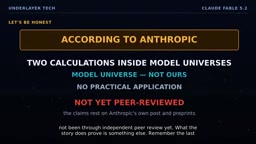
But the video itself remained restrained about this: according to Anthropic, these are two calculations in model universes, not our universe, and have no practical applications; the conclusions rely on Anthropic's own blog and preprint and have not yet undergone independent peer review.
The real signal is not in the physics results themselves but in the method. The same model, Fabel 5.2, had previously made an animation: a single prompt became 4,800 lines of Python driving Blender—a cartoon pelican, a 21-bone rig, and a 14-inch bicycle whose drivetrain actually turns, with no artist drawing a single frame. Before that, about a thousand Fabel agents formalized Fermat's Last Theorem in Lean in about 30 hours.
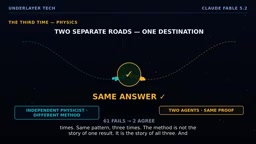
Three successes, the same model, the same playbook: one model splits into many minds, each working independently and checking one another, running in the background for weeks. What changes is not the model's intelligence but the task given to it and how long it is allowed to work in the background.
Lean is an interactive theorem prover and also a dependently typed programming language. Its core value lies in this: a proposition is accepted only after the machine checks every step of reasoning, and the prover cannot get away with "it looks right." The "formalization" movement promoted by the mathematics community in recent years (such as Lean's mathlib library) has covered a large amount of undergraduate- to graduate-level mathematics. "Formalizing Fermat's Last Theorem in Lean," mentioned in the text, is a frontier-scale project that requires decomposing the existing proof into a chain of machine-checkable lemmas. Note that Lean verifies that "the proof is consistent with the statement and the reasoning is valid"; it does not automatically guarantee that the statement itself faithfully translates the physics problem—the correctness of the physical modeling still requires human review.
The Bottleneck Shifts from Computation to Problem Selection
Claude did not prove quantum gravity, nor did it solve black holes. What it completed were two specific calculations that physicists had failed to finish in paper universes. But that is enough to change the judgment about AI's role in research: a lab partner that can run a research project in the background for six weeks and complete work humans left on the shelf for 23 years means the bottleneck is no longer computation itself but judging which computation is worth doing.
Of the 22 open problems Claude listed, two have been solved. Where to point next, and what happens once the list is exhausted, are the questions truly worth watching.
Multi-agent parallelism and "long-running background operation" are the two key methodological variables in this experiment. Multi-agent means instantiating the same model into several roles, each independently solving subproblems and cross-checking, to reduce the accumulation of errors along a single path; long-running background operation allows tasks to span hours to weeks, with the model able to repeatedly trial and error, call tools, and maintain intermediate state. This is fundamentally different from "one-shot question answering": the capability gain comes from the breadth of search and verification, not the depth of a single reasoning pass. The risks scale accordingly—errors can propagate far before being checked, and reproducibility depends on whether run logs and verification steps are fully preserved.
One-line Summary
Claude, running multi-agent in the background for six weeks, completed a 23-year-old black hole phase transition calculation verified in Lean.
Paragraph Summary
The article describes an Anthropic researcher Hongbin Chen's side-project experiment: letting Claude list open problems in black hole physics and bootstrap methods, yielding 22 candidates, then dispatching independent agents to attack them for about six weeks, ultimately solving two. One is the black hole phase transition calculation proposed in 2003 but never completed, whose conclusion points to a sudden jump rather than a gradual transition, showing that black hole formation is built into quantum theory; the other is the exact upper bound of modular bootstrap in a simplified two-dimensional universe, proved with sphere-packing mathematics. The results were formally verified in Lean and the preprint made public, but they concern model universes and have not yet undergone independent peer review. The article stresses that the real signal is in the method: the same model, Fabel 5.2, had previously completed animation generation and formalization of Fermat's Last Theorem, and the bottleneck is shifting from computation to problem selection.
Related articles
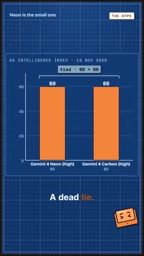
Gemini 4 Neon Hands-On: Small Model Matches Flagship, Doubles the Speed
Gemini 4 Neon tied flagship Carbon 60-60 in independent tests while running about twice as fast. We break down why small models are quicker, why benchmarks fail, and why model selection should drop single scores for real-task timing.
Gemini 4 Neon Tops Coding Model Leaderboard: #1 Performance at a Quarter of the Cost
Google Gemini 4 Neon tops the Models Engineering Index coding leaderboard with 68.0, beating OpenEye 6.2 Astra and Anthropix's flagship at a quarter of the cost.

Gemini 4 Neon In-Depth Review: Near Top-Tier Performance, But Not the Cheapest
Gemini 4 Neon, Google's fourth model in seven weeks, balances performance and cost. Independent tests rank it third overall, matching rivals in coding at half the cost.