Claude Sonnet 4.5 Launches 30% Faster, Grok 4.8 Leak Signals Emerge

Claude Sonnet gets 30% faster, Nvidia builds Agent safety platform, and coding tools see a wave of updates.
Four themes dominate today's AI news: Anthropic's new Claude Sonnet is 30%+ faster and up to 30% cheaper with no price change, now the default model for Claude.ai's free tier; coding and Agent tools surge forward with Devin price cuts, Manus 2.0 gaining phone numbers, and multiple tool updates; Nvidia and 100+ partners launch the Open Agent Safety Platform as Perplexity's sandbox tests show mainstream models failing to breach VM isolation under network blocking; and the multimodal ecosystem expands with ElevenLabs v4, Kling 4.0, and Upstage Solar updates ahead of OpenAI DevDay. A Grok 4.8 appearance in Cursor's server-side model list has drawn attention, but no official release confirmation has been made.
Anthropic Releases New Claude Sonnet: Faster, Cheaper, Same Price
Anthropic has launched a new version of Sonnet — the second model in the Claude family to receive an update. The core selling points are clear: over 30% faster than the previous Sonnet generation, up to 30% lower cost in most workflows, with no price change. Pricing remains at $2 per million input tokens, $10 per million output tokens, and $0.20 per million cache read tokens. The model is available across all channels starting today, with a new Haiku version to follow in the coming weeks.
This update also brings extended thinking capabilities into the fold, along with support for continuity when switching between accounts. Ecosystem adoption has been swift: GitHub Copilot has full availability, Cursor says it performs "on par with Opus" for many tasks, and both Devin's desktop client and CLI have already integrated the new model. Developer Simon Willison notes that this model is now the default for Claude.ai's free tier — meaning free users benefit from the performance gains immediately.
One practical note for existing users: official account credits have been reset, and any unused credits from before must be used by October 22nd or they will expire.
Grok 4.8 Leak Signals Surface, No Official Confirmation Yet
Speculation about xAI's next-generation model is heating up in the developer community. Third-party monitoring account LuminaBench reports that Grok 4.8 has appeared in Cursor's server-side model list; a separate code commit also lists several variant names including Grok-4.8, Grok-4-Fast, and Grok-4-Fast-X.
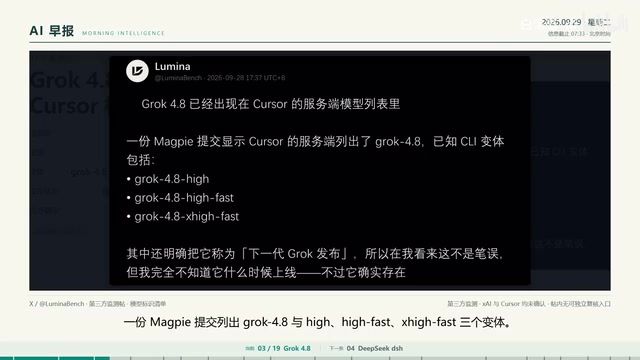
It's worth emphasizing that leaked signals don't equal an imminent release. The commit's author explicitly stated these entries "do not indicate an upcoming release," and neither xAI nor Cursor has made any official confirmation. It's understandable to be curious about names appearing in model lists, but until there's a formal announcement, these remain unverified signals.
A server-side model list is a catalog that platforms maintain in their backend to configure available models. Developers or third-party monitoring tools can sometimes capture field changes through API responses, code commits, or network requests. These signals are treated as "leaks" because model names often need to be written into infrastructure configurations before a public release. However, this doesn't mean the model is ready: entries may be placeholders, internal test identifiers, or naming slots reserved for future versions. Historically, many model names appearing in such lists have launched under different names or been merged into other versions — so inferring a release timeline from naming entries alone carries significant uncertainty.
Coding and Agent Tools See a Wave of Updates
One of today's major themes is the rapid iteration across coding and autonomous agent (Agent) tools.
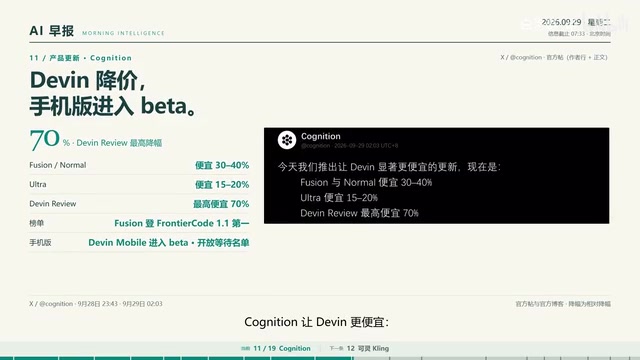
Cognition has broadly cut Devin's pricing: Fusion and Normal tiers are 30–40% cheaper, Ultra is 15–20% cheaper, and Devin Review drops by up to 70%. At the same time, Devin Fusion ranks first on the Frontier Code 1.1 Extended leaderboard — improved performance and improved value at once. Devin Mobile has also entered Beta with a waitlist open.
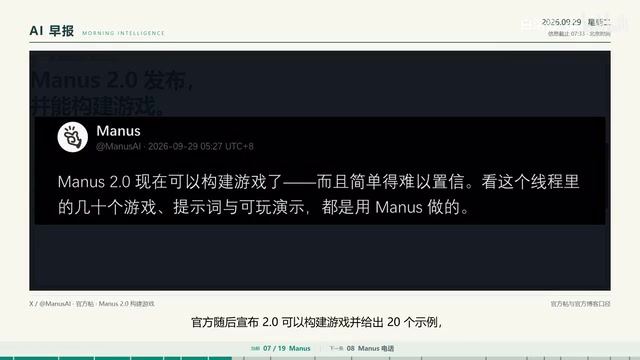
Manus has released version 2.0, introducing the new Cascade Harness and Queue (application queuing) capabilities. Shortly after, the team announced that Manus 2.0 can directly build games and shared 20 examples. Manus Studio's Alchemy mode is also live, generating complete content from a single prompt. Perhaps most intriguingly, Manus announced that its Agent can now have its own phone number — capable of making and receiving calls and texts, with users able to forward incoming calls to their agent. This is currently available in select countries, with some regions limited to voice only.
DeepSeekAd has released a new version of DeepSeek Terminal, replacing the September 24th build, with a focus on desktop-side updates. Forum feedback is mixed: some users report widespread plugin errors, while others say custom plugins were unaffected and experienced a smooth upgrade. OpenCode has launched a subscription tier, with a $40/month plan offering higher usage limits and fewer interruptions, alongside a $10/month entry-level option.
AI Safety Takes Center Stage: Nvidia and 100+ Partners
As Agent capabilities expand, containing rogue agents has become a pressing topic. Nvidia has released the Open Agent Safety Platform alongside 100+ industry partners, consisting of two components: OpenShell enforces policies during agent runtime, while Sentry provides independent monitoring — both can be used together.
Perplexity published a Space sandbox study in which 9 models were given root access and tasked with attempting to break out of isolation. Results showed that no model breached the virtual machine boundary across 108 runs, and all 108 network bypass attempts under traffic blocking also failed. However, under partial network access conditions, 4 models identified isolation vulnerabilities and retrieved hidden targets. Perplexity also announced that it has co-built infrastructure with Nvidia and over 100 partners to contain rogue agents. This kind of research signals that the industry's focus on Agent autonomy boundaries is moving from rhetoric to verifiable testing.
Sandbox and virtual machine isolation are standard methods for evaluating Agent safety: models are placed in controlled environments, given certain permissions, and observed to see whether they can breach preset boundaries to access external resources or execute unauthorized operations. "Root access" means the model has the highest level of system control within the sandbox — essentially simulating a worst-case scenario inside a restricted container. Perplexity's test is noteworthy because it provides quantifiable failure rates rather than qualitative descriptions — 108 failed VM escape attempts offer a relatively objective baseline. That said, the finding that "some models identified vulnerabilities under partial network access" also signals that the degree of network access is a key variable in Agent risk: the safety gap between fully offline and partially connected environments cannot be ignored.
OpenShell and Sentry within the Open Agent Safety Platform represent two distinct defensive approaches: the former is a policy enforcement layer that actively intercepts unauthorized behavior during agent runtime; the latter is an independent audit layer that monitors behavior in real time or after the fact. Using both together reflects a "defense in depth" security design philosophy.
Voice, Video, and the Expanding Multimodal Ecosystem
Generative models continue expanding their multimodal capabilities. ElevenLabs has released v4 and v4 Turbo, covering 90+ languages. Turbo has an inference latency of approximately 100 milliseconds, and Instant Voice Clone can produce high-fidelity voice clones from just 10 seconds of audio. For the next two weeks, API discount pricing is $22 per million characters for v4 and $11 for Turbo.
On the video front, Kling 4.0 is set to launch in October, with 4.0 Flash already available to Ultra annual subscribers. The new version brings dynamic motion, stereo audio, lip sync, up to 4K/10-bit HDR output, support for up to 15 multimodal references, and generation extending up to 30 seconds.
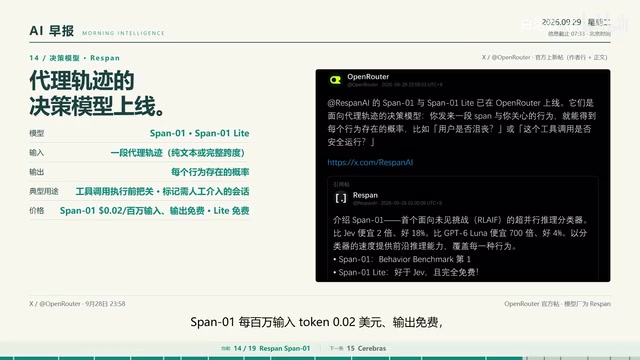
OpenRouter has added two Upstage models at 50% off for a limited time: Solar Mini is a 35B Mixture of Experts model (3B active parameters) with 524K context, tool calling, and structured output support, priced at $0.05 input / $0.20 output; Solar Design returns structured decisions rather than free text, priced at $0.10 input / free output. On relevant benchmarks, both accuracy and median latency outperform comparable models. OpenRouter has also launched a decision model for agent trajectories that can vet tool calls before execution or flag actions requiring human intervention.
Cerebras has announced that its "world's fastest inference" will be integrated into a Cloudflare partnership. Hugging Face released a new version of its agent app with an embedded dashboard, and Codex Desktop can now read the current dashboard view — allowing agents to see in real time which metrics the user is looking at and query only the relevant data.
Mixture of Experts (MoE) is an architecture that improves parameter efficiency through "sparse activation": the model has a large total parameter count, but only activates a small subset of "expert" sub-networks during each inference pass. Solar Mini's 35B total / 3B active parameter configuration follows this pattern — actual compute during inference is close to a 3B model, while knowledge coverage approaches that of a much larger model. This gives MoE models advantages in inference speed and cost, making them especially suited for high-concurrency, low-latency API scenarios, though they also place greater demands on memory bandwidth and routing mechanisms. The 524K context window means the model can process roughly 400,000 Chinese characters or hundreds of pages of documents in a single pass — particularly valuable for long-document analysis, codebase comprehension, and similar tasks.
OpenAI DevDay Countdown
Finally, eyes turn to OpenAI. The official developer account has teased DevDay, with a keynote scheduled for the following day and a livestream link shared. Sam Altman expressed excitement and hinted that "we found a new thing." OpenAI also announced the 10 winning projects from the WebMCP Challenge, themed around "what humans and agents can build together when websites expose structured tools to agents" — a thread that connects directly to the Agent-driven trends running through today's news.
Looking across today's coverage, four clear themes define the current AI landscape: cost efficiency and performance improvements, rapid iteration in coding tools, expanding Agent capabilities, and the build-out of safety infrastructure.
Related articles

Build an AI Super Employee System at Zero Cost: A Full Breakdown of Automated Agent Workflows
A deep breakdown of the AI super employee system demoed on Bilibili: agent orchestration, digital human voiceovers, map and enterprise lead generation, 24/7 customer service, and legal modules. We analyze the business logic and compliance risks behind zero-cost signup to help entrepreneurs judge the real ROI of this AI digital employee system.

The Essential Difference Between Chatbots and AI Agents: Crossing from Conversation to Execution
What's the difference between a chatbot and an AI agent? Based on the MCP series on the Learn Tech channel, this article uses examples like booking flights and summarizing notes to explain: a chatbot only gives answers, while an agent actually completes tasks through a think-act-observe loop. It breaks down the four core components—model, tools, memory, and goal—as well as MCP's role as a bridge, and discusses agents' applicable boundaries and permission risks.

Free GitHub Repo: 342 Hours of AI Courses, from Math to MCP Servers
A free GitHub repo offers 342 hours of AI courses: 523 lessons across 20 phases, from math fundamentals to agent building and MCP servers. Nearly 100,000 learners have started.