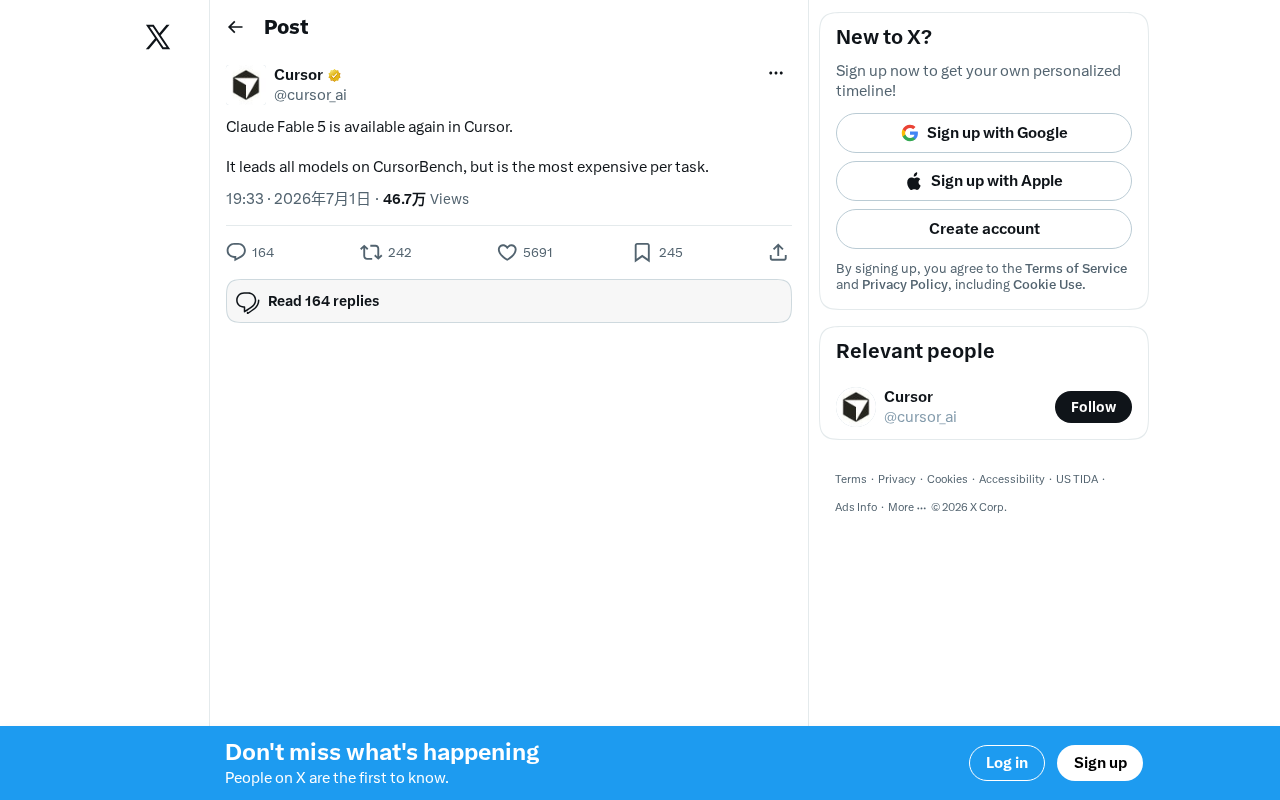
Claude Sonnet 4 Returns to Cursor: Tops CursorBench, But at the Highest Cost Per Task

Claude Sonnet 4 tops CursorBench on Cursor but comes with the highest cost per task.
Claude Sonnet 4 has returned to the Cursor editor and claimed the top spot on CursorBench, Cursor's internal real-world coding benchmark. However, it also carries the highest cost per task among available models. This article explores what the benchmark ranking really means, breaks down token economics in coding scenarios, and offers a tiered model selection strategy to help developers balance performance and cost.
Claude Sonnet 4 Returns to Cursor
The AI coding community recently received a noteworthy update: Claude Sonnet 4 is back on the Cursor editor. Claude Sonnet 4 is Anthropic's latest flagship code model.
Anthropic's technical DNA: Founded in 2021 by former OpenAI VP of Research Dario Amodei and VP of Policy Daniela Amodei, along with several core researchers, Anthropic's central research focus is "interpretable AI" and "Constitutional AI" — a training methodology that aligns models with human values through self-critique and revision, distinct from the RLHF approach that relies purely on human annotation. The Claude model family forms a comprehensive matrix spanning different performance and cost tiers: from the Claude 3 series with its three-tiered positioning of Haiku (lightweight) / Sonnet (balanced) / Opus (flagship), to codename-based next-generation releases — consistently earning a strong reputation in the engineering community for its exceptional long-context handling and precise instruction-following. For developers who rely on AI-assisted coding, this represents yet another powerful option. Even more noteworthy is that this model topped Cursor's official benchmark, CursorBench, surpassing every other available model on the platform.
However, leading performance doesn't come without a price. According to available information, Claude Sonnet 4 is simultaneously the model with the "highest cost per task." This combination of high performance and high cost puts the classic trade-off in AI coding tool selection squarely back on the table for developers.
What Does Topping CursorBench Actually Mean?
The Real Value of a Benchmark
CursorBench is Cursor's internal evaluation system for measuring how various models perform in real-world coding scenarios. This benchmark represents an important trend in AI coding tool evaluation: the shift from "general benchmarks" toward "vertical, scenario-specific benchmarks."
The rise of vertical benchmarks: Traditional code capability benchmarks like HumanEval (introduced by OpenAI in 2021, containing 164 function-level Python programming problems, widely cited for its simplicity and reproducibility) or MBPP (Mostly Basic Python Problems) primarily test a model's performance on isolated, closed-ended problems — far removed from real development scenarios. Their design characteristics include standalone functions, no external dependencies, and almost no real engineering complexity. In contrast, vertical benchmarks like SWE-bench (which tests a model's ability to fix real GitHub issues) and CursorBench attempt to replicate engineers' actual work: multi-file context understanding, incremental code modification, codebase-level bug localization — tasks that demand stronger long-context processing and engineering judgment. Evaluation results from these benchmarks are far more relevant to specific use cases than general benchmarks, but this also means their conclusions have a narrower scope of applicability. A model that leads on CursorBench may not excel equally in other vertical scenarios.
Claude Sonnet 4's ability to lead all models on this leaderboard signals clear advantages in handling complex code contexts, understanding project structure, and generating usable code. For engineers who frequently work with large codebases and need cross-file reasoning, this capability gap often translates directly into measurable gains in development efficiency.
A Top Ranking Deserves a Level-Headed Assessment
"Topping CursorBench" is a conclusion drawn within a specific evaluation framework — different task types, programming languages, and project scales can all shift the rankings. Benchmark scores are a valuable reference, but they don't guarantee the model will be the optimal choice in your specific workflow. Before committing, it's worth validating performance on your own real-world projects.
Cost Is the Real Decision Variable
The Bill Behind the Performance
"Highest cost per task" is the part of this news that deserves the most attention. In the era of AI-assisted coding, model calls are typically billed based on token consumption.
Token economics and the cost structure of coding scenarios: Tokens are the atomic units language models use to process text, produced by a tokenizer splitting raw text. Different models use different tokenization strategies: the GPT series uses Byte-Pair Encoding (BPE), and Claude uses a similar mechanism — a typical English word maps to roughly 1–2 tokens, Chinese characters to about 1–2 tokens, while special symbols, indentation, and variable names in code can significantly affect token density depending on language and style. What makes coding scenarios unique is their "input-heavy" nature: developers often need to inject entire files, related dependencies, or conversation history into the context, where input token counts can easily reach tens or even hundreds of thousands, while the model's output (typically a completion or patch) is relatively short. Top-tier models like Claude Opus are priced at roughly $15 per million input tokens and $75 per million output tokens (2024 reference pricing), while lightweight models like Claude Haiku cost approximately $0.25 / $1.25 — a cost gap of up to 60x. In high-frequency usage scenarios, this gap compounds rapidly and ultimately gets passed on to the end user.
For individual developers or small teams, frequently calling a high-cost model can cause monthly bills to climb fast. In enterprise settings, an engineering team of dozens or hundreds of people using the most expensive model across the board will accumulate substantial costs. "The strongest performer" and "worth paying for" are two questions that need to be evaluated separately.
A Tiered, Scenario-Based Model Selection Strategy
A more pragmatic approach is to layer model usage according to task complexity:
- High-value, high-complexity tasks: Architecture refactoring, complex bug investigation, cross-module reasoning — these justify calling a top-tier model like Claude Sonnet 4, trading cost for quality and time saved.
- Routine, low-complexity tasks: Simple completions, formatting adjustments, boilerplate code generation — cheaper models are perfectly sufficient here, avoiding unnecessary spend.
This "allocate compute on demand" mindset is quickly becoming standard practice for mature teams using AI coding tools.
The Multi-Model Competitive Landscape in the Cursor Ecosystem
Claude Sonnet 4's return also reflects one of Cursor's core strengths as an AI coding platform: it doesn't lock developers into a single model, but instead builds an open ecosystem with multiple models to choose from.
Model routing and the LLM gateway architecture: At the technical architecture level, this embodies the concept of "model routing" — a mechanism that dynamically dispatches requests to different model backends based on task characteristics, cost budgets, or service availability. This concept matured rapidly during the LLM application boom of 2023–2024, giving rise to specialized LLM gateway products like LiteLLM, PortKey, and OpenRouter. These gateways typically provide a unified OpenAI-compatible API interface, transparently connecting to backends from Anthropic, Google, Mistral, Cohere, and others, while handling cross-cutting concerns like rate limiting, retries, cost tracking, and audit logging. Cursor has built this capability directly into the editor — the same editor frontend calls model backends from different providers through a unified interface, allowing users to switch models on demand without changing tools. This is essentially bringing what was previously enterprise infrastructure-layer capability down to the individual developer tool layer, and it's one of the core architectural differences that sets Cursor apart from traditional IDE plugins (like early versions of GitHub Copilot). This aligns closely with the "LLM gateway" concept emerging in the AI infrastructure space, which is becoming an important middleware layer for enterprise AI applications.
This open strategy benefits developers. On one hand, competition among models continuously drives performance improvements and price optimization; on the other, users aren't locked into any single vendor and can always choose the best option for their current needs. The phrase "again available" regarding Claude Sonnet 4 also hints that a model's availability on the platform can change dynamically — developers should stay informed.
Practical Recommendations for Developers
Faced with this "most capable but most expensive" model, here are a few dimensions to consider when making a decision:
- Try it before committing: Compare Claude Sonnet 4's actual performance against your current model on real projects, rather than relying solely on leaderboard rankings.
- Quantify the ROI: Assess whether the development time it saves is enough to offset the higher call costs.
- Build tiered usage habits: Assign different models to different task types, and reserve the most expensive compute for where it matters most.
- Monitor availability: Since the model is "again available," its availability is clearly not guaranteed to be stable — critical work shouldn't depend entirely on a single model.
Closing Thoughts
Claude Sonnet 4's return to Cursor and its top ranking on CursorBench is yet another snapshot of the continuous iteration happening in AI-assisted coding. It reinforces a clear trend: the capability ceiling of top-tier models keeps rising, but so does the cost. For developers, the real competitive edge isn't about always using the most powerful model — it's about knowing how to make smart trade-offs between performance and cost. Understanding token economics, leveraging model routing, and building tiered usage strategies: these "engineering skills for using AI well" are becoming core competencies for the next generation of developers.
(Note: This article is based on information from a single source on Twitter. For specific model performance and pricing, please refer to official Cursor announcements.)
Related articles
Understanding GitHub's Availability Report: Platform Stability and Developer Response Strategies
Deep dive into GitHub's monthly availability report: analyzing service degradation impacts, CI/CD fault tolerance, and platform dependency risk strategies for resilient development.
OpenAI's Claim of Solving a Millennium Prize Problem Sparks Academic Controversy
OpenAI claims its AI solved a Millennium Prize Problem, sparking debates over attribution, verification, and AI's role in reshaping mathematical research.
Ledoit-Wolf Covariance Shrinkage in Practice: 57% Lower Turnover + 10x GPU Acceleration
Learn how Ledoit-Wolf covariance shrinkage reduces portfolio turnover by up to 57% and how cuML GPU acceleration cuts backtest time from 1.5 hours to 9 minutes.