Claude Sonnet 5.5 Released: 70.6% on Terminal-Bench, Costs Far Less Than GPT-6

Claude Sonnet 5.5 tops Terminal-Bench at 70.6% while undercutting rival flagship models at just $2/1M input tokens.
Anthropic's Claude Sonnet 5.5 is positioned as the enterprise agentic workhorse, achieving a 70.6% solve rate on Terminal-Bench 4.0 — surpassing Opus 5.5 (66.4%) and GPT-6 Astra (61.8%) — while hitting 80.1% on OSWorld 2.1. Its edge comes from three pillars: deep native terminal tool support (bash, GDB, LLDB), high-resolution visual reasoning without OCR, and a Preserved Thinking mechanism that retains reasoning state across long tool-call chains. At $2/1M input tokens with prompt cache reads at $0.20/1M, it can cut context costs by over 87% in large-scale agentic workflows. Benchmark comparisons cited are from a single vendor source and should be validated with independent testing.
The competition among frontier AI models has entered a new phase — raw analytical capability is no longer the sole measure of technical dominance. For engineering teams and software development departments, the true frontier lies in agentic operational efficiency: the ability to execute complex tasks end-to-end in command-line environments, debug code with native tools, navigate dense visual interfaces, while keeping inference latency and cost at a commercially sustainable level. Claude Sonnet 5.5, officially released by Anthropic, is the company's answer to exactly this challenge.
Note: Data in this article is sourced from Anthropic's technical report and the Models.dev platform index. Competitor model names and benchmark figures cited are based on vendor claims from a single source; readers should treat them accordingly and await independent third-party verification.
Breaking Out Below the Flagship: Sonnet 5.5's Positioning and Breakthroughs
Claude Sonnet 5.5 sits in the middle of Anthropic's product lineup — between the ultra-lightweight Haiku 5.5 and the deep-reasoning Opus 5.5 — and is positioned as the enterprise "workhorse engine." Yet across several benchmarks closely mirroring real-world development scenarios, it delivered a counterintuitive result: it not only surpassed the more expensive Opus 5.5, but also outperformed OpenAI's GPT-6 Astra and Google DeepMind's Gemini 4 Argon.
Most notably, it achieved a 70.6% solve rate on Terminal-Bench 4.0, setting a new high for Linux shell interaction, CI pipeline debugging, and autonomous repository management. By comparison, Opus 5.5 scored 66.4% and GPT-6 Astra scored 61.8%.
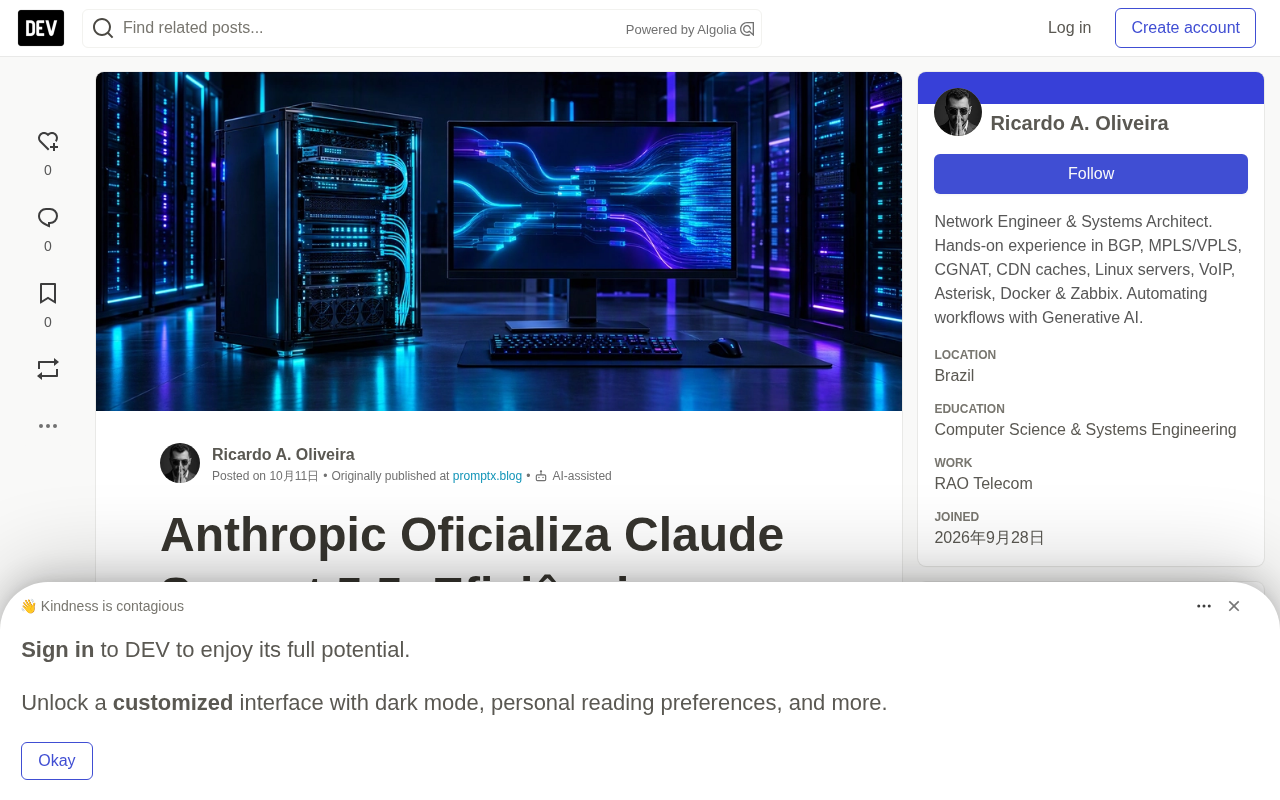
Spec-wise, Sonnet 5.5 delivers over 30% faster token generation than its predecessor, paired with a 128,000-token maximum output limit and a 1 million-token context window — making sustained agentic engineering a realistic proposition for enterprises at scale.
Three Technical Pillars: Why It Wins
Deep Adaptation to Terminal and CLI Environments
Unlike models that only generate static code snippets in a chat box, Sonnet 5.5 was trained with heavy emphasis on real terminal operation dynamics. It understands bash execution details, stdout/stderr redirection, process signal management, supports native debuggers like GDB and LLDB, and navigates large file trees with ease.
Terminal-Bench 4.0 is precisely the kind of rigorous proving ground that tests this: models must diagnose bugs in real repositories, install missing dependencies, run tests, analyze stack traces, apply precise patches, and verify final compilation — all without human intervention. A 70.6% pass rate establishes a clear lead on this "end-to-end autonomous repair" track.
Terminal-Bench 4.0 is one of the most representative benchmarks for evaluating LLMs' autonomous terminal operation capabilities, and its design philosophy differs fundamentally from traditional code completion benchmarks. Traditional benchmarks (such as HumanEval and MBPP) only require models to generate function bodies in isolated environments, while Terminal-Bench 4.0 simulates a complete real-world Unix workflow loop: the model must sequentially complete environment exploration, dependency installation, build failure diagnosis, log analysis, and patch submission within a stateful shell session, where each step's output becomes the next step's input. This "toolchain coupling" design means any single-step error causes cascading failures in subsequent steps — making a 70%+ pass rate technically significant within this framework. GDB (GNU Debugger) and LLDB (LLVM Debugger) are the most mainstream native debuggers in the Linux/macOS ecosystem, supporting breakpoints, memory inspection, stack unwinding, and other low-level operations. The ability to handle these tools indicates the model has the foundational capability to participate in real C/C++/Rust project debugging.
High-Resolution Visual Reasoning
Sonnet 5.5 also shows a significant leap in multimodal perception and spatial reasoning. It achieves 61.6% on the Chartography benchmark, parsing complex architectural diagrams, SVG network topologies, and high-density vector charts — without relying on external OCR tools or auxiliary scripts.
A particularly compelling demonstration: the model was able to play the classic Game Boy game Pokémon Red using only raw real-time screenshot pixels — analyzing screen pixels, interpreting in-game dialogue, navigating battle menus, and planning routes on the game map, entirely through vision. On the enterprise desktop automation benchmark OSWorld 2.1, it reached 80.1%, placing it among the most capable tools available for OS automation tasks today.
Inference Speed and the Preserved Thinking Mechanism
For developers using tools like Claude Code CLI, Cursor, or Windsurf, token return speed directly determines daily productivity. Sonnet 5.5's output speed is more than 30% faster than its predecessor, significantly reducing the idle time developers spend waiting for the agent to "think."
Anthropic has also optimized Preserved Thinking: in long sessions involving sequential tool calls, previously established analytical reasoning states are retained as active cache within context memory, preventing the model from recalculating architectural premises from scratch each time a bash command is executed.
The Preserved Thinking mechanism addresses a core pain point in long agentic sessions: KV Cache invalidation. In standard Transformer inference, the model must recompute attention for each new token, but KV Cache stores intermediate states of already-processed tokens to avoid redundant computation. However, in tool-calling agentic scenarios, the context structure changes each time a tool returns a result, causing traditional implementations to partially or fully invalidate reasoning state — the model effectively needs to "re-read" all prior history. Preserved Thinking fixes this by anchoring the prior reasoning chain in a structured format within the context prefix, ensuring that even through continuous loops of bash command calls, the model's understanding of codebase architecture, task objectives, and already-ruled-out hypotheses is never lost to tool calls. This is especially critical for complex refactoring tasks requiring 50+ consecutive steps, significantly reducing the model's tendency to "backtrack" and re-derive already established conclusions in long sessions.
Benchmark Showdown: Head-to-Head Against Active Frontier Models
The source material provides a direct comparison between Sonnet 5.5 and a range of contemporary frontier models, revealing an interesting "architectural specialization" pattern:
| Benchmark | Sonnet 5.5 | Opus 5.5 | GPT-6 Astra | Gemini 4 Argon | DeepSeekAd 4.1 |
|---|---|---|---|---|---|
| Terminal-Bench 4.0 | 70.6% | 66.4% | 61.8% | 57.4% | 55.2% |
| CursorBench 4.0 | 55.5% | 57.8% | 51.0% | 48.2% | 49.2% |
| OSWorld 2.1 | 80.1% | 78.5% | 75.4% | 72.1% | 69.8% |
| Chartography | 61.6% | 60.2% | 56.7% | 54.8% | 51.3% |
| Input Cost (per 1M tokens) | $2.00 | $4.00 | $12.00 | $10.00 | $0.55 |
The data reveals a key divergence: Opus 5.5 maintains a slight edge on tasks requiring large-scale theoretical synthesis and deep abstraction (e.g., CursorBench, GDPval), while Sonnet 5.5 — thanks to faster iteration and less "conceptual drift" — surpasses the more expensive flagship in dynamic terminal environments.
Against GPT-6 Astra, Sonnet 5.5 demonstrates greater resilience in continuous compilation command chains, particularly when interpreting complex compiler errors in Rust and modern TypeScript, with a lead of 8.8 percentage points. Compared to Gemini 4 Argon, while the latter offers the largest sustained output window, its cost is $10 per million input tokens versus Sonnet 5.5's $2 — for the vast majority of everyday engineering pipelines with outputs in the 5,000–50,000 token range, Sonnet 5.5 delivers better results at a fraction of the cost.
Cost Math: How Prompt Caching Rewrites the Economics
Sonnet 5.5's true killer advantage lies in its cost-effectiveness per unit task. Its pricing structure is:
- Standard input tokens: $2.00 / 1M
- Output tokens: $10.00 / 1M
- Prompt cache reads: $0.20 / 1M (90% discount)
- Prompt cache writes: $2.50 / 1M
In modern agentic development pipelines, an entire project repository (database schemas, API documentation, config files) is injected once into the system prompt prefix. For a typical enterprise repository of 400,000 tokens, each interaction costs $0.80 just to read the context — without caching.
With Sonnet 5.5's caching architecture, the initial write costs $1.00, and each subsequent loop read costs only ~$0.08. Over a 50-step autonomous refactoring session, total context cost drops from $40.00 to approximately $4.92 — over 87% savings — which is what makes large-scale autonomous agents financially viable.
Prompt Caching is an optimization mechanism now widely adopted across mainstream LLM APIs. It works by persistently storing the KV Cache of repeated long prefixes on the API server side, and directly reusing cached states for subsequent requests that match the same prefix — providing cache reads at a much lower price without recomputation. A prerequisite for cache hits is that the request prefix must exactly match what was written to cache (typically requiring byte-level matching). This is why embedding dynamic content like timestamps or session IDs into system prompts causes frequent cache invalidation — even a single character difference will cause a hash mismatch, forcing the system to recompute and charge full input pricing. For agentic workflows that use entire code repositories as context, this mechanism is especially valuable: repository content barely changes within a single refactoring session, making it a naturally high-hit-rate caching scenario. Cache read pricing from Anthropic, OpenAI, and similar providers is typically only 10–25% of standard input pricing, fundamentally transforming the cost structure of context-heavy workloads.
Deployment Strategy: Cascade Routing and Caching Best Practices
The source material outlines a production migration framework centered on Model Cascading:
- Initial triage and simple commands: Handled by Haiku 5.5 at minimal cost for UI directives and syntax validation;
- Engineering execution, CLI, and refactoring: Sonnet 5.5 handles 85%+ of workload, covering terminal diagnostics, code writing, unit testing, and patch generation;
- Extreme edge cases: Opus 5.5 is invoked only for mathematical theorems, critical security formal verification, and similar scenarios.
According to the source, this division of labor can reduce total enterprise AI spend by over 65% while maintaining high accuracy.
For Prompt caching best practices, a few key points stand out: place immutable prefixes like system instructions and database schemas at the very beginning of messages; never insert timestamps or dynamic variables into prefixes, as this invalidates the cache hash — put ephemeral information at the end of message history instead; wrap code blocks in XML tags (e.g., <repo_files>) when loading external library analysis, enabling the model's sparse attention mechanism to retrieve them precisely.
Model Cascading draws from the concept of "cascade classifiers" in traditional machine learning, reinterpreted for the LLM era as an architectural pattern for dynamically allocating compute resources based on task complexity. Its core assumption is that subtasks of varying complexity have vastly different actual demands on model capability, and using a flagship model for all requests is fundamentally wasteful. In practical engineering, the routing layer typically requires a lightweight classifier or rule-based scheduler to determine which model tier should handle a given task, with common decision dimensions including: semantic complexity of the task description, context length, whether multi-step reasoning is involved, and historical failure rates for similar tasks. A key engineering challenge is the asymmetric cost of routing errors — the failure cost of misrouting a complex task to a lightweight model far exceeds the redundancy cost of routing a simple task to a high-tier model. Consequently, real systems tend to set conservative thresholds at classification boundaries, trading some theoretical cost savings for reliability. A robust cascading system should also include failure fallback mechanisms: when a lower-tier model returns a low-confidence result or explicitly declines, the system automatically escalates to the next tier and retries.
A Measured Reading of These Numbers
It's worth emphasizing that GPT-6 Astra, Gemini 4 Argon, Terminal-Bench 4.0, and other model names and benchmarks referenced in this article all come from a single vendor source and cannot be independently verified externally. When making technology selection decisions, readers should rely on official documentation and empirical results from their own actual workloads — not benchmark rankings alone.
That said, the direction Sonnet 5.5 represents is clear: as agents shift from "can it solve the problem" to "can it run entire workflows continuously and cost-effectively," efficiency and caching economics are becoming more important competitive dimensions than peak capability.
Related articles
LLaMA-Factory in Practice: A Complete No-Code Guide to Fine-Tuning Large Models
An introduction to LLaMA-Factory, the open-source fine-tuning tool: its 60.1K-star background, supported models and algorithms, local vs. cloud deployment, and CUDA setup steps.

Zeng Ming's Deep Retrospective: Why OpenAI May Not Be the Ultimate Winner — and Why the Corporate System Will Disappear
Zeng Ming's deep retrospective on the AI endgame: model companies are just infrastructure, OpenAI and Anthropic won't be the final winners; the next battle is the Agent entry point standard; the corporate system will disappear as AI restructures collaboration, and only mission-driven companies can survive the cycle.

OpenHands v1.28.0: OpenCode and PI Added as Built-in Agents, API Keys Requestable In-Conversation
OpenHands ships 5 releases in 21 days: v1.27.0 adds OpenCode and PI as built-in agents, v1.28.0 enables in-chat key requests. ACP integration, credential reuse, model list changes, and upgrade advice.