Claude Sonnet 5.5 Released: Faster, Cheaper, and Now Free to Use

Claude Sonnet 5.5 is faster, cheaper, near-flagship on coding, and now free on claude.ai.
Anthropic has released Claude Sonnet 5.5, delivering 30%+ speed improvements and up to 30% cost reduction on most tasks while maintaining the same pricing as its predecessor. The model nearly matches flagship Opus 5.5 on coding tasks and is now the default model for the claude.ai free tier — a significantly stronger free offering than ChatGPT's Luna 5.6. One known bug causes the model to burn through 128K tokens without producing output when thinking intensity is set to "max." The lighter Haiku 5.5 is expected within weeks.
Anthropic has launched its next-generation Sonnet model — Claude Sonnet 5.5. The official pitch is straightforward: over 30% faster, up to 30% lower cost on most tasks, all at the same price as the previous Sonnet 5. In short, it's an upgrade that delivers better performance and lower operational costs for the same price.
Performance and Cost: A Clear Step Up from the Previous Generation
Based on Anthropic's published data, Sonnet 5.5 outperforms Sonnet 5 on nearly every benchmark while maintaining the same pricing. For real-world usage billed by token, this means developers can get better output quality at the same or lower cost.
Even more noteworthy is its performance on coding tasks. According to independent tester Simon Willison, Sonnet 5.5 "nearly matches" Opus 5.5 on certain coding tasks, including popular 3D animation demos making the rounds in the community. For a mid-tier model positioned around price-to-performance ratio, that's quite impressive — it brings capabilities previously reserved for flagship models down to a more accessible price point.
The "Pelican Riding a Bicycle" Test: Highlights and Gotchas
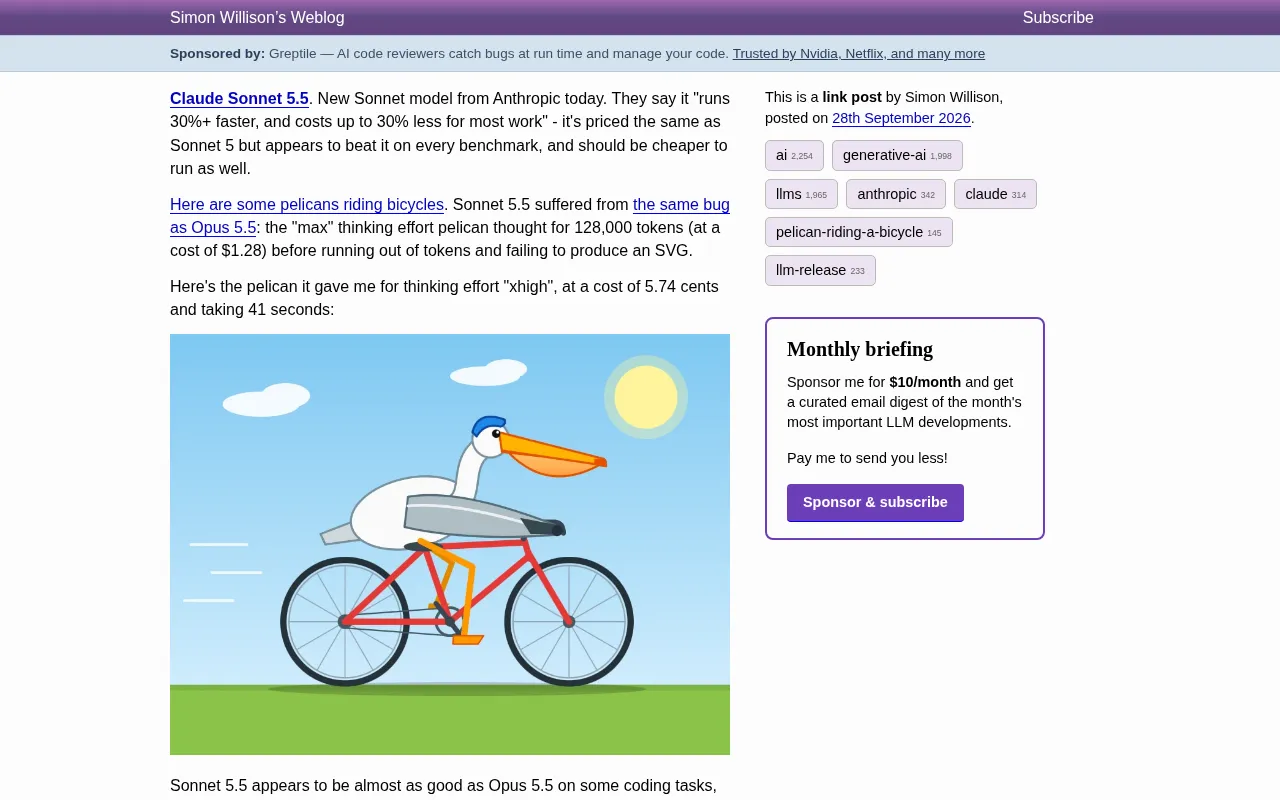
Simon Willison has long used a fixed benchmark to compare AI models side by side — asking them to generate an SVG image of "a pelican riding a bicycle." This deceptively quirky task actually tests a model's ability to handle spatial structure, object relationships, and code generation all at once.
At "xhigh" thinking intensity, Sonnet 5.5 delivered a solid result: correct bicycle frame, the pelican's legs positioned on either side of the frame, feet on the pedals, chain in the right place — the only flaw being a slightly misshapen blue helmet. The generation cost roughly $0.0574 and took 41 seconds.
However, the test also revealed a bug shared with Opus 5.5: when thinking intensity was set to "max," the model fell into over-thinking mode, burning through 128,000 tokens (at a cost of roughly $1.28) before running out of tokens entirely — without producing any SVG output. This serves as a reminder that blindly cranking up the "thinking budget" parameter doesn't necessarily yield better results, and can actually waste resources and cause task failures.
SVG (Scalable Vector Graphics) is an XML-based vector image format that requires precise coordinate, path, and geometric definitions to describe the position and shape of every element. That's exactly why generating a semantically "correct" SVG — with the pelican's legs actually on the pedals and the chain connecting the right gear positions — tests not just code generation but also the model's understanding of how three-dimensional space projects onto a two-dimensional plane. This test works well as a comparative benchmark because the criteria are relatively objective (is the structure sound? are the spatial relationships correct?), and the differences between models are often visible to the naked eye. "xhigh" is one of the parameter tiers in Anthropic's Extended Thinking feature, which allows the model to spend more tokens on internal reasoning before producing a final answer — generally improving accuracy on complex tasks, but at the cost of higher latency and expense.
The Biggest News: Sonnet 5.5 Is Now the Free Tier Model on claude.ai
The most strategically significant aspect of this release is that Sonnet 5.5 is now the model powering the free tier on claude.ai.
By comparison, OpenAI's ChatGPT free tier uses Luna 5.6. In terms of what free users can actually access, Anthropic is now offering a noticeably more capable free option. For everyday users, being able to use a model that excels at coding and structured generation tasks — without paying anything — significantly lowers the barrier to entry.
Simon Willison tested it directly on the free tier with this prompt:
build me an HTML page that renders a three-dimensional pelican riding a bicycle using WebGL
He got back a working WebGL page rendering a 3D pelican on a bicycle, which he called "a solid effort." Getting that kind of result out of the free tier further demonstrates Sonnet 5.5's real-world usability.
Luna 5.6, mentioned here, is OpenAI's model for free users — positioned between GPT-4o mini and the full flagship model, primarily used to manage service costs while maintaining a baseline user experience. Which model each company offers at the free tier directly shapes the first impressions of AI capabilities for hundreds of millions of everyday users, making this competition far more strategically significant than a pure technical comparison. By opening up Sonnet 5.5 — a mid-tier model approaching flagship performance — to free users, Anthropic is making a deliberate market positioning move, aiming to build word-of-mouth through tangibly better user experiences, and ultimately gaining a competitive edge in both paid conversion and developer ecosystem growth.
What's Next: Haiku 5.5 Is Worth Watching
Anthropic reiterated in its announcement that the lighter-weight Haiku 5.5 is coming "within the next few weeks." The Haiku line has always been about low cost and high speed, targeting latency- and price-sensitive use cases at scale.
Simon Willison voiced a widely shared hope in the developer community: that Haiku 5.5 will be able to compete head-to-head with GPT-6 Luna on pricing. If Anthropic can push hard on both ends — a near-flagship free experience and an ultra-affordable small model — its competitiveness in cost-sensitive markets will only grow stronger.
Wrap-Up
The core logic behind Claude Sonnet 5.5 is simple: get a better model for the same money, with speed and cost optimizations that improve real-world efficiency. It brings near-flagship coding capabilities to a mid-tier price point, and expands reach by powering the free tier. For both developers and everyday users, this is a pragmatic upgrade. That said, the over-thinking bug at "max" thinking intensity is a reminder that there are still rough edges to polish in the new model.
Related articles

AI Compute Is the New Oil, But the Market Mechanism Has Yet to Take Shape
Hacker News compares AI compute to the new oil, noting the lack of price discovery, concentrated supply, and no hedging tools. The article analyzes structural issues in compute trading and explores a possible three-tier market of spot, contracts, and derivatives, plus the real impact on AI practitioners' cost management.

Running Full iOS 16.5 Firmware on Android Devices: Technical Demo or Marketing Gimmick?
A Hacker News post claims full iOS 16.5 firmware can run on Android, with 315 upvotes. This analysis argues it is more likely a web UI simulation than a true firmware port, and explores the value and risks of such projects.

Etsy Cracks Down on AI Slop: Addressing Buyer and Seller Anxieties
Etsy introduces stricter rules limiting AI-generated content in listings, addressing buyer confusion over AI products and seller fears of original work being diluted by AI slop.