Claude Sonnet 5.5 Tested: Outperforms Opus at Half the Cost

Claude Sonnet 5.5 cuts speed and cost by 30% while matching Opus 5.5 on coding benchmarks.
Anthropic's Claude Sonnet 5.5 delivers roughly 30% improvements in both speed and cost, while surpassing the previous Sonnet 5 across coding benchmarks, vision interaction, and general intelligence tests. Most notably, it outperforms Opus 5.5 on Terminal Bench 4.0 at just 1/90th of the cost. However, the Max effort tier presents a "high cost, low return" trap — Hi or Extra Hi is recommended. Cybersecurity and biology tasks trigger an automatic downgrade to the weaker Sonnet 5, a key practical limitation. Overall, Sonnet 5.5 re-establishes Anthropic's competitiveness in the mid-tier AI model market.
Anthropic has just released Claude Sonnet 5.5 (also referred to as Summit 5.5 in the video), just days after last week's impressive Opus 5.5 debut. The core selling points are straightforward: roughly 30% faster, roughly 30% cheaper, and better than the previous Sonnet 5 across nearly every dimension. For a mid-tier model positioned around "everyday tasks," that's a remarkably ambitious upgrade.
From Disappointment to Surprise: Sonnet 5's Pain Points Addressed
The original Sonnet 5 launch didn't land well. Beyond mediocre benchmark scores, its bigger problem was "token overuse" — when you pushed the model hard on complex tasks, real-world costs could spiral out of control. That eroded developer confidence in the Sonnet line.
Sonnet 5.5 directly targets that pain point. According to the analysis, the new model shows significant jumps across multiple coding benchmarks: Frontier Code-related scores climbed from 42 to 46 and then 52, while Cursor Bench scores also improved substantially. In other words, Anthropic didn't just stack capabilities — they brought the value proposition back above the bar.
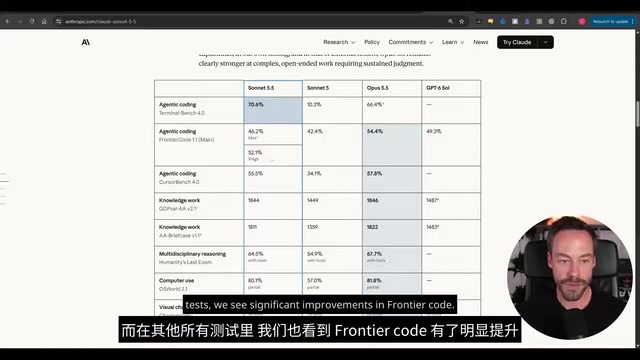
Terminal Bench 4.0: Sonnet Unexpectedly Beats Opus
The most striking result came from Terminal Bench 4.0 coding tasks. At the highest difficulty settings, Sonnet 5.5 actually outperformed the higher-tier Opus 5.5 — while completing the same tasks for just $12.54, compared to Opus's $1,124. This "underdog beats the top dog" outcome warrants some skepticism, but the cost gap alone speaks volumes.
Another interesting pattern: Sonnet 5.5's performance on this benchmark scaled almost linearly from Medium all the way to Max effort, whereas many models plateau as you push into higher tiers. This suggests that for terminal-style tasks, investing more reasoning budget genuinely delivers consistent returns.
Terminal Bench 4.0 is a benchmark designed to evaluate AI models autonomously completing complex programming tasks in terminal/command-line environments. Version 4.0 introduced stricter multi-step task chains. Tests typically feature an "Effort Level" parameter ranging from Low to Max, controlling the number of reasoning steps and tool calls available. Tiers like Medium, Hi, Extra Hi, and Max directly affect total token consumption per task — and therefore cost. The "underdog" result is partly explained by the fact that Opus-tier models default to more complex reasoning chains, causing exponential token usage, while Sonnet 5.5's optimized coding capabilities achieved similar accuracy with far fewer reasoning steps.
Max Mode Isn't Always Better: The Cost Spiral Risk
Switch to more complex advanced coding scenarios, though, and things get nuanced. At the "Hi" effort level the model hits 49.4%, but cranking it up to Max actually drops performance to 46.2% — while costs balloon from 42 cents all the way to $21.

This is almost a replay of the Sonnet 5 era problem — Max mode doesn't always mean better performance, but it almost always means higher costs. The practical recommendation here is to keep effort levels at "Hi" or "Extra Hi" for everyday use, and avoid blindly maxing out, since the cost-to-benefit ratio deteriorates quickly.
Looking at per-million-token pricing, Sonnet 5.5 has a clear edge over Opus 5.5: cache read costs are the same at $0.20, but cache write fees are half the price, and both input and output tokens cost half as much. Combining that pricing structure with the benchmark improvements gives you a model that's ideally suited to moderate-complexity tasks — no need to reach for Opus, and no need for anything more powerful.
"Token overuse" refers to a model generating excessive intermediate reasoning steps, repetitive validations, or redundant outputs when faced with complex or ambiguous tasks — causing actual token consumption to far exceed what the task actually requires. In API-billed commercial contexts, this can cause seemingly reasonable single-call costs to skyrocket. Max mode removes caps on reasoning steps, letting the model "do its best" to explore solutions, but on tasks with fuzzy boundaries this can lead to looping or overthinking — accuracy doesn't necessarily improve, but costs can increase tenfold or more. This is why many production engineers look for a "sweet spot" tier within budget constraints rather than always maxing out.
Intelligence and Multimodal: Closing in on Opus 5.5
On the more real-world GDP VAL benchmark, Sonnet 5.5 also shows a massive leap — analysis suggests its performance has reached Opus 5.5 levels, with roughly a 400-point improvement over Sonnet 5.
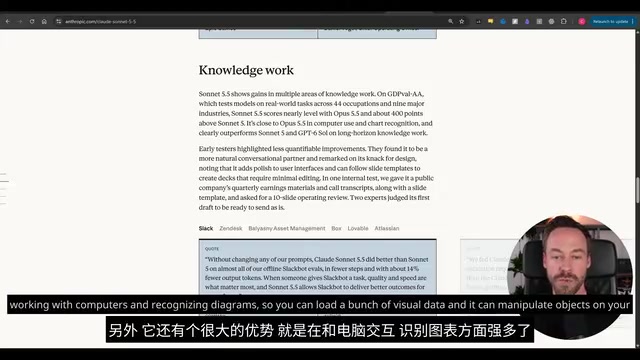
Vision and computer interaction capabilities are another focus of this upgrade. Sonnet 5.5 shows clear improvements in recognizing charts and manipulating various on-screen objects, with the ability to load large amounts of visual data and execute tasks reliably. The analyst also specifically noted improvements in "conversational experience" — Opus 5 had solid test scores but was difficult to communicate with, a problem that was fixed in Opus 5.5, and Sonnet 5.5 is now also claimed to be better at dialogue. If these improvements carry through the entire Sonnet line, that's a genuinely meaningful quality-of-life upgrade.
Safety Mechanisms: Cybersecurity and Biology Tasks Get Downgraded
Every new model generation comes with safety measures, and Sonnet 5.5 is no exception. Its cybersecurity capabilities have grown strong enough to match Opus and higher-end models — so Anthropic has implemented a mechanism: when the model determines a user is performing risky cybersecurity tasks, it automatically switches to a smaller, simpler model.

For the Sonnet line, this means downgrading back to the underwhelming Sonnet 5 (the Opus line drops to Opus 4.8). This creates a real practical problem: for cybersecurity-related tasks, don't count on the Sonnet series, because the downgraded Sonnet 5 experience is poor. The same restrictions apply to biology-related tasks.
Anthropic's "auto-downgrade" mechanism is part of its AI safety strategy under "capability restriction." It works by classifying task intent at the inference layer — once a request is deemed to involve high-risk domains (such as exploit development, malicious code generation, or biochemical synthesis pathway queries), the request is routed to a more capability-limited smaller model rather than simply refused. The design aims to maintain model usability while reducing misuse risk, but it can inadvertently impact legitimate security researchers, since classifiers struggle to precisely distinguish "penetration testing exercises" from "genuine attack intent." The fact that Opus drops to Opus 4.8 and Sonnet drops to Sonnet 5 means security-focused users need to evaluate upfront whether the downgraded model still meets their workflow requirements.
Conclusion: Anthropic Fills the Gap in Its Mid-Tier Lineup
Sonnet 5.5 is live everywhere and has been performing consistently since launch. If Opus 5.5 solidified Anthropic's position at the high end, Sonnet 5.5 attempts to close the gap in the mid-tier market where competitors like OpenAI had opened a lead — delivering a powerful model for everyday tasks at a significantly lower price.
The analysis is candid: the previous Sonnet 5 left Anthropic struggling in this price segment, while the 5.5 improvements swing the situation back to a favorable position. For everyday users, this means you no longer need to pay Opus-tier prices for moderate-complexity coding and analysis tasks while still getting near-Opus results — and that's the most tangible value this update delivers.
Related articles

Free Unlimited Claude Code Solution: Agnes AI + CC Switch Setup Guide
No paid subscription needed — pair the free AI platform Agnes AI with the open-source tool CC Switch to provide a backend for Claude Code, enabling unlimited free calls to text, image, and video models. This guide covers the full setup, test results, and usage boundaries.

A Complete Zero-Cost Guide to Getting Started with Claude Code for Beginners in China
A beginner's guide to Claude Code for users in China: two installation methods (command line and IDE plugin), full configuration steps for replacing the official API with the free domestic LongCat model, and a hands-on demo of building a small tool with natural language, plus tips.

When the NSA Gets Involved: The AI Supply Chain Crisis Behind Open-Source CVEs and API Key Hijacking
Multiple open-source projects disclosed severe CVEs in one day, PHP flaws alarmed the FBI, and Railway and OpenCode were breached with API keys stolen. This article breaks down the vulnerability window, AI-accelerated exploitation, and the AI supply chain crisis behind the API key black market, with a developer defense checklist.