Cline CLI v3.0.70 Update Breakdown: Critical Bug Fixes and Model Catalog Refresh

Cline CLI v3.0.70 fixes commit errors, MCP stability issues, and adds Claude Haiku 5.5 as default for many providers.
Cline CLI v3.0.70 is a stability- and maintainability-focused update. Bug fixes resolve 400 errors when generating commit messages with reasoning off, and a race condition causing data loss when MCP servers exit early. CLI improvements fix a security issue where `cline mcp add` silently dropped `--header` auth values, rename `cline hub dashboard`, and convert several legacy no-op options from silent acceptance to explicit errors, with upfront validation added for schedule delivery configs. On the model side, Claude Haiku 5.5 is added and set as the default for over ten providers including Google Vertex AI and GitHub Copilot. Developers using Cline in scripting workflows should audit their scripts for deprecated CLI parameters.
Cline CLI has released version v3.0.70, focusing on three areas: bug fixes, CLI experience improvements, and a model catalog refresh. For developers who rely on Cline for AI-assisted programming, this release addresses several long-standing workflow pain points while introducing Anthropic's new Claude Haiku 5.5 as the default model for multiple providers.
Key Bug Fix: No More Errors When Generating Commit Messages
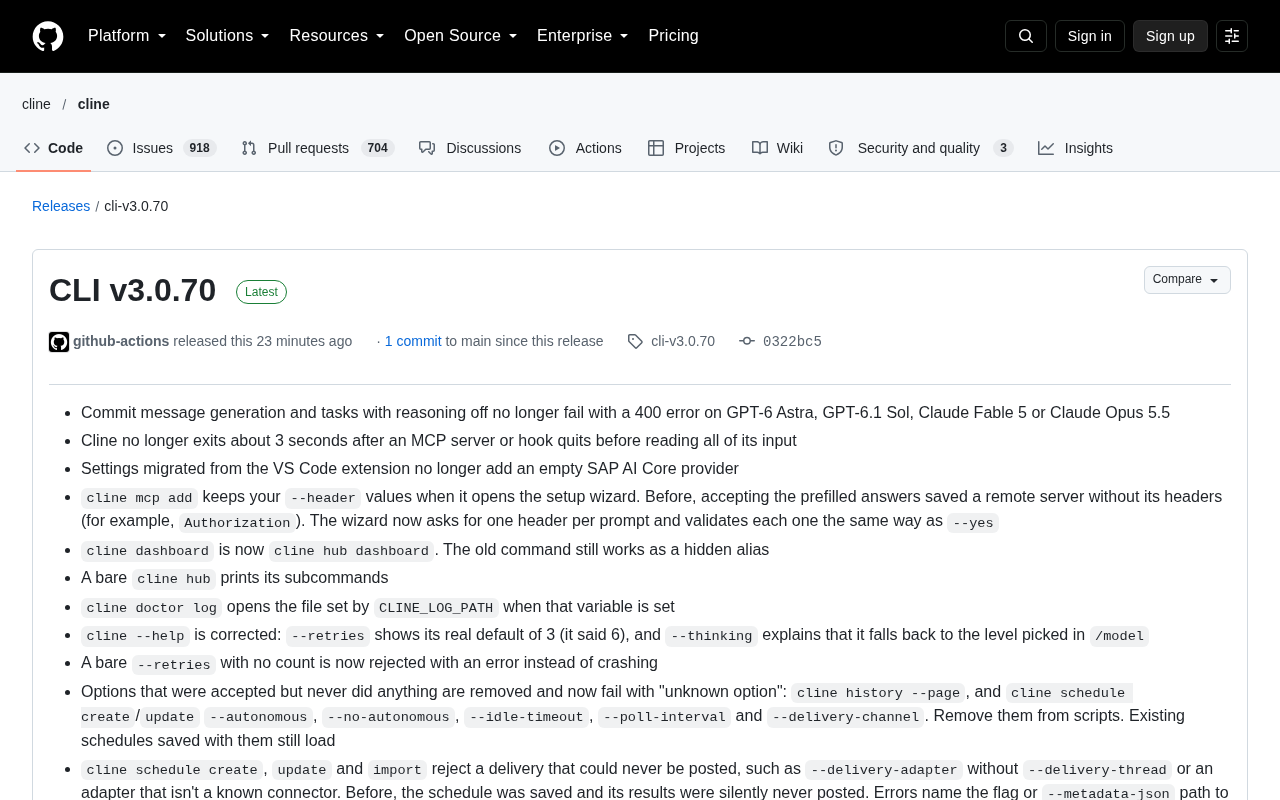
The most notable fix in this update resolves 400 errors that were triggered when generating commit messages and running tasks with reasoning turned off. This issue affected several mainstream models, including GPT-6 Astra, GPT-6.1 Sol, Claude Fable 5, and Claude Opus 5.5. For developers who rely on Cline to auto-generate Git commit messages, these errors would directly interrupt the commit workflow — a significant disruption.
Another subtle but important fix addresses Cline exiting prematurely — roughly 3 seconds after an MCP server or hook exits — before fully reading all output. Previously, if an MCP service terminated before Cline had consumed all of its output, Cline would close early and lose partial data. The new version ensures Cline reads all input before exiting, improving stability when integrating with the MCP ecosystem.
Additionally, migrating settings from the VS Code extension no longer incorrectly adds an empty SAP AI Core provider, fixing a dirty-data issue during configuration migration.
Background: What is MCP? MCP (Model Context Protocol) is an open protocol led by Anthropic that standardizes how AI models interact with external tools and data sources. Developers can expose capabilities like file systems, databases, and APIs to Cline via MCP servers, which Cline calls during task execution to fetch context or perform actions. Because MCP servers run as independent processes, their lifecycle is asynchronous from Cline's main process. If a server exits before its output is fully consumed and the main process closes in sync, data truncation occurs. This fix specifically targets that race condition by ensuring Cline exits only after reading all output.
CLI Experience Improvements: MCP Config and Command Restructuring
This update makes several adjustments to the CLI's command structure and interaction logic, with the overall goal of making behavior more predictable and less error-prone.
MCP Header Fix
cline mcp add now preserves --header values when opening the configuration wizard. Previously, there was a serious hidden issue: when a user accepted pre-filled answers, the remote server would be saved but headers (such as Authorization) would be silently dropped. Authentication credentials could be discarded without the user's knowledge. The new version prompts for headers one by one and validates each entry the same way --yes mode does.
Command Renaming and Subcommand Discovery
cline dashboard has been renamed to cline hub dashboard, with the old command remaining available as a hidden alias to preserve backward compatibility. Running cline hub directly now prints a list of its subcommands, making available features easier to discover. Additionally, cline doctor log now opens the file specified by the CLINE_LOG_PATH environment variable when that variable is set.
Help Documentation and Argument Validation Fixes
The cline --help documentation has been corrected: --retries now shows its actual default value of 3 (previously incorrectly labeled as 6), and --thinking clarifies that it falls back to the level selected in /model. More importantly, a bare --retries without a value now produces a clear error instead of crashing — a classic improvement from silent failure to explicit error reporting.
Cleaning Up Invalid Options: From Silent Failure to Explicit Errors
A commendable design decision in this update is the thorough removal of options that were previously accepted but had no effect — they now produce "unknown option" errors.
Affected options include cline history --page, and the --autonomous, --no-autonomous, --idle-timeout, --poll-interval, and --delivery-channel flags in cline schedule create/update. The team explicitly recommends removing these parameters from any scripts. The good news is that existing scheduled tasks saved with these parameters will still load correctly — existing configurations won't break.
A related improvement is the addition of upfront validation for delivery configurations: cline schedule create, update, and import now reject configurations that can never successfully deliver — for example, providing --delivery-adapter without --delivery-thread, or specifying an unknown connector adapter. Previously, such schedules would be saved but silently never delivered — the hardest kind of failure to debug. The new error messages directly indicate which flag or --metadata-json path needs to be corrected.
This shift from "silently accepting invalid input" to "failing fast with explicit errors" is a hallmark of mature CLI tooling, and significantly reduces the chance of developers getting burned in scripting and automation.
Background: Silent Failure vs. Fail Fast "Silent failure" is a high-risk anti-pattern in CLI tool design: the program accepts user input but doesn't perform the expected operation and gives no error feedback. This is especially dangerous in scripting and automation — a CI/CD pipeline or cron script exits with code 0, leading the operator to believe execution succeeded when a critical step was actually skipped. The "fail fast" principle requires programs to immediately terminate with a non-zero exit code and a clear error description upon detecting invalid input, surfacing problems during development rather than letting them lurk in production. Cline's change of several legacy invalid options from "silently accepted" to "unknown option" errors is a direct application of this principle.
Model Catalog Refresh: Claude Haiku 5.5 Becomes the New Default for Many Providers
This version refreshes the model catalog with the addition of Claude Haiku 5.5. More notably, the default models for multiple providers have been updated — most switching to Claude Haiku 5.5.
Affected providers include Google Vertex AI (switching from Claude Sonnet 5.5 to Claude Haiku 5.5), Cortecs, DevPass (LLM Gateway), Eden AI, GitHub Copilot, LLM Gateway, NanoGPT, OpenCode Go, Requesty, and Vivgrid.
Switching the default from the Sonnet tier to the Haiku tier generally reflects a tradeoff between cost, speed, and capability — the Haiku series is positioned as lighter, faster, and more cost-effective, making it well-suited for high-frequency coding assistance. Users who rely on default configurations should take note of this change after upgrading and can manually specify a more capable model via /model if needed.
Background: Claude Model Tiers Anthropic's Claude model family is divided into tiers by capability and cost: Opus is the most powerful, targeting complex reasoning tasks; Sonnet sits in the middle, balancing performance and speed; Haiku is the lightest, focused on low latency and low cost. Based on publicly available Claude 3 series pricing, Haiku's input token cost is typically around one-fifth that of Sonnet, with shorter output latency as well. For a high-frequency tool like Cline — where every code completion and commit message generation consumes tokens — switching the default to the Haiku tier can significantly reduce users' API bills. For tasks requiring complex architectural reasoning or multi-step planning, users can still switch to Sonnet or Opus via the
/modelcommand.
Summary
Cline CLI v3.0.70 is a minor version bump that packs quite a bit of substance: it fixes critical bugs affecting the commit workflow and MCP integration, makes numerous "reduce surprises" improvements to CLI interactions, and keeps pace with the latest model ecosystem. Overall, this release delivers clear improvements in both stability and maintainability. Developers who rely on Cline in their workflows are encouraged to upgrade promptly and audit their scripts for any of the now-removed deprecated options.
Related articles

Uber Deploys ChatGPT Work Company-Wide: AI in the Workplace Enters the Scaled Implementation Phase
Uber deploys ChatGPT Work to 30,000+ employees, extending it from engineering to all roles. We analyze its expert-engineer pairing, end-to-end automation, and questions of AI control and power concentration—insights for scaling AI in the workplace.

Shift at Midnight Hands-On: When "ID Verification" Becomes Alien Hunting
Shift at Midnight blends ID verification with horror survival in a four-player co-op game. We break down its inspection mechanics and chaotic humor.

Zelensky Recounts the Outbreak of War: I Need Ammunition, Not a Ride
Zelensky recalls the first day of war in a YouTube interview: farewell to family, rejecting Biden's evacuation offer with "I need ammunition, not a ride," and how Bucha shaped his stance on compromise and peace talks.