Cline Releases @cline/llms SDK v0.0.90

Cline releases @cline/llms v0.0.90, its core LLM integration SDK, continuing rapid multi-model support iteration.
Cline, the popular open-source AI coding agent (≈69.8k GitHub stars), has auto-published `@cline/llms` v0.0.90 via GitHub Actions. This standalone SDK handles model adapters, API protocol wrappers, and related LLM integration concerns in a decoupled architecture. Still in the `0.x` stage with no guaranteed API stability, the patch number reaching 90 reflects the module's high iteration frequency alongside the fast-moving LLM ecosystem. No detailed changelog was provided, so developers depending on this SDK should diff versions manually and validate upgrades in a test environment before deploying.
Cline Open-Source Project Releases New LLMs SDK Version
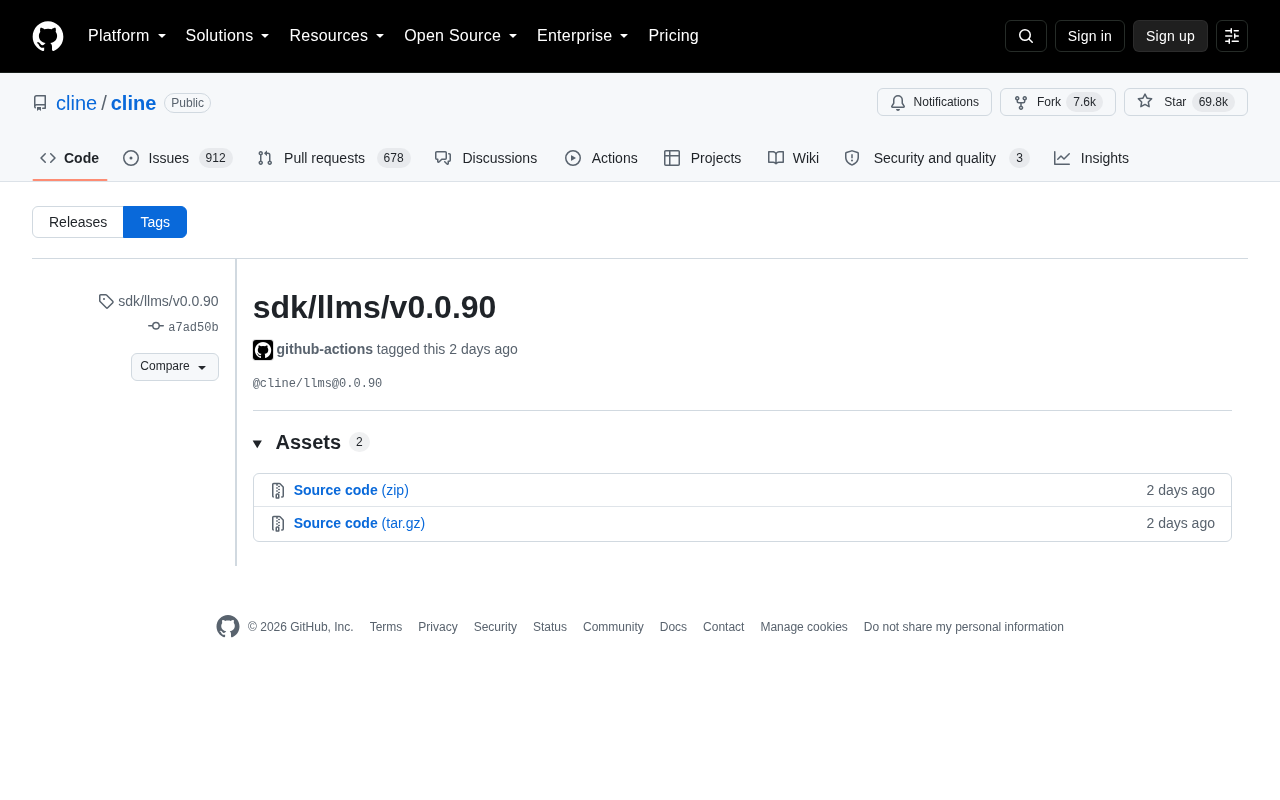
The popular open-source AI coding assistant Cline has automatically published version v0.0.90 of its @cline/llms SDK (tagged sdk/llms/v0.0.90) via GitHub Actions. With approximately 69.8k stars and 7.6k forks on GitHub, every component update from the Cline project is worth tracking for developers in its ecosystem.
This release covers the core SDK module responsible for integrating and invoking large language models (LLMs) within the Cline project. Based on its naming convention, @cline/llms is a standalone sub-package published to a package manager under the @cline npm scope, handling the low-level work of connecting to various LLM services.
About Cline and @cline/llms
Cline is an AI coding agent that runs inside a code editor. It can understand a codebase, execute commands, edit files, and collaborate with developers on coding tasks. At the heart of its capabilities is integration with multiple large language models — and @cline/llms is the modular component that handles exactly that.
Decoupling the LLM integration logic into a standalone SDK means Cline has adopted a loosely coupled engineering architecture. This design allows model provider adapters, API protocol wrappers, token billing logic, and related concerns to iterate independently — without requiring a full release of the main application every time. For downstream consumers, an independent version number (v0.0.90) also makes it easier to pin dependencies precisely and debug compatibility issues.
The core distinction between an AI coding agent and a traditional code completion tool lies in autonomy: completion tools passively respond to cursor position, while agents can proactively plan multi-step tasks — such as understanding requirements, searching relevant files, running terminal commands, writing code, and verifying results. Cline follows a "tool-use loop" pattern: user intent is passed to an LLM for reasoning, the LLM returns structured tool-call instructions (e.g., "read file," "run command"), Cline executes them and feeds the results back to the LLM, repeating the cycle until the task is complete. This workflow places extremely high reliability demands on the LLM integration layer — any model switch or API protocol difference directly affects the stability of the entire loop. This is a key engineering motivation for extracting
@cline/llmsas a standalone SDK.
What the Version Number Signals
Two observations can be drawn from the version number 0.0.90. First, the package is still in the early 0.x stage, meaning the API may not yet be fully stable — users should watch for potential breaking changes when upgrading. Second, the patch number has accumulated to a relatively high value, indicating the module iterates quite frequently. This aligns with the rapid pace of the LLM ecosystem itself: new models and new interfaces emerge constantly, requiring the integration layer to keep up continuously.
This release was automatically tagged and published by the github-actions bot on October 2nd, and includes 2 asset files. Since the official release notes do not include a detailed changelog, developers will need to review the corresponding commit history or the npm package's change log to understand what specifically changed.
The Semantic Versioning (SemVer) specification states that packages in the
0.x.ystage may introduce breaking changes at any minor version (x) bump, without the backward-compatibility guarantees that apply once a major version is established. This means that upgrading from0.0.89to0.0.90could theoretically involve changes to interface signatures, return structures, or even module exports. For an LLM integration SDK, common breaking change scenarios include: updates to model name enumerations, adjustments to request/response type definitions, and renamed token billing fields. In the absence of a clear changelog, it's recommended to usenpm diff @cline/llms@0.0.89 @cline/llms@0.0.90or directly compare the type declaration files (.d.ts) between versions on the npm registry to quickly identify differences.
Practical Implications for Developers
For teams building on top of Cline or directly depending on @cline/llms to construct their own AI toolchains, keeping the SDK up to date helps ensure support for the latest models as well as potential performance and stability improvements. It's recommended to validate upgrades in a test environment first — especially during the 0.x stage, where backward compatibility is not guaranteed.
For regular Cline users, sub-package updates like this are typically bundled into subsequent releases of the main application automatically, requiring no manual intervention. That said, paying attention to these lower-level updates helps users understand the pace at which the tool's capabilities are evolving.
Summary
@cline/llms v0.0.90 represents a routine iteration of Cline's open-source project at the LLM integration layer. While the official release lacks detailed notes, the modular architecture and frequent versioning cadence make it clear that the Cline team is continuously improving multi-model support. For developers active in the AI coding tools ecosystem, staying on top of updates like this is an essential part of keeping your toolchain competitive.
Related articles

Free Unlimited Claude Code Solution: Agnes AI + CC Switch Setup Guide
No paid subscription needed — pair the free AI platform Agnes AI with the open-source tool CC Switch to provide a backend for Claude Code, enabling unlimited free calls to text, image, and video models. This guide covers the full setup, test results, and usage boundaries.

A Complete Zero-Cost Guide to Getting Started with Claude Code for Beginners in China
A beginner's guide to Claude Code for users in China: two installation methods (command line and IDE plugin), full configuration steps for replacing the official API with the free domestic LongCat model, and a hands-on demo of building a small tool with natural language, plus tips.

When the NSA Gets Involved: The AI Supply Chain Crisis Behind Open-Source CVEs and API Key Hijacking
Multiple open-source projects disclosed severe CVEs in one day, PHP flaws alarmed the FBI, and Railway and OpenCode were breached with API keys stolen. This article breaks down the vulnerability window, AI-accelerated exploitation, and the AI supply chain crisis behind the API key black market, with a developer defense checklist.