Cline SDK Releases shared v0.0.90: Open-Source AI Coding Tool Gets Another Update

Cline releases sdk/shared v0.0.90, a routine early-stage update — dependents should pin versions carefully.
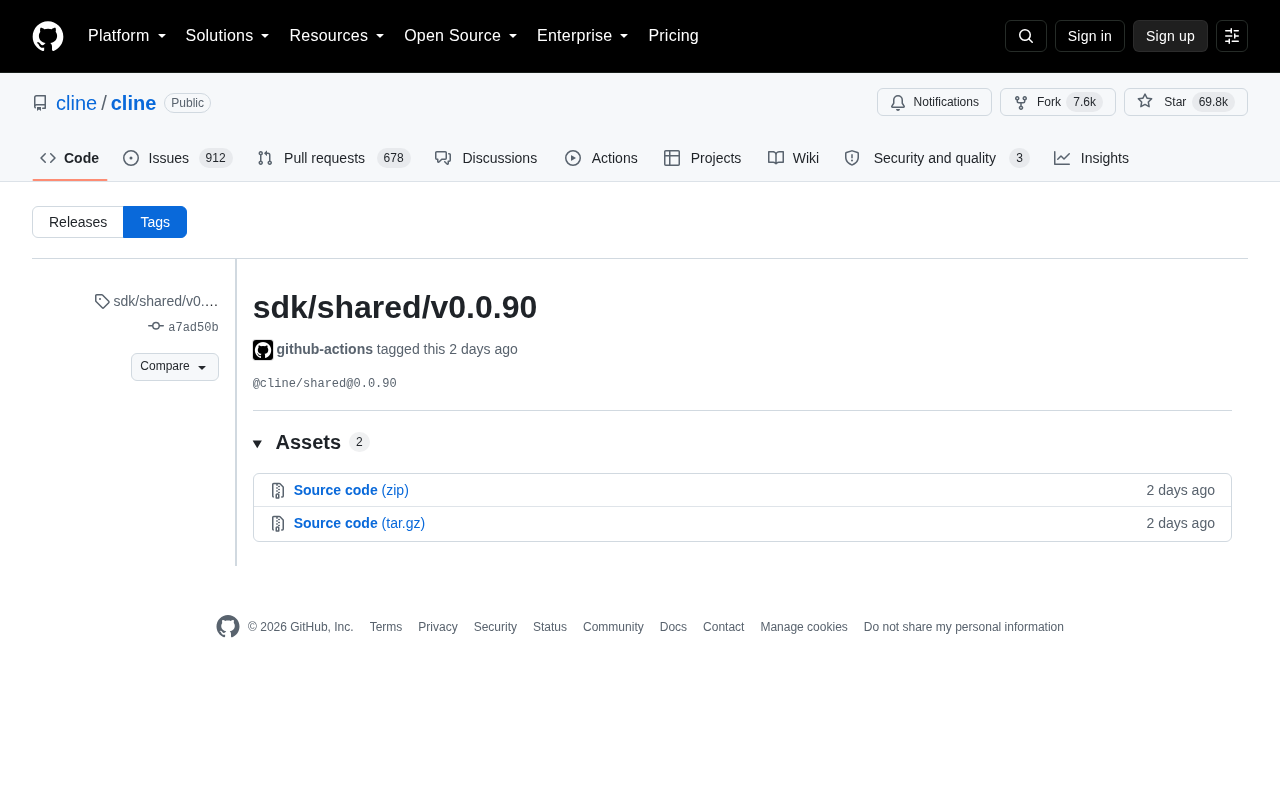
Cline has published `@cline/shared@0.0.90`, a routine minor update to its SDK shared module, auto-released via GitHub Actions. The package carries reusable type definitions and protocol conventions core to the Cline ecosystem. With ~69.8k GitHub Stars and 7.6k Forks, Cline ranks among the top open-source AI coding tools. As the version remains in the `0.0.x` stage with no API stability guarantees, developers depending on this package should pin exact versions and review changelogs before upgrading.
Cline Releases shared v0.0.90
Open-source AI coding assistant Cline has published version v0.0.90 of its sdk/shared package (npm package @cline/shared@0.0.90), automatically tagged and released via GitHub Actions. This is a routine component update in Cline's ongoing iteration cycle, targeting developers who depend on its SDK.
Based on the release details, this update belongs to Cline's shared module — a package that typically carries reusable type definitions, utility functions, and protocol conventions shared across components. The version number still sitting in the 0.0.x range indicates the SDK is in early development, with interfaces potentially changing rapidly between releases. Integrators should pay close attention to compatibility.
Cline's Community Traction and Positioning
Worth noting is the broader community momentum behind the Cline project itself. According to the release page, the repository has accumulated approximately 69.8k Stars and 7.6k Forks, making it one of the leading open-source projects in the AI coding tools space. This level of traction reflects a sustained and strong demand among developers for AI coding assistants that can be integrated and self-hosted.
Cline's core positioning is as an in-editor AI coding agent capable of reading codebases, executing commands, editing files, and collaborating with developers to complete tasks. Its modular SDK architecture — including the shared package updated here — enables the community and third parties to build extensions or integrations on top of it.
Cline runs primarily as a VS Code extension, leveraging external large language models (such as Claude, GPT-4, etc.) to power code generation, refactoring, and task automation. Unlike closed-source solutions such as GitHub Copilot, Cline is fully open-source, allowing users to configure their own API keys to connect to different model providers or deploy in local and private environments — giving them complete control over data flow. This "bring your own model" architecture is a key reason Cline has gained significant attention among enterprise developers who prioritize data security.
How to Think About Frequent Minor Version Releases
For active open-source projects, high-frequency minor version iterations like v0.0.90 are completely normal. They typically correspond to internal refactoring, dependency upgrades, bug fixes, or foundational changes that pave the way for higher-level features — rather than major end-user-facing releases.
For developers who directly depend on @cline/shared, the recommended approach includes:
- Review the corresponding changelog or commit history before upgrading to confirm whether any breaking changes are present.
- Since the package is still in the
0.0.xstage, pin to a specific version number to avoid unexpected issues from automatic upgrades. - Evaluate alongside the main Cline runtime version to ensure the shared module's protocol is consistent with the runtime.
npm's Semantic Versioning (SemVer) spec defines version numbers as MAJOR.MINOR.PATCH. When the major version is 0, it signals that the project has not yet reached a stable public API — at this stage, each minor version change may introduce breaking changes, and SemVer explicitly provides no backward compatibility guarantee. 0.0.x goes even further, representing an extremely early experimental phase where interfaces may be renamed, reorganized, or removed at any time. Therefore, users of @cline/shared should use exact version pinning in their package.json (e.g., "@cline/shared": "0.0.90") rather than range specifiers (^ or ~), to prevent automatic upgrades from triggering unexpected compatibility issues.
Summary
sdk/shared v0.0.90 is a foundational component update within the Cline open-source ecosystem. While the release itself carries limited information, it reflects the rapid iteration pace of Cline as a high-profile AI coding tool. For developers tracking the AI coding space, Cline's evolution toward an SDK-based architecture is worth following closely — it signals that these tools are moving beyond standalone plugins toward open platforms that can be broadly integrated.
Related articles

Huberman's Rational Supplement Guide: A Five-Layer Health Framework and Scientific Decision-Making
Stanford neurobiology professor Huberman proposes a rational supplement framework: behavior and nutrition are the foundation, basic combination supplements serve as insurance, and sleep/hormonal/cognitive directions should stick to single-ingredient experiments. Omega-3 is the top single-ingredient choice, and melatonin is not recommended.

The Unsung Painter Behind Gilded Age Manhattan Interior Design
HN discussion highlights the painter behind Gilded Age Manhattan interiors: he created murals and decorative paintings but was long overlooked as his work was seen as architectural appendage.

Can AI Agents Be Socially Engineered? Understanding Prompt Injection and Tool Permission Risks
Through Invariant Lab's GitHub Issue injection and Brave's AI browser attack, this article analyzes how Prompt Injection induces AI Agents to perform unauthorized actions, and offers protection advice across three layers: least privilege, tool validation, and operation auditing.